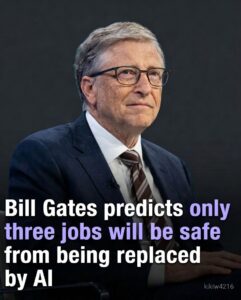
As artificial intelligence continues to advance at an extraordinary pace, conversations about the future of work are no longer theoretical—they are immediate, practical, and deeply personal. Few voices carry as much weight in this discussion as Bill Gates, whose long-standing perspective on technology and society offers both clarity and caution. His central message is not one of fear, but of transformation: the nature of work is changing, and those who understand how to adapt will not only survive but thrive.
At the heart of this transformation lies a powerful idea—AI will not simply replace human labor; it will redefine it. Entire categories of tasks will be automated, accelerated, or augmented. Yet at the same time, new opportunities will emerge, demanding skills that machines cannot replicate. The future, according to Gates, belongs to those who learn how to work with AI rather than compete against it.
The rise of “free intelligence”
One of the most striking concepts Gates has introduced is the idea of “free intelligence.” This refers to the increasing accessibility of high-level knowledge through AI systems. Tasks that once required years of specialized training—analyzing medical data, writing code, interpreting legal documents—can now be assisted or partially handled by intelligent systems.
This shift has profound implications.
In the past, expertise was scarce. Becoming a doctor, teacher, or engineer required not only talent but access to education, resources, and mentorship. Today, AI tools are beginning to lower those barriers. A student with a basic internet connection can access explanations, simulations, and guidance that rival traditional instruction.
But this does not eliminate the need for experts. Instead, it changes what expertise looks like.
Medicine: technology meets humanity
Healthcare is one of the clearest examples of how AI is reshaping work without eliminating the human role.
AI systems can:
- Analyze medical images with remarkable accuracy
- Suggest potential diagnoses
- Monitor patient data continuously
- Assist in drafting treatment plans
On paper, this might seem like a direct threat to medical professionals. In reality, it shifts their role.
Doctors are no longer just sources of information. Their value increasingly lies in interpretation, judgment, and connection. A machine can identify patterns in data, but it cannot fully understand a patient’s fears, values, or personal circumstances.
A physician working alongside AI might process far more cases than before. But what makes them indispensable is their ability to:
- Explain complex information in human terms
- Make ethical decisions in uncertain situations
- Build trust with patients and families
The future of medicine is not less human—it is more deeply human, supported by powerful tools.
Education: beyond information delivery
Education may undergo an even more dramatic transformation.
AI has the potential to act as a personalized tutor for every student, adapting lessons to individual pace, strengths, and weaknesses. This could address long-standing inequalities in education systems around the world.
Students could receive:
- Instant feedback on their work
- Customized learning paths
- Explanations tailored to their understanding
Yet this raises an important question: if AI can teach information, what is the role of the teacher?
According to Gates, the answer lies in what AI cannot do.
Teachers of the future will focus less on delivering content and more on:
- Inspiring curiosity
- Encouraging critical thinking
- Building emotional and social skills
- Guiding collaborative learning experiences
A classroom is not just a place to absorb facts. It is a space where students learn how to think, interact, and grow. These are deeply human processes that technology can support—but not replace.
The changing nature of expertise
As AI becomes more capable, the definition of expertise evolves.
In the past, expertise meant knowing more than others. In the future, it will mean knowing how to use knowledge effectively—especially when that knowledge is widely accessible.
This includes:
- Asking the right questions
- Evaluating AI-generated outputs
- Combining insights from multiple sources
- Applying knowledge in real-world contexts
In other words, expertise becomes less about memorization and more about judgment.
Jobs at risk—and jobs emerging
There is no denying that some roles will decline.
Jobs involving repetitive, predictable tasks are particularly vulnerable. These include:
- Basic data entry
- Routine customer service
- Standardized document review
- Simple coding tasks
AI excels in environments where rules are clear and patterns are consistent.
However, this does not mean fewer jobs overall. It means different jobs.
New roles are already emerging, such as:
- AI system trainers and supervisors
- Human-AI interaction designers
- AI ethics specialists
- Data interpreters and strategists
These roles require not just technical knowledge, but also creativity, communication, and ethical awareness.
The importance of adaptability
If there is one skill Gates emphasizes above all others, it is adaptability.
The pace of technological change means that no single set of skills will remain sufficient for an entire career. Workers must be prepared to learn continuously, updating their abilities as tools and systems evolve.
This does not mean constant instability. Rather, it reflects a shift toward lifelong learning as a normal part of professional life.
Those who resist change may find themselves struggling. Those who embrace it can discover entirely new paths.
Human strengths in an AI world
Despite the rapid advancement of AI, certain human qualities remain difficult—if not impossible—to replicate.
These include:
- Empathy
- Creativity
- Moral reasoning
- Leadership
- The ability to navigate ambiguity
These are not “soft skills” in the sense of being secondary. In an AI-driven world, they become central.
For example:
- A manager must lead teams that include both humans and AI systems
- A designer must create experiences that resonate emotionally
- A healthcare worker must provide comfort and understanding
These roles rely on qualities that go beyond data and algorithms.
Creativity as a differentiator
AI can generate text, images, music, and even code. But generation is not the same as originality.
Human creativity involves:
- Drawing from lived experience
- Understanding cultural context
- Expressing meaning and intention
AI can assist in the creative process—offering ideas, variations, or drafts—but it does not possess genuine perspective.
Artists, writers, and creators who learn to use AI as a tool can expand their capabilities. Those who rely on it entirely risk losing the very quality that makes their work valuable.
Collaboration, not competition
A common misconception is that humans and AI are in direct competition. Gates challenges this idea.
The most successful individuals will not be those who try to outperform machines in tasks machines are designed to do. Instead, they will be those who integrate AI into their workflow.
This collaboration might look like:
- Using AI to analyze large datasets quickly
- Generating initial drafts or prototypes
- Automating repetitive tasks
- Enhancing decision-making with data insights
The human role then becomes one of direction, interpretation, and refinement.
Expanding opportunities in healthcare and care work
As populations age globally, demand for healthcare and caregiving services will increase.
AI can assist with monitoring and diagnostics, but it cannot replace:
- Physical care
- Emotional support
- Human presence
Roles likely to grow include:
- Nurses and caregivers
- Mental health professionals
- Physical therapists
- Wellness coaches
These professions require empathy and interpersonal connection—qualities that remain uniquely human.
The future of business and innovation
In the business world, AI is already transforming how decisions are made.
Companies can:
- Analyze market trends in real time
- Optimize operations
- Personalize customer experiences
However, data alone is not enough. Leaders must interpret insights, make strategic choices, and consider broader impacts.
This creates demand for professionals who can:
- Bridge technical and business knowledge
- Communicate complex ideas clearly
- Think critically about long-term consequences
Innovation will increasingly come from the intersection of human insight and machine capability.
The role of education and policy
Gates also emphasizes the responsibility of institutions.
Governments and educational systems must:
- Invest in digital literacy
- Provide access to retraining programs
- Support workers transitioning between careers
Without these efforts, the benefits of AI may not be distributed evenly.
Education, in particular, must evolve. Memorization-based learning becomes less relevant when information is instantly accessible. Instead, systems should focus on:
- Critical thinking
- Problem-solving
- Collaboration
- Adaptability
These skills prepare individuals for a dynamic, technology-driven world.
A realistic optimism
Gates’ perspective is neither overly optimistic nor pessimistic. It acknowledges both the opportunities and the challenges.
AI has the potential to:
- Increase productivity
- Improve access to knowledge
- Enhance quality of life
But it also raises questions about:
- Job displacement
- Economic inequality
- Ethical decision-making
Addressing these challenges requires thoughtful planning, collaboration, and a willingness to adapt.
What individuals can do now
For individuals navigating this transition, the path forward is not about predicting the future perfectly. It is about preparing for change.
Practical steps include:
- Learning how AI tools work
- Developing communication and interpersonal skills
- Staying curious and open to new ideas
- Building a habit of continuous learning
The goal is not to become a machine, but to become better at what machines cannot do.
Final reflection
The age of AI is not the end of human work—it is a redefinition of it.
As Bill Gates suggests, the most valuable skills of the future will not be purely technical. They will be deeply human.
Empathy will matter more in a world of automation.
Creativity will stand out in a world of generated content.
Judgment will guide decisions in a world of abundant data.
The question is no longer whether AI will change the workforce. It already is.
The real question is how individuals, institutions, and societies will respond.
Those who choose to adapt, learn, and collaborate with technology will not just keep up—they will help shape what comes next.