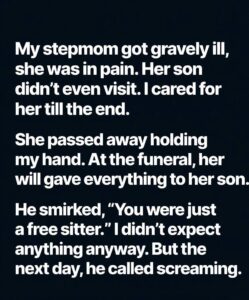
When my stepmother became gravely ill, I was the one who stayed.
Not her biological son—the man she had always defended, excused, and quietly believed would eventually show up when it mattered most. He lived less than an hour away, yet weeks would pass without a visit, a message, or even a brief check-in. At first, I tried not to judge it. People cope with illness in different ways, I told myself. But as her condition worsened, absence stopped looking like circumstance and started feeling like choice.
I never confronted him. I never complained. I simply showed up.
I was there for every difficult stage of her illness. I made her soup when she could no longer tolerate solid food. I cleaned the bathroom floor when she got sick at two in the morning and couldn’t make it in time. I sat beside her bed during long, silent nights when the machines beeped softly in the background and sleep came in fragments. I brushed her thinning hair gently, pretending not to notice how much of it remained in my hands afterward. And I told her stories—not because they were remarkable, but because they made her smile, even briefly.
Sometimes she would look at me with tired eyes and whisper, “You have your father’s heart.”
I never quite knew how to respond to that.
My father had been gone for years. My relationship with my stepmother had never been perfect—there had been misunderstandings, distance, and moments of quiet tension—but beneath all of it, there had always been a shared history. She had tried, in her own imperfect way, to hold a fractured family together after my father’s death. And when her health declined, something in me made the decision before I could fully analyze it: I would not leave her alone.
So I moved into her home.
Not as a guest, not as a visitor, but as someone who understood that presence matters more than permission when time is running out. I cooked, cleaned, managed medications, and sat through appointments where doctors used softened language to describe hard realities. There was no applause for any of it. No acknowledgment beyond her quiet gratitude.
One night, as she struggled to breathe more easily after a long coughing fit, she squeezed my hand and said, “You’re a good son… even if you weren’t mine by blood.”
That sentence stayed with me longer than I expected.
It wasn’t dramatic. It wasn’t poetic. But it was honest in a way few things in life ever are.
When she died, it was peaceful.
Rain tapped gently against the windows. I was sitting beside her, reading aloud from a book she had loved for years. Her breathing slowed gradually between sentences until it simply stopped. There was no sudden moment, no dramatic final word—just a quiet absence where presence had been moments before.
I didn’t cry immediately. I just sat there, holding her hand, realizing that the world had become quieter in a way that would never feel normal again.
She died holding my hand.
And she didn’t die alone.
At the funeral, the room was full of familiar faces. People spoke warmly about her kindness, her generosity, her gentle humor. Her son stood near the front in a perfectly pressed black suit, eyes glossy in a way that looked carefully constructed. He nodded solemnly at every condolence, playing the role of grieving heir with practiced ease.
I stood further back.
Not out of shame, but out of habit. I had never needed attention for what I had done. My grief felt private, unperformable.
Then came the reading of the will.
The lawyer cleared his throat and began listing assets in a calm, professional tone. The house. The accounts. The jewelry. The personal belongings. Everything was left to her son.
Every single item.
There was no mention of me.
For a moment, I felt nothing. Not anger, not disappointment—just confirmation of something I had long understood but never fully spoken aloud: love and recognition do not always arrive together.
I accepted it quietly.
I had not stayed for reward. I had stayed because leaving would have felt wrong.
But then he spoke.
He leaned toward me, just slightly, with a smile that carried more cruelty than grief. “Well,” he said, loud enough for a few nearby relatives to hear, “looks like you were just free help after all. Guess kindness doesn’t really pay off, does it?”
A few people shifted uncomfortably. Someone muttered something under their breath. But no one intervened.
I looked at him for a moment.
And said nothing.
There are times when silence is not surrender, but restraint. That was one of them.
That night, I went home and slept deeply for the first time in months. The kind of sleep that comes not from peace, but from exhaustion finally allowed to settle.
The next morning, everything changed.
My phone started ringing at six in the morning. I ignored the first few calls, then finally answered on the seventh.
It was him.
His voice was no longer smug. It was fractured, uneven, almost panicked.
“You need to come here,” he said. “Right now. There’s something in the house.”
I sat up slowly. “What are you talking about?”
“There’s an attic,” he said quickly. “I found something. A letter. It’s for you.”
Something in my chest tightened.
I drove there without hesitation.
When I arrived, he was pacing outside the house like someone who had lost his sense of direction. His face was pale, his confidence gone.
“There’s something upstairs,” he said again. “A chest. I was cleaning and found a key taped under a drawer. Inside it… was an envelope with your name.”
We went inside together.
The house felt different in the morning light. Heavier. Still. Like memory had settled into the walls overnight. The scent of lavender lingered faintly in the air.
We climbed the stairs to the attic.
Dust floated in beams of sunlight. The wooden floor creaked under every step. In the corner, there was an old chest, its surface worn with time.
He pointed at it. “That’s it.”
I opened it.
Inside were a few carefully stored items and, resting on top, an envelope with my name written in handwriting I knew instantly.
Her handwriting.
I turned to him. “Why did you call me?”
He hesitated. “Because I already opened it.”
“You what?”
“I didn’t know,” he said quickly. “I thought it might be about me. I didn’t mean to—”
I didn’t respond. I simply unfolded the letter.
The first words stopped me.
My dear,
If you are reading this, I am gone. I wrote this not out of desperation, but clarity. And because you were the only one who stayed when staying was not required.
The will is not the truth of my heart. It is the result of obligations I could not legally change. But I needed you to know that my gratitude was never absent.
Inside the smaller envelope is the deed to the lake cottage in Rosewood. It belongs to you now. I arranged it before my passing.
I want you to have it because you understand what it means to give without expectation.
As for my son—he must learn that love is not inherited. It is demonstrated.
I read it twice before speaking.
Then I handed it to him.
He read it slowly. And with every line, something in his expression collapsed.
“She left you something?” he whispered.
“Yes.”
His voice cracked slightly. “Why you?”
I looked at him.
“Because I was there.”
Silence followed.
It wasn’t dramatic. It wasn’t cinematic. It was just the absence of anything left to argue with.
That afternoon, I drove to the lake cottage.
It sat quietly beside the water, surrounded by trees just beginning to turn with the season. The house was simple but warm. White curtains moved slightly in the breeze. Inside, the air smelled faintly of old wood and lavender.
On the mantle was a framed photograph of her, my father, and me at a picnic years ago. I had never seen it before.
Behind the frame, another note.
If you are here, you’ve found what matters. This place was my peace. Let it be yours too. And please… forgive him. He is still learning how to love without fear.
I sat there for a long time.
That evening, he came to the cottage.
He looked different now. Smaller somehow. Not in stature, but in certainty.
“I read her journals,” he said quietly. “She wrote about you. About how proud she was. About how she wished I understood things the way you did.”
I didn’t interrupt him.
“I thought I was the favorite,” he continued. “But I wasn’t even close.”
He looked down. “I didn’t earn anything. I just assumed I would receive it.”
There was a long pause.
Then, “I’m sorry.”
It wasn’t loud. It wasn’t performative. It was tired.
I nodded slowly. “She didn’t want us divided.”
Over time, something shifted.
He began visiting the cottage. At first awkwardly. Then regularly. He fixed things, small repairs, as if trying to rebuild something invisible. We talked more. Not about the past at first—but about her.
Her habits. Her laughter. The way she always burned toast and insisted it was intentional.
One evening, he said, “She didn’t leave me nothing. She left me the truth.”
I didn’t argue.
Because he was right.
We never became something simple. Not brothers. Not strangers. Something in between—connected by absence, shaped by the same loss, learning slowly how to exist in the aftermath of her decisions.
I eventually turned the cottage into something she would have appreciated: a quiet retreat for caregivers. A place where people who spend their lives giving could finally rest.
I named it Mara’s Haven.
He helped renovate it.
Sometimes, while working, he would stop and look at the lake and say, “She would’ve liked this.”
And I would agree.
Every summer, we still meet there.
We sit on the porch. We don’t always talk. Sometimes we don’t need to.
One evening, as the sun dropped low over the water, he said quietly, “You know… she left me the house. But she left you her heart.”
I looked out at the lake.
“She had enough to go around,” I said.
Years have passed since that morning in the attic.
And I’ve learned something I didn’t understand then.
Karma doesn’t always arrive as punishment. Sometimes it arrives as understanding. As humility. As the moment someone finally sees what they could not see before.
He mocked me at a funeral.
But that wasn’t the end of the story.
The letter was.