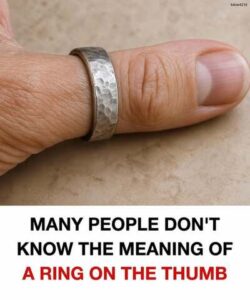
At first glance, a thumb ring can seem like one of the simplest fashion choices a person can make. It is not as traditionally symbolic as a wedding band, nor as culturally loaded as a signet ring or class ring. It does not immediately signal relationship status, profession, or social role. Instead, it sits slightly outside those familiar categories—noticeable, but not immediately defined.
And yet, that is precisely what makes it interesting.
A thumb ring draws attention in a different way. Not because it is always large or ornate, but because it is unexpected. It occupies a space on the hand that most people associate with function rather than decoration. The thumb is used for grip, precision, interaction, and physical control. It is active, visible, and constantly engaged in movement. So when something decorative is placed there, it naturally becomes part of that motion—part of how a person exists in the world.
This combination of visibility and exception is what gives the thumb ring its quiet psychological weight.
Across cultures and time periods, the thumb has carried symbolic associations with willpower, autonomy, and direction. In body language, it is often tied to confidence and assertiveness. People gesture with thumbs when they want to emphasize a point or express certainty. Even small subconscious habits—like hooking thumbs into pockets or holding objects with a firm grip—reflect a sense of control or groundedness.
So when someone chooses to wear a ring on that finger, even without conscious intention, they are placing emphasis on a part of the hand already associated with agency. It becomes more than decoration; it becomes emphasis.
But meaning is never fixed. It is layered, shifting, and deeply personal.
The Psychology of Placement
In fashion psychology, placement often matters as much as the object itself. Jewelry is not just about what is worn, but where it is worn. Rings on different fingers can carry distinct social interpretations, even if those interpretations are subtle or culturally inconsistent.
The thumb stands apart from the rest of the fingers physically and symbolically. It is opposable, meaning it works in opposition to the other fingers. This anatomical distinction has long been used as a metaphor for individuality and independence. It is the finger that allows humans to grip tools, create, build, and manipulate the physical world.
Placing a ring on the thumb subtly highlights that independence. It does not necessarily declare it loudly, but it draws attention to it.
Psychologically, this can be interpreted in several ways. For some, it reflects self-assurance. For others, it signals a comfort with standing slightly outside convention. And for others still, it is simply aesthetic preference—an appreciation for balance, symmetry, or style that feels visually satisfying.
What is important is not a single meaning, but the openness of interpretation itself.
Expression Without Explanation
One of the most compelling aspects of a thumb ring is that it does not require explanation. Unlike other symbolic accessories, it does not come with a widely recognized script. There is no universal assumption about engagement, profession, or hierarchy.
This absence of fixed meaning creates space for personal expression.
A person wearing a thumb ring does not have to define what it “means.” Instead, it is interpreted in context—through style, behavior, confidence, and presence. This makes it one of the more fluid forms of self-expression in fashion.
In some cases, that ambiguity is intentional. People may choose it precisely because it resists categorization. It allows identity to remain open rather than labeled.
In other cases, the meaning develops afterward. A ring worn casually may begin to feel significant over time, becoming associated with a particular phase of life, personal transformation, or emotional milestone.
Independence and Self-Definition
For many wearers, especially in contemporary fashion contexts, the thumb ring is associated with independence.
This does not necessarily mean rebellion or rejection of tradition. Rather, it often reflects self-definition—the idea that identity is something chosen rather than assigned.
Unlike rings that symbolize external relationships, the thumb ring tends to point inward. It is less about connection to another person and more about connection to oneself.
This is why it is sometimes associated with personal transitions. People may adopt thumb rings during periods of change: after ending relationships, beginning new careers, moving cities, or entering phases of self-discovery. In such moments, small external changes in appearance often reflect internal shifts.
The ring becomes a quiet marker of that shift—not necessarily visible to others in a defined way, but meaningful to the wearer.
Gendered Interpretations and Their Limits
While interpretations can differ across genders, these distinctions are not universal rules. Instead, they are cultural tendencies that vary widely.
In some interpretations of women’s fashion, a thumb ring is associated with autonomy and self-possession. Because it is not traditionally tied to relational status, it can symbolize a sense of identity that exists independently of romantic or familial definition. It may also reflect confidence in nontraditional aesthetics—choosing something visually bold or unconventional without concern for expectation.
In interpretations of men’s fashion, thumb rings have historically been associated with strength, status, or functionality. In certain periods, they were used practically, such as protective tools in archery or indicators of wealth. In modern contexts, however, those associations have softened. Today, they are often linked more with creative expression, individuality, and relaxed confidence rather than dominance or hierarchy.
Still, these interpretations are not rules. They are cultural echoes rather than fixed meanings.
History and Cultural Memory
The thumb ring is not a modern invention. Its history stretches across practical, symbolic, and decorative uses.
In some ancient societies, thumb rings were functional objects. Archers used reinforced thumb rings to protect their fingers when drawing bows. In other contexts, they were decorative markers of status or identity, sometimes indicating wealth or social position.
Over time, as fashion evolved and functionality shifted, the thumb ring moved from utility into expression. But remnants of its history remain embedded in how it is perceived.
Even today, there is a subtle sense that a thumb ring is slightly more “intentional” than other accessories. That sense is partly aesthetic and partly historical. It carries echoes of purpose, even when no purpose is explicitly intended.
Visibility and Movement
One of the reasons thumb rings feel distinct is their constant visibility.
Unlike rings on more stationary fingers, the thumb is always active. It appears in gestures, in speech, in everyday tasks. It is one of the most expressive parts of the hand, constantly entering and leaving attention.
This means a thumb ring is rarely static. It moves with the person, becoming part of their physical communication. When someone gestures, points, holds, or interacts, the ring becomes part of that motion.
Because of this, it can subtly influence how others perceive the wearer. Not because of its meaning alone, but because of its integration into behavior. It becomes part of presence.
Interpretation by Others
Human perception tends to assign meaning to visible details, especially those that stand out from norms. A thumb ring often triggers subtle curiosity. People may not consciously analyze it, but they notice it.
From there, interpretation begins.
Some may associate it with confidence. Others may see creativity or nonconformity. Some may assume it signals independence or alternative thinking. But these interpretations are not reliable—they depend heavily on context, style, and personal bias.
A minimalist silver band may be read differently from a bold, ornate design. A ring worn in a professional environment may be interpreted differently than one worn in artistic or casual spaces.
This variability is part of what makes the thumb ring so open-ended. It does not define the wearer as much as it invites perception.
The Risk of Overmeaning
Because the thumb ring is visually distinct, there is a temptation to overinterpret it.
But meaning in fashion is not always intentional or symbolic. Sometimes, it is aesthetic. Sometimes, it is habit. Sometimes, it is simply preference without deeper narrative.
A thumb ring can certainly carry meaning—but it does not always.
This duality is important. It allows the object to remain flexible rather than fixed. It can be expressive without being prescriptive.
A Symbol of Fluid Identity
In a broader sense, the thumb ring reflects something larger about modern identity itself.
Contemporary self-expression is less about rigid categories and more about fluidity. People increasingly mix styles, symbols, and influences without needing to adhere to singular definitions. Jewelry, clothing, and accessories become tools for exploration rather than declarations of fixed identity.
Within that context, the thumb ring fits naturally. It does not lock meaning into place. It allows meaning to shift depending on who is wearing it, how it is worn, and when it is worn.
It is, in essence, an open symbol.
Final Reflection
A thumb ring is not powerful because it demands attention, but because it quietly invites interpretation.
It sits at the intersection of visibility and ambiguity, structure and freedom, tradition and individuality.
For some, it reflects confidence.
For others, independence.
For others still, it is simply a visual preference that feels right.
But across all interpretations, one theme remains consistent: choice.
The decision to wear something slightly unconventional, slightly unexpected, and slightly outside tradition is itself meaningful—even when that meaning is personal rather than symbolic.
In that sense, a thumb ring is less about what it says universally, and more about what it allows individually.
It does not define identity.
It reveals it—quietly, subtly, and in motion.