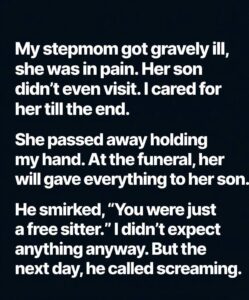
When my stepmother got sick, I didn’t think twice.
I stayed.
Not because I expected anything in return. Not because I thought it would earn me a place in her will. I stayed because someone had to—and because, despite everything, she had been there in ways that mattered.
Her son wasn’t.
He lived forty minutes away. Close enough to visit. Close enough to help. But weeks passed with nothing—no calls, no messages, no signs that he even noticed how quickly her condition was declining.
I never said anything about it. It wasn’t my place. But I saw the way she looked at the door sometimes, as if expecting it to open.
It never did.
The Months That Changed Everything
Her illness came in waves.
Some days she could sit up and talk, her voice soft but steady. Other days, she barely had the strength to lift her hand. I learned quickly how to read the small signs—the way her breathing changed, the way her eyes lost focus when she was in pain.
I made her soup when she couldn’t eat. I cleaned up when she got sick in the middle of the night. I helped her walk when her legs stopped cooperating.
When her hair began to fall out, she tried to laugh it off.
“Less time brushing,” she joked weakly.
I smiled with her, even as I gently gathered the strands from her pillow.
At night, I’d sit beside her bed and read aloud. Old novels she loved. Stories she already knew by heart. Sometimes she’d close her eyes and just listen, her breathing slowing, her face softening.
“You have your father’s heart,” she whispered once.
That stayed with me.
The Final Night
The night she passed was quiet.
Rain tapped softly against the windows. The house felt still, like it was holding its breath.
I sat beside her, reading as I always did. Her hand rested in mine—light, fragile, but still warm.
Her breathing slowed between sentences.
Then it stopped.
No drama. No sudden moment. Just silence.
I didn’t cry right away. I just sat there, holding her hand, trying to understand how something so present could suddenly be gone.
Her last words were barely audible.
“Thank you… for staying.”
The Funeral
Funerals have a strange way of turning grief into performance.
People came and went, sharing stories, offering condolences. Some were genuine. Others felt rehearsed.
Her son stood at the center of it all.
Dressed perfectly. Speaking carefully. Nodding at the right moments.
He looked like what people expect grief to look like.
I stayed in the background.
I didn’t need attention. I didn’t need recognition. I had already said goodbye in the only way that mattered.
The Will
Then came the reading.
We gathered in a quiet room. The lawyer unfolded the document and began listing everything she owned.
The house.
The savings.
Her jewelry.
Every possession.
All of it went to him.
There wasn’t a single mention of me.
For a moment, I felt something sharp—something I couldn’t quite name. Not anger. Not even disappointment.
Just… confirmation.
Confirmation that doing the right thing doesn’t always come with acknowledgment.
But the feeling passed quickly.
I hadn’t stayed for this.
The Moment That Said Everything
Then he leaned toward me.
Smiling.
“Well,” he said loudly, making sure others could hear, “looks like you were just the free help after all.”
A few people shifted uncomfortably. Someone muttered, “That’s not right.”
But he didn’t care.
“Guess kindness doesn’t pay,” he added with a quiet laugh.
I looked at him.
And said nothing.
Because sometimes silence says more than anything you could ever respond with.
The Morning Everything Changed
The next morning, my phone rang.
Again.
And again.
And again.
By the seventh call, I answered.
It was him.
But the arrogance was gone.
“You need to come here,” he said, his voice shaking. “Please.”
Something in his tone made me get up immediately.
When I arrived, he was outside the house, pacing like he hadn’t slept at all.
“There’s something in the attic,” he said. “A letter. For you.”
The Attic
The house felt different.
Quieter. Heavier.
We walked up the narrow stairs to the attic. Dust floated in the morning light. The air smelled faintly of lavender—her favorite scent.
He pointed to an old wooden chest.
“It was locked,” he said. “I found the key taped underneath a dresser.”
Inside was an envelope.
My name was written on it—in her handwriting.
The Letter
I held it for a moment before opening it.
Inside was a letter… and a second, smaller envelope.
Her words were steady, familiar.
If you’re reading this, I’m gone.
I know the will must have hurt you. But it was never about love.
She explained everything.
Legal agreements. Things she couldn’t change. Decisions that had already been made long before she got sick.
Then came the part that changed everything.
A lake cottage.
Hidden. Quiet. Unknown to almost everyone.
Left to me.
You were the one who stayed, she wrote.
You were the one who saw me when I felt invisible.
Then one final line:
Love cannot be inherited. It must be earned.
The Realization
He read the letter after me.
I watched his face change as he reached the end.
“She left you… something?” he asked quietly.
“Yes.”
“But why you?”
I met his eyes.
“Because I was there.”
For once, he had nothing to say.
The Cottage
That afternoon, I drove there.
It was exactly what she would have loved.
Simple. Peaceful. Overlooking still water framed by trees.
Inside, everything felt intentional—like she had prepared it, knowing one day someone would arrive who needed it.
On the mantle was a photo of us.
Her. My father. Me.
I didn’t even know she still had it.
Behind it was a note.
This was my happy place. I hope it becomes yours.
What Came After
He called me that evening.
Not to argue.
Not to defend himself.
To apologize.
At first, it felt unfamiliar. Almost uncomfortable. But it was real.
Over time, he started visiting the cottage.
At first awkwardly. Then more naturally.
He fixed things. Repaired what was broken. Stayed longer each time.
We talked.
Not about the will. Not about money.
About her.
The Meaning of Karma
One evening, sitting by the water, he said something that stayed with me.
“I thought karma would be punishment,” he admitted. “But this… this feels different.”
It was.
Karma didn’t come as loss.
It came as realization.
As clarity.
As the understanding that what he had valued… wasn’t what mattered most.
A Different Kind of Inheritance
The house he inherited was just a place.
The cottage I received was something else entirely.
A memory.
A message.
A responsibility.
I eventually turned it into a small retreat for caregivers—people like me, who had spent months or years giving everything to someone else.
I named it after her.
And every time I stand on that porch, watching the water, I understand what she really left behind.
Final Reflection
Years later, I don’t think about the will.
I think about that letter.
Because in the end, she didn’t divide us.
She revealed us.
She showed him what he had missed.
And she showed me what I had always had.
He inherited her belongings.
I inherited her truth.
And that made all the difference.