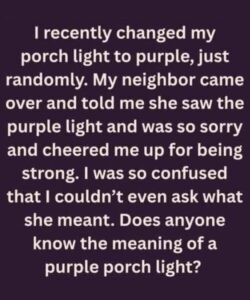
If you’ve ever walked through a neighborhood at dusk and noticed a soft purple glow coming from a porch, it may have stood out immediately. It’s not a typical choice for exterior lighting. Most homes stick to warm whites or soft yellows—colors that feel familiar, safe, and conventional. Purple, by contrast, feels intentional. It draws attention without being loud, creating a quiet sense that there is meaning behind the choice.
More and more homes are beginning to adopt this subtle lighting style, and while it may look decorative at first glance, the purple porch light has evolved into something far more symbolic. For many, it represents awareness, solidarity, and silent support for issues that are often hidden behind closed doors.
A Color That Speaks Without Words
At its core, the purple porch light is a form of nonverbal communication. It doesn’t require explanation to be noticed, yet it invites curiosity. People passing by may wonder why a home looks different, and that moment of curiosity often opens the door to conversation.
In many cases, the most widely recognized meaning behind purple lighting is its connection to Domestic Violence Awareness Month in October. During this time, individuals and families replace standard porch bulbs with purple ones as a way of showing support for survivors of domestic abuse. The gesture is simple, but its meaning is deeply emotional.
Domestic violence is often hidden from public view. It exists behind walls, behind closed doors, and within silence. Because of that, awareness plays a critical role in breaking isolation. A purple light becomes a quiet signal: someone sees, someone cares, and someone stands in solidarity even if no words are spoken.
Awareness Through Visibility
One of the most powerful aspects of purple porch lights is how they transform private concern into public awareness without forcing attention. Unlike signs or loud campaigns, a light is subtle. It does not accuse or confront—it simply exists.
This subtle visibility allows difficult topics to enter everyday spaces in a gentle way. A neighbor might ask about the light. A child might notice and become curious. A visitor might pause and reflect. These small moments create opportunities for conversation that might otherwise never happen.
For survivors of domestic violence, this visibility can be profoundly meaningful. It sends a message that their experiences are not invisible. Even if they are not ready to speak, they can see signs that their community acknowledges what they are going through.
More Than a Month of Awareness
While October is the most widely recognized time for purple lights, many people choose to keep them on year-round. For these households, the message is not seasonal—it is ongoing.
Domestic violence does not follow a calendar. Neither do healing, recovery, or support. A permanent purple porch light can represent continued solidarity, personal experience, or a commitment to advocacy.
In some homes, the light is deeply personal. It may honor a survivor, remember someone lost, or reflect a family’s journey through trauma and healing. In others, it is a quiet promise of support for anyone who may need it.
A Color With Multiple Meanings
Although domestic violence awareness is the most common association, purple lighting also appears in connection with other causes.
It is sometimes used in epilepsy awareness campaigns, where purple represents support for individuals living with seizure disorders. It is also associated with Alzheimer’s and dementia awareness efforts, symbolizing memory, care, and understanding for affected families.
In certain contexts, purple is linked to honoring military service, particularly through recognition of the Purple Heart.
Because of these overlapping meanings, the significance of a purple porch light can vary depending on where and when it is seen. But across all interpretations, the color consistently carries themes of dignity, reflection, and support.
The Psychology of Purple
Color plays a powerful role in human perception. Purple, in particular, has long been associated with both calmness and depth. Historically rare and expensive to produce, it was once linked to royalty and exclusivity. Over time, it became associated with spirituality, introspection, and emotional awareness.
Today, those associations continue in modern symbolism. Purple sits between the warmth of red and the calmness of blue, creating a balance that feels both grounded and reflective. This makes it especially fitting for causes involving healing, resilience, and emotional strength.
Small Actions With Collective Impact
On their own, a single purple porch light might seem like a small gesture. But when many homes participate, the effect becomes something larger and more visible.
Neighborhoods begin to shift in tone. Streets take on a quiet unity. Without saying a word, communities begin to communicate shared values: awareness, compassion, and support for those facing invisible struggles.
These lights do not demand attention. They invite reflection. They do not force conversation. They make space for it.
And perhaps that is where their real power lies.
A Quiet Form of Solidarity
In a world often filled with noise, urgency, and constant expression, the purple porch light stands out precisely because of its simplicity. It does not try to solve everything or announce certainty. Instead, it acknowledges something important: that some struggles are quiet, and support does not always need to be loud to be meaningful.
Whether used for domestic violence awareness, health advocacy, personal reflection, or community solidarity, the purple light has become a symbol of empathy in physical form.
Final Thought
The next time you notice a purple glow on a porch, it may be easy to pass by without thinking twice. But behind that soft light, there is often a message—sometimes personal, sometimes collective, always intentional.
It is a reminder that awareness can live in everyday spaces. That compassion does not always need words. And that even the smallest gestures, when shared across communities, can quietly reshape how we see and support one another.