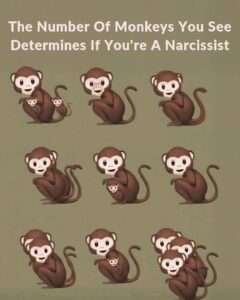
A group of cartoon monkeys sits arranged against a simple background, inviting nothing more than a quick glance before someone scrolls away. It looks playful, almost childish—the kind of internet post designed for light entertainment during a boring afternoon.
But then comes the sentence above the image.
“The number of monkeys you see determines whether you’re a narcissist.”
Suddenly, the experience changes completely.
What was once casual becomes personal. Your brain shifts from passive observation to active analysis. Without consciously deciding to, you begin counting. One monkey. Two monkeys. Maybe four. Wait—is that another hidden shape inside the tail? Is that outline supposed to count?
You pause.
You look again.
And within seconds, the image accomplishes exactly what it was designed to do: it makes you question your own perception.
This is why illusions like these spread so rapidly online. They combine curiosity, uncertainty, self-reflection, and challenge into a single visual moment. They feel interactive. They provoke conversation. Most importantly, they trigger a deep psychological instinct that exists in nearly everyone—the desire to understand ourselves.
People naturally want to know what their choices, reactions, and perceptions reveal about them. Even when the claim itself sounds questionable, curiosity often overrides skepticism.
Could the number of monkeys you see actually reveal narcissism?
The short answer is no.
But the reason people believe it might is far more interesting than the illusion itself.
Why the Image Feels So Convincing
The power of the monkey illusion has very little to do with monkeys.
Its effectiveness comes from uncertainty.
The human brain is deeply uncomfortable with ambiguous information. When we encounter something unclear, incomplete, or open to interpretation, our mind immediately begins searching for resolution. We want certainty. We want the “correct” answer.
That psychological tension is what makes illusions addictive.
At first, most viewers identify only the obvious monkey figures. But after staring longer, hidden patterns begin to emerge. Shapes overlap. Small outlines appear within larger designs. Suddenly, the original count no longer feels stable.
This creates a fascinating mental conflict:
If we are all looking at the same image, why are we seeing different things?
The answer lies in perception itself.
The Brain Does Not Simply “See” Reality
Most people assume vision works like a camera.
We imagine our eyes recording the world exactly as it exists, delivering objective information directly to the brain. But neuroscience shows that perception is far more complicated.
Your brain is not passively observing reality.
It is actively constructing it.
Every second, your brain receives enormous amounts of sensory information—far too much to process consciously all at once. To manage this overload, the brain relies on filtering systems, shortcuts, assumptions, and predictive models.
In simple terms, your brain constantly decides:
- What deserves attention
- What can be ignored
- What patterns seem familiar
- What information appears most important
This process happens almost instantly and usually without awareness.
Visual illusions expose these hidden mental processes by disrupting normal expectations. They reveal that perception is not fixed or universal. Two people can view the same image and genuinely experience it differently because their brains prioritize information differently.
That difference does not mean one person is smarter or more correct than another.
It simply reflects different cognitive tendencies.
Why Some People See More Monkeys Than Others
One reason this illusion fascinates people is because it creates multiple possible interpretations.
Some viewers focus only on the largest and clearest monkey figures. Their brain prioritizes efficiency and simplicity. Once enough information has been gathered to understand the image generally, the brain stops searching for additional complexity.
Other viewers naturally continue scanning for hidden details. They notice embedded outlines, secondary shapes, or subtle visual tricks that others overlook.
This difference often reflects two distinct cognitive approaches:
Big-Picture Processing
People who quickly identify the most obvious shapes tend to process information globally. Their brains prioritize overall structure rather than tiny details.
This style can be highly effective in real-world situations requiring:
- Fast decisions
- Broad thinking
- Pattern recognition
- Adaptability under pressure
These individuals often excel in leadership, strategy, or environments where speed matters more than precision.
Detail-Oriented Processing
People who continue examining the image closely tend to process information more analytically. Their brains naturally search for subtleties, inconsistencies, and hidden layers.
This approach can be advantageous in:
- Research
- Problem-solving
- Creative analysis
- Technical work
- Observation-heavy tasks
These individuals may notice things others miss entirely.
Importantly, neither style is inherently superior.
Most people shift between both approaches depending on mood, context, stress levels, personality, and environment.
The illusion does not diagnose anything—it simply reveals how flexible and varied human perception can be.
The Narcissism Claim Is Not Scientifically Real
Despite the dramatic caption, there is no scientific evidence connecting the number of monkeys someone sees to narcissism.
None.
Narcissism is a complex psychological trait involving patterns of self-focus, emotional regulation, empathy, interpersonal behavior, and identity formation. It cannot be measured through hidden-image puzzles or visual counting exercises.
Real psychological assessment requires careful evaluation over time—not viral internet images.
So why do people believe claims like this so easily?
Because the illusion uses a powerful psychological technique often called “clickbait psychology.”
How Clickbait Psychology Works
The phrase “this reveals your personality” is incredibly effective online because it combines three powerful emotional triggers:
1. Personal Relevance
Humans naturally prioritize information connected to identity.
If a post claims to reveal something about intelligence, personality, relationships, or emotional traits, people become immediately more interested because the topic feels personally meaningful.
2. Curiosity Gaps
The image creates uncertainty:
- Did I count correctly?
- What are others seeing?
- Am I missing something?
- What does my answer mean?
The brain dislikes unanswered questions, so it keeps returning to the image seeking closure.
3. Social Comparison
Once people realize others are getting different answers, comparison begins.
Someone sees four monkeys.
Another sees eight.
Another claims there are twelve.
Now the illusion becomes social rather than individual. People compare interpretations, debate results, and revisit the image repeatedly.
This transforms a simple visual puzzle into a viral experience.
Why Illusions Spread So Fast Online
Social media rewards engagement above almost everything else.
Illusions perform exceptionally well because they encourage:
- Comments
- Sharing
- Debate
- Rewatching
- Emotional reaction
- Self-comparison
Unlike ordinary content, illusions create participation.
People do not simply consume them—they interact with them.
And because perception feels deeply personal, disagreements become emotionally engaging. When someone sees a different answer, it challenges our confidence in our own observation.
That tension keeps the conversation alive.
Additionally, illusion posts are accessible to everyone. They require no specialized knowledge, no long attention span, and no complicated explanation. Within seconds, anyone can participate.
That simplicity makes them perfect for viral culture.
What the Illusion Actually Reveals
Although the narcissism claim is false, the illusion still teaches something meaningful.
It demonstrates that perception is selective.
What we notice—and what we ignore—is shaped by countless internal processes:
- Attention
- Experience
- Expectations
- Emotional state
- Memory
- Cognitive habits
This principle extends far beyond visual puzzles.
In everyday life, people often believe they are seeing situations objectively when they are actually interpreting them through personal mental filters.
Two people can experience the same conversation and remember it differently.
Two witnesses can observe the same event and focus on entirely different details.
Two family members can recall the same childhood with completely opposite emotional interpretations.
Perception is not pure reality.
It is reality filtered through the brain.
Visual illusions simply make this process visible.
Cognitive Bias and the Need for Certainty
Another reason illusions fascinate people is because they expose cognitive bias.
Cognitive biases are mental shortcuts the brain uses to process information quickly. These shortcuts are useful for survival, but they can also distort interpretation.
For example:
Confirmation Bias
Once someone decides how many monkeys they see, they often search for evidence supporting that conclusion while ignoring contradictory details.
Anchoring Bias
The first number someone hears influences later perception. If a friend says they saw ten monkeys, your brain becomes more likely to search for ten.
Pattern Recognition Bias
Humans naturally seek patterns—even where none intentionally exist. This tendency helps explain why hidden images feel compelling.
The brain is constantly trying to create order from ambiguity.
Illusions exploit that instinct beautifully.
Why People Want Personality Answers So Badly
Part of the reason personality-based illusions go viral is because self-discovery is emotionally attractive.
People want explanations for who they are.
Why do I think this way?
Why do I react differently from others?
What makes me unique?
How do people perceive me?
Even inaccurate personality tests can feel emotionally satisfying because they offer structure and reflection. They provide temporary clarity in a world where identity often feels uncertain.
That does not mean such tests are scientifically reliable.
But it explains why they remain popular.
Humans are storytelling creatures. We constantly build narratives about ourselves, and personality content feeds that instinct.
The Deeper Lesson Hidden Inside the Illusion
Ironically, the monkey illusion becomes most meaningful once we stop treating it as a personality test.
Its real value lies elsewhere.
It reminds us that certainty is often fragile.
The image teaches that:
- First impressions may be incomplete
- Different perspectives can coexist
- Observation is influenced by expectation
- Perception is flexible rather than fixed
These lessons matter far beyond internet entertainment.
In relationships, assumptions shape communication.
In society, perception influences judgment.
In everyday life, people often mistake personal interpretation for objective truth.
The illusion quietly challenges that habit.
Sometimes what we see says less about reality itself and more about how our brain organizes information.
Why Looking Closer Matters
One of the most fascinating aspects of the illusion is how dramatically perception changes once someone slows down.
At first, the image appears obvious.
Then uncertainty appears.
Then hidden complexity emerges.
That progression mirrors many real-life experiences.
People, situations, and emotions often reveal deeper layers only after patience and attention replace immediate judgment.
The illusion therefore becomes symbolic in an unexpected way.
Not because it diagnoses narcissism.
But because it encourages reconsideration.
It reminds us that:
- Quick conclusions are not always complete
- Perspective can shift with attention
- Complexity often hides beneath simplicity
And perhaps most importantly:
looking closer can change understanding entirely.
Final Reflection
The viral monkey illusion does not determine whether someone is narcissistic.
It cannot reveal personality disorders, emotional health, or moral character.
But its popularity reveals something genuine about human psychology.
People are fascinated by perception because perception shapes reality itself.
We trust our eyes instinctively. We assume what we notice reflects objective truth. Yet illusions expose how flexible, selective, and interpretive the human mind truly is.
That realization can feel uncomfortable—but also valuable.
Because once we understand that perception is filtered, we become more open-minded, more reflective, and perhaps more patient with perspectives different from our own.
The monkeys in the image are ultimately less important than the experience of searching for them.
The uncertainty.
The curiosity.
The reconsideration.
The awareness that seeing is not always as simple as it seems.
And maybe that is the real reason illusions continue captivating millions of people online.
Not because they reveal hidden truths about personality—
but because they reveal how mysterious the human mind still is.