The Night I Discovered a Cyberpunk Jaw Guard in My Dad’s Garage — A Strange Discovery That Changed Everything
I still think about that night more often than I probably should. Not because anything supernatural happened, and not because I found some world-changing invention hidden under dust and cobwebs—but because of the way it felt. Like I had accidentally stepped into a story that had been paused years ago and was waiting for someone to press play again.
It started as something completely ordinary. My dad had finally decided to clean out the garage. Years of accumulated tools, half-finished projects, old boxes of cables, paint cans, and forgotten furniture had turned the space into something between storage unit and archaeological dig site. He asked me to help, and I brought a friend along because, honestly, no one wants to sort through decades of “I might need this later” alone.
At first, it was boring in the way all garage cleanouts are boring. We found broken extension cords, rusted nails, cracked plastic bins filled with mystery screws. The air was thick with dust, and every movement stirred up memories that didn’t belong to us.
Then we reached the back corner.
It was darker there, the single overhead bulb barely reaching past a shelf of stacked boxes. A heavy tarp covered something large and awkwardly shaped. It didn’t look important—just another forgotten pile. My friend pulled the tarp first.
That’s when everything changed.
Underneath was something that didn’t belong in a suburban garage at all.
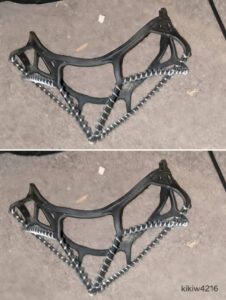
At first glance, it looked like a piece of futuristic armor. A lower face mask—almost like a jaw guard—constructed from a black skeletal frame. It was angular, precise, and unsettlingly elegant. The structure was made of interlocking geometric pieces that curved outward like a mechanical ribcage designed for the face.
But what really made it strange were the coils.
Thin metallic springs ran along the lower edges in tightly arranged rows, catching the light in subtle flashes. They weren’t random. They were intentional—like veins of engineered tension designed to move, flex, or react.
My friend picked it up first.
It was lighter than expected.
Too light for something that looked so complex.
We turned it over slowly. The inner surface was smooth, shaped with an almost anatomical precision, like it had been molded to fit a human jaw. Small mounting points sat near the sides, as if it could be attached to something larger—maybe a helmet or a full suit.
None of it made sense.
“What is this supposed to be?” my friend asked.
I didn’t answer. Because I didn’t know.
And I had the strange feeling that I wasn’t supposed to know yet.
We carried it to a workbench under the light. Dust fell off in thin layers as we brushed it clean. The more we examined it, the more details appeared—micro grooves, hidden seams, subtle symmetry that suggested engineering rather than decoration.
It didn’t feel like junk.
It felt like something paused mid-development.
Like a prototype abandoned halfway through becoming real.
When my dad saw us holding it, he went quiet.
Not surprised.
Not confused.
Just… still.
That was the first clue that this wasn’t random.
He walked over slowly, wiped his hands on a cloth, and stared at it for a long time without speaking. Then he said something I didn’t expect.
“I forgot that was still here.”
That sentence changed the entire atmosphere of the room.
We sat down in the garage that night, surrounded by half-organized chaos, while he explained.
Years ago, he had bought an abandoned storage unit at auction. The kind of impulse purchase people make thinking they’ll find something valuable or interesting. Most of it was junk—old electronics, broken tools, sealed boxes of papers.
But inside one locked metal case, wrapped carefully in foam, was this object.
No instructions.
No branding.
No explanation.
Just the jaw guard.
He thought it might be a prop from a film production. Or a prototype from an industrial design experiment. Or something military-adjacent that never made it past testing. But there was no clear answer.
And eventually, like so many forgotten curiosities, it ended up in the garage.
We brought it inside that night.
On the kitchen table, under warm light, it looked even more unreal.
My dad pulled out an old notebook he had kept from the same storage unit. Inside were sketches—hand-drawn diagrams labeled with cryptic notes about “wearable augmentation,” “facial interface mechanics,” and something called Project K-4216.
That was the first time the object started to feel less like junk… and more like history.
The sketches matched perfectly.
The jaw guard wasn’t random.
It had been designed.
Not just as protection, but as something more complex. There were references to “resonance coils,” “voice modulation effects,” and “psychological stabilization under confrontation conditions.”
It sounded like science fiction.
But the detail was too specific to dismiss.
That night, none of us slept early.
I kept turning the object in my hands, noticing new things every time. The coils weren’t just decorative—they had slight responsiveness. A gentle pressure caused subtle recoil, like they were part of a tension system designed to react to movement.
It felt alive in a mechanical way.
Not animated.
Just… aware of structure.
The next morning, I tried it on.
I don’t know why.
Curiosity, maybe.
Or the same instinct that makes people press buttons they shouldn’t press.
It strapped surprisingly easily to my face. The fit was precise, almost unsettlingly accurate. When I spoke, my voice changed—not dramatically, but enough to notice. It gained depth, a faint echo-like resonance that made it sound less like me and more like a filtered version of me.
I stared at myself in the mirror.
For a moment, I didn’t recognize the reflection.
It wasn’t fear exactly.
It was awareness.
Like I had briefly stepped into an alternate version of reality where this kind of object was normal.
My dad watched quietly from behind me.
He didn’t stop me.
He just said, “It still works better than I expected.”
That was the second clue that this wasn’t just curiosity anymore.
It had function.
Over the next few days, we couldn’t stop thinking about it. My friend started sketching redesign ideas. I began researching similar wearable tech concepts—neural interfaces, experimental cosplay engineering, cybernetic aesthetics.
But nothing matched exactly.
This thing felt… isolated.
Like a one-off experiment from a timeline that didn’t continue.
The more we studied it, the more it became less of an object and more of a question.
What was it for?
And why was it abandoned?
We never got a definitive answer.
But something else happened instead.
It changed how we looked at everything else in the garage.
Old objects stopped being “junk.” They became possibilities. Forgotten tools became potential mechanisms. Broken devices became puzzles waiting for reconstruction.
The garage itself started to feel different.
Less like storage.
More like a museum of unfinished ideas.
We eventually cleaned the space completely. Organized everything. Built shelves. Sorted tools.
But we kept the jaw guard.
It didn’t go back into storage.
It stayed on display in my room.
Not because it was valuable in a traditional sense.
But because it represented something else entirely.
The idea that creativity doesn’t always come from invention.
Sometimes it comes from discovery.
And sometimes discovery comes from places you almost didn’t bother to look.
Years later, I still think about that night.
Not the object itself—but the feeling of lifting the tarp and realizing that something unknown had been sitting quietly in the dark for years, waiting.
Waiting for attention.
Waiting for curiosity.
Waiting for someone to ask the right questions.
We never fully solved its origin.
Maybe it was a prototype.
Maybe a prop.
Maybe an abandoned art project from someone who never explained it properly.
Or maybe it doesn’t matter.
Because the real impact wasn’t the object itself.
It was what it unlocked.
A shift in perspective.
A reminder that ordinary spaces hide extraordinary possibilities.
And that sometimes, the most important discoveries don’t come from searching the world…
They come from finally looking closely at the places you already are.
Even a garage.
Even a dusty corner.
Even under a tarp you almost didn’t lift.