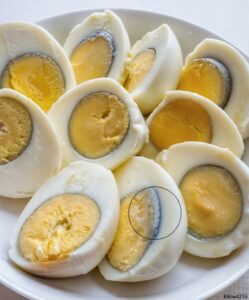
At first glance, a hard-boiled egg seems like one of the simplest foods to prepare. It requires no special ingredients, no complicated steps, and no advanced cooking skills. You place eggs in water, heat them, wait, and they’re done. But despite this simplicity, many people consistently make the same small mistake—one that reveals itself in a subtle yet unmistakable way.
A green ring around the yolk.
It’s something most people have seen at least once: a thin, grayish-green layer encircling the bright yellow center of an otherwise ordinary egg. Some ignore it, some scrape it off, and others assume it means something has gone wrong with the egg itself. In reality, that green ring tells a very specific story about how the egg was cooked.
It means the egg was overcooked.
This common kitchen issue happens more often than you might think, largely because of outdated or overly simplistic cooking advice. Instructions like “boil for ten minutes” don’t account for the many variables that affect how eggs cook. As a result, people unknowingly push their eggs beyond the ideal cooking point, triggering a chemical reaction that alters both appearance and texture.
The science behind the green ring is surprisingly straightforward. Eggs are made up of two primary components: the white (albumen) and the yolk. Each contains different nutrients and compounds. The egg white is rich in sulfur-containing proteins, while the yolk contains iron. When eggs are exposed to high heat for too long, sulfur from the white reacts with iron from the yolk, forming a compound known as iron sulfide.
Iron sulfide is what creates that greenish-gray discoloration.
This reaction is not dangerous. The egg remains safe to eat, and the green ring poses no health risk. However, it is a clear indicator that the egg has been exposed to excessive heat, and that has consequences beyond just appearance.
Texture is the first casualty.
A perfectly cooked hard-boiled egg should have a firm yet slightly creamy yolk and tender, smooth whites. Overcooked eggs, on the other hand, develop a dry, crumbly yolk that lacks richness. The whites become rubbery and tough, losing their delicate structure. The overall eating experience changes dramatically, even if the difference seems subtle at first.
Flavor is affected as well. While overcooked eggs are still edible, they often develop a slightly sulfuric taste that can be off-putting. This is especially noticeable in dishes where eggs are the main ingredient, such as egg salad or deviled eggs.
The green ring, then, is not just a cosmetic issue—it’s a visible sign that the egg’s quality has declined.
One of the biggest reasons this happens is residual heat. Even after water stops boiling, it remains hot enough to continue cooking the eggs. If eggs are left sitting in hot water after boiling, the internal temperature stays elevated, allowing the iron-sulfur reaction to continue. This is why the green ring often appears even when eggs are only slightly overcooked.
The solution is simple but often overlooked: rapid cooling.
Transferring eggs immediately into an ice bath stops the cooking process almost instantly. This prevents further chemical reactions and preserves the yolk’s natural color and texture. It also has the added benefit of making eggs easier to peel, as the sudden temperature change causes the egg to contract slightly inside the shell.
Another common mistake is starting with boiling water instead of cold water. When eggs are dropped directly into boiling water, they cook unevenly and are more likely to become overdone on the outside before the inside is properly set. Starting with cold water allows the eggs to heat gradually, resulting in more consistent cooking.
Timing also plays a crucial role. Instead of relying on a fixed boiling time, a more reliable method is to bring eggs to a boil, then remove the pot from heat and let them sit covered in hot water for a specific duration. For most large eggs, this means about 9 minutes for slightly softer yolks and up to 12 minutes for fully set yolks. Going beyond that increases the likelihood of developing the green ring.
Egg size, starting temperature, and even altitude can affect cooking time. Larger eggs take longer to cook. Eggs straight from the refrigerator require more time than those at room temperature. At higher altitudes, water boils at a lower temperature, which can change how heat is transferred to the eggs.
Because of these variables, precision matters.
Many people assume that overcooking eggs is harmless since they remain edible. While it’s true that the nutritional impact is not drastic, prolonged heat can reduce the availability of certain vitamins that are sensitive to temperature. Eggs are a valuable source of nutrients like vitamin B12, riboflavin, and choline, and preserving these nutrients is another reason to avoid excessive cooking.
More importantly, consistently overcooking eggs can lead to a pattern of settling for less-than-ideal results. When people become accustomed to rubbery whites and chalky yolks, they may not realize how much better eggs can taste when prepared correctly.
The difference is noticeable.
A properly cooked egg has a vibrant yellow yolk, smooth and slightly creamy in texture. The white is tender, not chewy. The flavor is clean and balanced, without any harsh sulfur notes. These qualities elevate even the simplest dishes, turning an ordinary breakfast into something more enjoyable.
This is especially important in recipes where eggs play a central role. In deviled eggs, for example, the yolk is mixed with other ingredients to create a creamy filling. If the yolk is dry and crumbly, the final texture suffers. In egg salad, overcooked eggs can make the mixture less cohesive and less flavorful.
Even when eggs are used as a topping—on toast, salads, or grain bowls—their texture and appearance matter. A bright, well-cooked yolk is visually appealing and enhances the overall dish.
Despite this, many people continue to rely on inconsistent methods. They boil eggs for too long out of fear of undercooking them, or they leave them in hot water while attending to other tasks. These habits are understandable, but they lead to predictable results.
Breaking these habits doesn’t require advanced skills—just a bit of awareness.
Start with cold water. Use a pot large enough to hold the eggs in a single layer. Bring the water to a gentle boil, then remove from heat and cover. Let the eggs sit for the appropriate amount of time, depending on your desired doneness. Then transfer them immediately to an ice bath.
These steps are simple, but they make a significant difference.
There are also a few optional techniques that can improve results. Using slightly older eggs can make peeling easier, as the membrane inside the shell loosens over time. Adding a small amount of baking soda or vinegar to the water can also help with peeling, though it’s not strictly necessary.
Avoid overcrowding the pot, as this can lead to uneven cooking. And always use a timer—guessing is one of the main reasons eggs end up overcooked.
These small adjustments transform a basic cooking task into a reliable process.
Beyond the practical benefits, there’s a broader lesson here. Cooking is full of moments where small details matter. The difference between good and great often comes down to timing, temperature, and attention.
The green ring around an egg yolk is a perfect example of this principle. It’s a visible reminder that even simple foods require care. It shows how a minor oversight—just a few extra minutes—can change the outcome.
At the same time, it offers an opportunity to improve. Once you understand why the green ring forms, it becomes easy to avoid. And once you start paying attention to these details, you naturally become a better cook.
This awareness extends beyond eggs. It influences how you approach other foods—how you cook vegetables, meats, grains, and more. You begin to notice when something is just right, and when it has gone too far.
Over time, this leads to more consistent results, greater confidence, and a deeper appreciation for the process of cooking.
In the end, the green ring is not something to fear. It’s not a sign that your food is unsafe or spoiled. It’s simply feedback—a small clue that helps you refine your technique.
And with a few simple changes, you can eliminate it entirely.
Perfect hard-boiled eggs are not difficult to achieve. They just require a bit of attention, a bit of timing, and a willingness to adjust your approach.