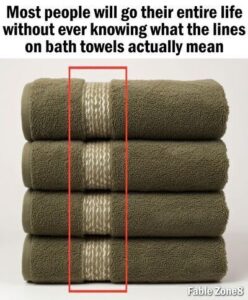
Towels are among the most common and familiar objects in everyday life. They exist quietly in bathrooms, kitchens, gyms, hotels, beaches, spas, and laundry baskets, used so routinely that most people rarely stop to examine them closely. We rely on them instinctively after showers, while washing dishes, during travel, or after swimming, expecting them to remain soft, absorbent, and durable through years of repeated use.
Yet despite how frequently towels are handled, few people ever question how they are designed.
At first glance, a towel appears simple: a rectangular piece of fabric made to absorb water.
But like many everyday objects, its simplicity hides a surprising amount of thoughtful engineering.
One of the most overlooked features found on many towels is the subtle woven band or line running near the ends. Most people notice it subconsciously without ever wondering why it exists. Some assume it is purely decorative, while others barely register it at all.
In reality, this feature has a specific name and an important purpose.
It is called the dobby border.
And far from being a meaningless design choice, it plays a crucial role in how towels function, last, feel, and maintain their structure over time.
The dobby border represents a quiet example of practical textile engineering—one of those subtle innovations that improves daily life without demanding attention. Its presence reflects how even the most ordinary household items are shaped by decades of refinement, balancing comfort, durability, efficiency, and aesthetics in ways most users never consciously notice.
At its core, the dobby border exists to reinforce the towel structurally.
Towels endure an enormous amount of physical stress throughout their lifespan. They are twisted, pulled, wrung out, folded, washed repeatedly in hot water, exposed to detergent, dried under high heat, and handled constantly. Without reinforcement, the edges of towels would begin deteriorating quickly.
Fabric edges are naturally vulnerable points.
Over time, unsupported edges can stretch unevenly, curl, fray, loosen, or unravel after repeated washing cycles. Once edge damage begins, the overall lifespan of the towel decreases significantly because the structural integrity of the fabric weakens gradually from the outside inward.
The dobby border helps prevent this.
Unlike the fluffy central section of the towel, which contains soft absorbent loops, the border is woven more tightly and flatly. This denser weave creates a stabilizing section that distributes tension more evenly across the towel’s edges.
In simple terms, the border acts almost like a frame.
It reinforces the towel’s structure, helping it withstand repeated mechanical stress while maintaining its shape over time. This added stability prevents excessive stretching and reduces the likelihood of fraying, especially at the ends where towels experience the most strain during handling and laundering.
As a result, towels with properly designed dobby borders often retain their appearance and usability longer than towels without reinforced edges.
The feature may seem small, but it contributes significantly to durability.
Beyond preventing fraying, the dobby border also helps towels maintain their overall shape.
Fabric naturally shifts during washing and drying cycles. Heat, water absorption, tumbling, and repeated movement gradually distort textile fibers. Without structural control, towels may become warped, uneven, or misshapen over time.
Many people have experienced older towels that no longer fold neatly because one side stretched longer than the other or the corners became twisted and uneven.
The dobby border helps minimize this problem.
Because the border stabilizes the edges, it keeps the towel balanced and symmetrical through repeated use. This structural consistency allows the towel to remain flatter, easier to fold, and more visually organized even after years of laundering.
The effect is subtle but important.
People may not consciously recognize why one towel feels “better” or easier to manage than another, but edge stability contributes significantly to that perception.
Interestingly, the dobby border also supports the towel’s absorbency—even though the border itself is less absorbent than the central fabric.
The fluffy middle sections of towels are made using looped fibers called terry cloth. These loops increase surface area dramatically, allowing towels to absorb moisture efficiently. However, those same soft loops are more vulnerable to distortion and wear without structural support surrounding them.
The tighter weave of the dobby border helps preserve the alignment and stability of the absorbent sections.
In other words, the border protects the towel’s performance indirectly.
By maintaining the overall structure of the fabric, it allows the absorbent central area to continue functioning effectively over time. Without reinforcement, distortion and stretching could reduce how evenly the loops perform, gradually affecting drying efficiency and comfort.
The border acts as a support system that quietly helps the rest of the towel do its job properly.
There is also a practical everyday benefit many people experience without consciously realizing it: folding and storage become easier.
The flatter texture of the dobby border creates a natural visual and physical guide for folding towels neatly. Towels with reinforced borders tend to align more evenly when stacked, folded, or hung.
This contributes to a cleaner appearance in linen closets, hotel bathrooms, spas, and homes.
The reduced bulk at the towel’s edges also prevents awkward bunching or uneven folds. While this may sound minor, small conveniences accumulate in daily life. Objects that handle smoothly and consistently often feel more satisfying to use precisely because they eliminate subtle frustrations users rarely identify consciously.
Comfort is another overlooked advantage.
Without reinforced borders, towel edges could feel excessively thick, lumpy, or stiff compared to the rest of the fabric. The flatter weave of the dobby border creates smoother transitions along the edges, reducing bulk and helping towels feel more refined against the skin.
This contributes to a cleaner tactile experience.
Again, the improvement is subtle rather than dramatic—but thoughtful design often works exactly this way. The best everyday objects solve problems quietly enough that users barely notice the problems existed in the first place.
The dobby border also offers aesthetic and branding opportunities.
Because the border uses a different weaving technique from the soft terry loops, manufacturers can incorporate decorative textures, patterns, stripes, logos, or woven branding elements into the towel without interfering with softness or absorbency.
Historically, decorative woven borders often served as indicators of craftsmanship and quality.
Luxury linens frequently used intricate border patterns as subtle demonstrations of weaving skill and textile refinement. Even today, the border provides visual structure that helps towels appear more polished and intentional in design.
Importantly, these decorative benefits exist alongside practical functionality rather than replacing it.
The border succeeds because it balances both form and function simultaneously.
This reflects a broader principle within textile engineering itself.
Towels must satisfy multiple competing demands at once.
They need to be soft but durable.
Absorbent but quick-drying.
Comfortable yet structurally stable.
Flexible while resistant to repeated stress.
Achieving this balance requires careful decisions involving fiber selection, weave density, loop construction, edge reinforcement, and finishing techniques.
Cotton, for example, remains widely used because of its natural absorbency and softness. But the weaving method determines how that cotton behaves under real-world conditions. The dobby border becomes one part of a larger engineered system designed to maximize performance over long-term use.
Seen this way, a towel is not just fabric.
It is a carefully constructed functional object shaped by material science, manufacturing expertise, and user-centered design.
And the dobby border represents one of the clearest examples of how tiny design choices influence everyday experience significantly.
There is also something philosophically meaningful about this kind of hidden functionality.
Modern culture often celebrates innovation in dramatic forms—advanced technology, digital systems, visible complexity, or futuristic aesthetics. Yet many of the most successful designs in human history are almost invisible precisely because they integrate so seamlessly into ordinary life.
The dobby border belongs to that category.
It does not advertise itself.
It does not require explanation.
Most people never notice it consciously.
Yet it quietly improves durability, comfort, organization, and performance every single day.
This reflects the highest level of practical design: solving problems so effectively that the solution becomes nearly invisible.
The feature also reminds us that innovation does not always mean inventing something entirely new.
Sometimes innovation means refining existing objects thoughtfully until they perform their roles exceptionally well.
The line on a towel may appear insignificant.
But behind that line exists a century of textile knowledge, manufacturing refinement, and human-centered problem solving.
Ultimately, the dobby border represents far more than decoration.
It strengthens edges.
Prevents fraying.
Maintains shape.
Supports absorbency.
Improves folding.
Enhances comfort.
And contributes to the longevity of one of the most frequently used objects in daily life.
Most importantly, it reminds us that thoughtful design often hides in the ordinary.
The objects we use every day—towels, tools, utensils, fabrics—carry layers of invisible intelligence shaped by generations of observation and refinement.
The next time you hold a towel and notice that subtle woven line near the edge, it is worth remembering:
It is not there by accident.