The Garage That Didn’t Feel Ordinary Anymore
After that discovery, the garage stopped feeling like just a storage space.
It became something else in my mind—a quiet archive of forgotten possibilities. Every box suddenly seemed suspicious. Every rusted tool felt like it might be hiding a story I hadn’t noticed before.
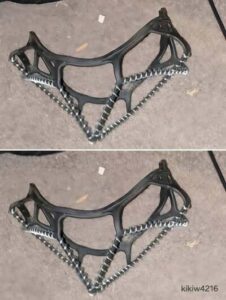
But nothing else came close to the jaw guard.
That object had changed the atmosphere of the entire place. Even after we cleaned everything out, the memory lingered like a faint echo trapped in the concrete walls.
My father noticed it too.
He didn’t say it directly, but I could tell from the way he occasionally paused near the back corner, as if expecting something else to reveal itself.
The Notebook That Kept Raising Questions
Over the next few days, the notebook labeled “Project K-4216” became the center of our curiosity.
We kept returning to it, flipping through pages slowly, as if rushing might cause the inked details to disappear.
Some sketches were clearly technical. Others felt almost artistic—drawn with a kind of obsessive imagination rather than engineering precision.
There were repeated references to “adaptive resonance,” “wearable feedback loops,” and something called “dynamic facial alignment.”
None of it was explained in a way that made complete sense.
But all of it suggested intention.
Not accident.
Not randomness.
Something had been built here with purpose, even if that purpose was never fully realized—or never fully understood.
A Growing Divide Between Logic and Wonder
My friend was the first to say what I was also thinking but hesitant to admit.
“What if it wasn’t meant to be finished?” he asked.
That question stayed with me longer than expected.
Because unfinished things carry a different kind of weight. They don’t resolve into answers. They sit in your mind as open loops.
The jaw guard wasn’t just an object anymore.
It was an incomplete sentence.
A design that stopped mid-thought.
A piece of someone else’s imagination left behind without explanation.
And that made it harder to dismiss.
Testing the Boundary Between Object and Experience
When I wore it again, I did it more carefully.
Not out of fear—but curiosity.
I wanted to understand whether the sensation I felt the first time was real or just psychological suggestion.
But the moment it settled against my face, I felt the same shift again.
Not transformation in appearance alone—but in awareness.
Sound felt slightly different.
My breathing felt more noticeable.
Even silence seemed structured, as if the world had edges I hadn’t noticed before.
When I spoke, the subtle vibration returned, altering the perception of my own voice just enough to make it feel unfamiliar.
It wasn’t magical.
It wasn’t supernatural.
But it was immersive in a way that made ordinary reality feel temporarily reconfigured.
My Father’s Confession About Curiosity
One evening, as we sat reviewing the sketches again, my father finally admitted something I didn’t expect.
“I never stopped wondering where it came from,” he said.
I looked up.
“Then why didn’t you investigate it?”
He paused for a long time.
“Because sometimes,” he said quietly, “not knowing feels safer than finding an answer you can’t unsee.”
That answer stayed with me.
Because it wasn’t laziness.
It wasn’t neglect.
It was hesitation shaped by uncertainty.
The kind people develop when they encounter something that doesn’t fit neatly into their understanding of the world.
The Strange Pull of Unidentified Design
The more we studied the jaw guard, the more it resisted simple classification.
It didn’t behave like a typical prop.
It didn’t match known consumer tech.
It didn’t align fully with medical devices or industrial components either.
Instead, it sat somewhere in between categories—like something designed for a purpose that never became mainstream, or perhaps never became public.
That ambiguity created a strange tension.
Part of me wanted a clear explanation.
Another part didn’t.
Because explanation would shrink it.
And mystery, once solved, often loses its emotional gravity.
The Shift From Mystery to Meaning
What surprised me most wasn’t the object itself.
It was how it changed the way my father and I interacted.
We talked more.
Not about chores or obligations—but ideas.
We debated design philosophy late into the evening. We looked up experimental wearable tech. We even explored artistic communities where creators build speculative devices inspired by fictional worlds like cyberpunk cities and dystopian futures.
For the first time in years, conversation between us didn’t feel transactional.
It felt exploratory.
As if the jaw guard had opened a door that wasn’t in the garage—but between us.
When Imagination Becomes a Shared Space
At some point, the question of origin stopped mattering as much.
What mattered more was what the object represented.
A possibility.
A fragment of someone’s imagination made physical.
A reminder that invention doesn’t always need validation to exist.
Some creations are never meant for production.
Some ideas live and die quietly in workshops, notebooks, and storage units.
And yet they still leave traces behind.
A Final Thought That Refuses to Settle
I still don’t know what the jaw guard truly is.
Even now, I sometimes revisit the sketches, searching for a detail I might have missed.
But the truth is no longer the only thing I’m looking for.
Because the object has already done something more important than explain itself.
It changed how I see forgotten things.
It made me realize how many objects around us carry hidden stories we never pause long enough to question.
And it turned a simple garage cleanup into a reminder that curiosity is often the difference between seeing junk and seeing potential.
The jaw guard still sits on my shelf today.