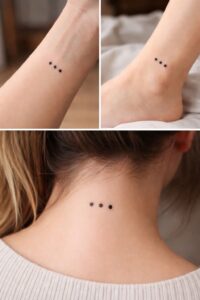
Tattoos have long served as powerful forms of human expression, carrying meanings that often extend far beyond their visual appearance. Some tattoos are elaborate and immediately recognizable, covering entire arms, backs, or legs with intricate artwork and symbolic imagery. Others are remarkably small and subtle, easily overlooked by those unfamiliar with their significance. Among the simplest yet most misunderstood of these designs is the three-dot tattoo, often represented as three small marks arranged in a triangular pattern or straight line: •••.
At first glance, the tattoo appears almost insignificant. Its minimalist appearance can make it seem decorative or random, especially compared to larger and more detailed forms of body art. Yet despite its simplicity, the three-dot tattoo carries a surprisingly wide range of interpretations shaped by culture, personal history, social environment, philosophy, and lived experience. Depending on who wears it and where it appears, the tattoo may symbolize loyalty, silence, rebellion, survival, spirituality, brotherhood, personal struggle, or identity.
This complexity is precisely what makes the symbol so fascinating.
Unlike tattoos with one universally accepted meaning, the three-dot tattoo exists within a landscape of overlapping interpretations. Its significance changes depending on geography, language, social setting, and individual intention. For one person, the dots may represent resilience and survival through hardship. For another, they may reflect a philosophical outlook on life. In some environments, they are associated with prison culture or gang symbolism. In others, they function as deeply personal reminders of growth, pain, or transformation.
The tattoo’s ambiguity has contributed both to its popularity and to the misunderstandings surrounding it.
One of the most widely recognized meanings connected to the three-dot tattoo is the phrase “Mi Vida Loca,” which translates from Spanish as “My Crazy Life.” In this interpretation, the dots symbolize a life shaped by unpredictability, risk, hardship, rebellion, or emotional intensity. The phrase became especially associated with certain street cultures and youth subcultures where identity and survival were closely tied to loyalty, resilience, and reputation.
Importantly, “Mi Vida Loca” does not necessarily refer to criminal behavior in every case, even though the symbol has sometimes become associated with gang-related imagery in public perception. For many individuals, the phrase reflects something broader and more personal: the idea of living through chaos, navigating instability, or embracing an unconventional path through life.
This interpretation resonates strongly because it captures a universal human experience. Many people feel that life itself can become unpredictable, emotionally turbulent, or difficult to control. The three dots, in this context, become shorthand for endurance through uncertainty.
Another common interpretation connects the tattoo to the proverb “see no evil, hear no evil, speak no evil.” In this philosophical sense, the dots symbolize restraint, discretion, or refusal to participate in harmful behavior. The simplicity of the tattoo mirrors the simplicity of the message: choosing silence over conflict, observation over judgment, or self-control over recklessness.
However, within prison environments or criminal subcultures, this meaning can evolve into something far more serious.
In those settings, silence often becomes tied directly to survival. Loyalty and refusal to cooperate with authorities may carry enormous social weight, and symbols connected to silence can function as markers of trustworthiness or group identity. In these contexts, the three-dot tattoo may represent adherence to an unwritten code where loyalty to peers is valued above communication with outsiders or law enforcement.
This association has significantly shaped public perception of the tattoo over time.
Because of its visibility within certain prison systems and street cultures, many people automatically associate the symbol with criminal activity regardless of the wearer’s actual background or intention. This has created situations where individuals with the tattoo face judgment, stereotyping, or suspicion based solely on appearance.
Yet reducing the symbol entirely to criminal associations oversimplifies its meaning dramatically.
Tattoos rarely exist in isolation from personal context. The same design can hold completely different emotional significance for different people. Someone may receive the tattoo as a reflection of personal hardship rather than gang affiliation. Another person may choose it as a minimalist artistic statement disconnected from any social code at all.
This disconnect between public assumption and personal meaning highlights a larger truth about body art in general: tattoos often become mirrors for society’s biases, fears, and cultural interpretations.
Historically, tattoos have frequently carried social stigma. In many societies, visible tattoos were once associated primarily with sailors, prisoners, rebels, or marginalized groups. Over time, however, tattoo culture expanded dramatically into mainstream life. Today, people from nearly every profession and social background wear tattoos openly, including teachers, doctors, athletes, artists, business executives, and parents.
Despite this broader acceptance, certain symbols continue to carry heavier social assumptions than others. The three-dot tattoo is one example because its small size and placement often align with historical prison tattoo traditions.
Placement itself plays an important role in interpretation.
Three-dot tattoos commonly appear on the hands, particularly between the thumb and index finger or along the knuckles. These locations are highly visible and historically associated with prison tattoos because they are easier to create using improvised tools. Incarcerated individuals often relied on homemade tattoo methods using basic materials, leading to smaller, simpler designs concentrated on accessible body areas.
As a result, hand tattoos featuring minimalist symbols became visually linked with prison culture even outside correctional settings.
At the same time, visibility can also represent intention. A tattoo placed prominently on the hand may signal openness about identity or personal experience. Unlike tattoos hidden beneath clothing, hand tattoos exist in constant view both to the wearer and to others. This visibility can transform the tattoo into a daily reminder of personal values, memories, or survival.
For some individuals, the three-dot tattoo functions almost like a private language.
It may symbolize a chapter of life survived rather than one celebrated. Some wearers connect the dots to difficult experiences such as addiction recovery, homelessness, trauma, incarceration, or emotional hardship. The tattoo becomes less about projecting an image outward and more about carrying an internal reminder of resilience.
In these cases, the simplicity of the symbol becomes part of its emotional power.
Tiny marks can hold enormous meaning precisely because they do not require elaborate explanation. A few dots may quietly represent years of pain, growth, mistakes, lessons, or transformation. To outsiders, the tattoo may appear insignificant. To the wearer, it may represent survival itself.
This relationship between minimalism and emotional depth is common in tattoo culture.
Not all meaningful tattoos are visually complex. Some of the most powerful symbols are also the simplest because they rely on shared understanding rather than artistic detail. Symbols work through association, memory, and context. Their emotional impact often comes not from appearance alone but from the stories attached to them.
The three-dot tattoo also reflects humanity’s long-standing use of symbols to communicate identity and belonging.
Throughout history, people have marked themselves physically to signal group membership, spiritual beliefs, social roles, achievements, or shared experiences. Ancient tribal markings, religious symbols, military insignia, and modern tattoos all emerge from the same human desire to externalize internal identity.
In tightly bonded communities, symbols become especially important because they create recognition without words.
Within prison environments, for example, tattoos often operate as forms of social communication. They may indicate affiliations, experiences, beliefs, or reputation. In some cases, tattoos serve protective purposes by signaling loyalty or group membership within dangerous environments where trust is essential.
Yet outside those environments, meanings can shift dramatically.
A person inspired by minimalist tattoo aesthetics may choose three dots simply because they appreciate geometric simplicity. Another individual may interpret the dots spiritually, associating them with balance, connection, or personal philosophy. Some view the three dots as representing past, present, and future. Others connect them to family members, life stages, or emotional milestones.
This flexibility helps explain why the tattoo persists across generations and cultures despite controversy surrounding certain interpretations.
Social media and modern tattoo culture have further expanded awareness of minimalist tattoo designs. Small symbolic tattoos became increasingly popular as body art entered mainstream fashion and self-expression trends. Tiny symbols now appear frequently on celebrities, influencers, and young adults seeking subtle but meaningful designs.
As a result, some people receive three-dot tattoos with little awareness of their historical associations.
This creates an interesting cultural tension.
On one hand, symbols naturally evolve over time as new generations reinterpret them. Meanings are never completely fixed. On the other hand, historical associations do not disappear simply because newer interpretations emerge. A symbol connected to prison culture for decades may continue carrying those associations in professional, legal, or social settings regardless of the wearer’s personal intent.
This reality can produce unintended consequences.
Individuals with visible three-dot tattoos may encounter assumptions from employers, law enforcement, or strangers who interpret the symbol negatively. In some situations, the tattoo may attract scrutiny even when no criminal affiliation exists. This demonstrates how public perception often shapes social experience as strongly as personal intention.
The broader lesson extends far beyond tattoos themselves.
Humans constantly interpret visual symbols based on cultural conditioning, media exposure, and social stereotypes. Clothing, hairstyles, jewelry, accents, and tattoos all become subject to interpretation whether accurate or not. The three-dot tattoo simply represents one especially concentrated example of this phenomenon.
Its simplicity invites projection.
Because the design contains so little explicit information, observers often fill in the gaps using their own assumptions. Someone familiar with prison symbolism may immediately connect the dots to incarceration or gang culture. Someone else may see them as abstract art or spiritual symbolism. Another person may recognize the “Mi Vida Loca” interpretation.
Each reaction reveals as much about the observer’s experiences as about the tattoo itself.
This complexity is part of why body art remains such a powerful form of self-expression. Tattoos operate simultaneously as personal symbols and public statements. Once placed visibly on the body, they enter social space where interpretation becomes unavoidable.
For many tattoo wearers, this tension is accepted as part of the experience.
Some intentionally choose controversial or misunderstood symbols precisely because they challenge assumptions. Others prioritize personal meaning over public approval. In either case, tattoos become negotiations between private identity and public perception.
The three-dot tattoo captures this dynamic perfectly.
It is tiny yet emotionally charged, simple yet culturally layered, minimalist yet socially complex. It can symbolize loyalty, rebellion, suffering, resilience, silence, brotherhood, philosophy, survival, or identity depending entirely on the individual and context involved.
Ultimately, the tattoo serves as a reminder that symbols rarely possess singular meanings.
Human lives are too complicated for universal interpretations. A design associated with hardship in one setting may represent healing in another. A mark once connected to danger may later become a symbol of transformation or survival. Meanings evolve because people evolve.
Perhaps that is why the three-dot tattoo continues to endure despite controversy and misunderstanding.
Its ambiguity allows individuals to attach deeply personal narratives to an otherwise simple image. Three tiny marks can quietly contain entire histories, emotions, and identities invisible to outsiders.
And in that sense, the tattoo reflects something fundamentally human: the desire to carry our experiences with us, permanently and visibly, even when the world may never fully understand what they mean.