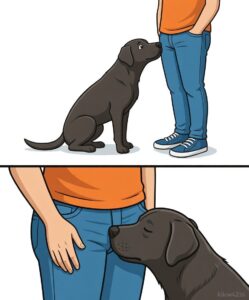
When a dog sniffs a human—especially around the groin or other highly sensitive areas—it often triggers embarrassment, confusion, or even discomfort in people. However, from a biological and neurological perspective, this behavior is neither rude nor random. It is one of the most information-rich forms of sensory communication in the animal kingdom.
To understand it properly, we must step into the world of canine perception, where smell is not just a sense but an entire information system—far more complex than human vision in terms of data processing.
The Canine Nose: A Biological Supercomputer
Dogs experience the world primarily through scent. While humans rely heavily on vision, dogs rely on olfaction as their dominant sensory channel.
Humans possess approximately 5–6 million olfactory receptors. Dogs, depending on breed, have between 100 million and 300 million. This gives them a scent detection capability that is estimated to be 10,000 to 100,000 times more sensitive than ours.
But receptor count alone does not explain the full picture.
Inside a dog’s nasal cavity lies a highly specialized system that functions almost like a parallel brain for smell processing. Air entering the nose is split into two pathways:
- One for respiration
- One exclusively for odor analysis
This allows dogs to continuously analyze scents even while breathing normally.
Additionally, dogs possess an advanced brain region dedicated to smell interpretation. In fact, the olfactory portion of a dog’s brain is proportionally about 40 times larger than that of humans relative to total brain size.
The Vomeronasal Organ: The Hidden Chemical Decoder
One of the most fascinating components of canine scent perception is the vomeronasal organ (VNO), also known as Jacobson’s organ.
Located between the nasal cavity and the roof of the mouth, this structure is specifically designed to detect pheromones—chemical signals that carry biological and emotional information between individuals.
Unlike regular odors, pheromones are not about “smell” in the traditional sense. Instead, they function as invisible biological messages, encoding information such as:
- Reproductive status
- Stress levels
- Hormonal changes
- Social hierarchy
- Emotional arousal
When a dog sniffs a human closely, particularly near areas rich in apocrine glands, it is activating both its main olfactory system and its vomeronasal system simultaneously.
This dual-processing mechanism allows dogs to interpret humans almost like “living chemical data streams.”
Why Certain Human Body Areas Produce Stronger Signals
Humans have two primary types of sweat glands:
- Eccrine glands (thermoregulation, mostly water-based sweat)
- Apocrine glands (protein-rich, scent-heavy secretions)
Apocrine glands are concentrated in:
- Armpits
- Groin region
- Around certain hair follicles
These glands produce secretions that interact with skin bacteria, creating unique odor signatures.
To dogs, these areas are essentially “information hotspots.” The groin region, in particular, emits a dense mixture of chemical signals because:
- It is hormonally active
- It contains sweat and sebaceous gland activity
- It reflects internal physiological states more clearly than other areas
So when a dog investigates this region, it is not behaving socially in a human sense—it is collecting biological data.
What Dogs Actually Learn From Smelling Humans
A single sniff can provide a dog with an astonishing amount of information. Research in animal behavior and olfactory neuroscience suggests dogs can detect:
1. Identity
Each human has a unique scent profile, similar to a fingerprint.
2. Emotional State
Dogs can detect:
- Anxiety (elevated cortisol)
- Fear (adrenaline changes)
- Calmness (stable hormonal patterns)
3. Health Conditions
Dogs have been trained to detect:
- Certain cancers
- Diabetes (via blood sugar-related scent changes)
- Infections
- Seizure-related biochemical shifts
4. Hormonal Cycles
Dogs can identify:
- Menstrual cycles
- Pregnancy
- Postpartum changes
- Puberty-related hormonal shifts
5. Diet and Lifestyle
Foods, medications, alcohol consumption, and hydration levels all alter body odor chemistry.
Why Dogs Focus on the Groin Area Specifically
While dogs will often sniff faces, hands, and feet, the groin region contains some of the richest chemical information because:
- It is densely packed with apocrine glands
- It is less frequently washed in a way that removes all scent traces
- It reflects internal hormonal states more strongly than surface-level skin areas
In canine social behavior, dogs greet each other by sniffing the rear region because it contains anal glands that provide identity and emotional data.
When a dog applies the same behavior to humans, it is not misinterpreting social rules—it is simply using the same biological strategy across species.
Evolutionary Origins of This Behavior
Dogs evolved from wolves, and wolves rely heavily on scent-based communication.
In wild canid societies:
- Scent determines rank and identity
- Pheromones regulate mating behavior
- Territorial marking conveys ownership and boundaries
- Social bonding is reinforced through olfactory exchange
Humans, in contrast, rely heavily on:
- Visual cues (facial expression, body language)
- Verbal communication
- Cultural norms
Because domesticated dogs live in human environments, they are constantly bridging two communication systems:
- Their ancestral scent-based system
- Human visual/social systems
This mismatch is why behaviors like sniffing can feel socially inappropriate to humans but completely natural to dogs.
Dogs and Emotional Detection
One of the most remarkable aspects of canine olfaction is emotional detection.
When a human experiences stress or fear:
- Cortisol levels rise
- Sweat composition changes
- Skin microbiota shifts slightly
Dogs can detect these biochemical changes almost instantly.
Studies have shown that dogs often:
- Become more protective when owners are stressed
- Show calming behaviors when detecting anxiety
- Adjust their body language based on human emotional chemistry
This means dogs are not just reacting to how we look—they are responding to how we chemically “feel.”
Medical Detection Abilities
Scientific research has validated that dogs can detect diseases with remarkable accuracy.
Trained detection dogs have been used to identify:
- Lung cancer via breath samples
- Skin cancer through odor changes
- Prostate cancer in urine samples
- Hypoglycemia episodes in diabetics
- Early-stage viral infections in controlled studies
The mechanism is believed to be subtle biochemical changes released by diseased or altered cells, which dogs detect long before symptoms become visible to humans.
This reinforces the idea that when dogs investigate human scent closely, they are responding to real physiological signals—not randomness.
Why Humans Misinterpret the Behavior
From a human social perspective, personal space and privacy are culturally defined. The groin area is considered private, and any attention directed there feels inappropriate.
However, dogs do not possess:
- Cultural taboos
- Social embarrassment systems
- Human concepts of modesty
Instead, they operate on:
- Biological necessity
- Survival instincts
- Chemical interpretation of environment
Thus, what humans interpret as “awkward” is simply information gathering from the dog’s perspective.
How Dogs Use Scent in Social Hierarchy
Among dogs, sniffing is not just informational—it is relational.
Through scent, dogs determine:
- Familiar vs unfamiliar individuals
- Emotional stability
- Social rank
- Reproductive status
In canine interactions, scent exchange is equivalent to:
- Handshakes
- Conversations
- Identity verification
When applied to humans, dogs are essentially extending their natural communication system across species boundaries.
Training and Managing the Behavior
While natural, this behavior can be socially managed.
Effective training methods include:
1. Redirection
Teaching dogs to sniff hands or receive greetings in more appropriate areas.
2. Command Training
Using cues such as “sit,” “greet,” or “leave it.”
3. Positive Reinforcement
Rewarding calm and appropriate greeting behavior.
4. Early Socialization
Puppies learn faster when exposed to structured greeting rules early.
Importantly, punishment is not effective because the behavior is instinctive, not disobedient.
Myths and Misconceptions
Myth: Dogs are behaving inappropriately.
Fact: They are following instinctual communication patterns.
Myth: Only certain dogs do this.
Fact: All dogs rely on scent exploration; intensity varies.
Myth: It indicates dominance.
Fact: It is information gathering, not dominance behavior.
Myth: It means sexual interest.
Fact: Dogs do not interpret human pheromones sexually in this context.
The Human-Dog Communication Gap
The core issue is not the behavior itself, but the difference in sensory worlds.
Humans live in:
- Visual-symbolic systems
- Language-based communication
- Social etiquette frameworks
Dogs live in:
- Chemical landscapes
- Real-time scent interpretation
- Emotional biochemical detection
To a dog, every human interaction is a full sensory briefing. To humans, it is often reduced to visual and verbal cues.
A Different Way to Understand the Behavior
Instead of seeing this behavior as intrusive, it can be reframed as:
- Recognition
- Investigation
- Social awareness
- Emotional reading
In essence, when a dog sniffs a human closely, it is saying—biologically, not verbally:
“I am trying to understand you.”
Final Reflection: Smell as a Language
Smell is the oldest communication system in the animal kingdom. It predates speech, writing, and even complex social structures.
Dogs remain one of the most advanced users of this ancient language.
So when a dog investigates human scent—no matter how personal the location—it is not breaking rules. It is following a biological script written millions of years before human social norms existed.
From their perspective, they are not being intrusive.