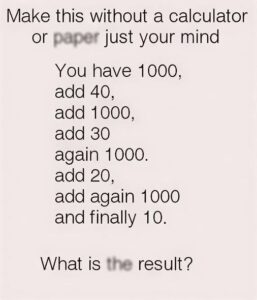
There is a peculiar kind of modern content that spreads not because it is difficult, but because it pretends to be simple. A short phrase appears—“Test your math skills”—and with it comes a sense of casual challenge, as though intelligence itself can be measured in seconds. Beneath it sits a neatly arranged problem, often stripped of context, inviting immediate response. The framing is deliberate: it encourages speed over reflection, instinct over structure, confidence over caution.
And that is where most people fall into the same pattern of error.
The issue is rarely mathematics itself. It is attention. More precisely, it is the diminishing willingness to slow down long enough to understand what is actually being asked. The mind, conditioned by fast scrolling, instant answers, and algorithmic immediacy, begins to treat every problem as something to be solved reflexively rather than understood deliberately.
The phrase “the answer is in the first comment” has become symbolic of this environment. It implies hidden depth, but often what it really exposes is how quickly people leap to conclusions without fully engaging with the material in front of them. It suggests mystery, but the real revelation is psychological: most mistakes are not mathematical—they are behavioral.
The Illusion of Simplicity
At first glance, a viral math puzzle appears harmless. The numbers are small. The operations are familiar. It resembles something from early education, something solved long ago and supposedly mastered. This familiarity is deceptive. It lowers cognitive defenses.
The brain sees comfort where it should see structure.
This is where errors begin—not in ignorance, but in assumption. People assume they already understand the rules. They assume the problem is straightforward. They assume there is nothing new to notice. That assumption replaces analysis.
The most dangerous problems are not complex ones. They are simple ones that disguise hidden structure.
Because simplicity invites speed.
And speed invites mistakes.
The Psychology of Rushing
When people encounter a short, framed challenge online, several cognitive shortcuts activate automatically. These include:
- Pattern recognition based on familiarity
- Impulse to respond quickly for validation
- Overconfidence in basic arithmetic ability
- Reduced attention to punctuation and structure
The result is predictable: answers are formed before full comprehension occurs.
This is not carelessness in the traditional sense. It is efficiency gone unchecked.
The mind prioritizes completion over correctness because modern digital environments reward engagement, not accuracy. A fast answer feels satisfying even when it is wrong. There is no immediate penalty for being incorrect, only for being slow.
And so speed becomes mistaken for intelligence.
A Different Lens: The Slow Logic of Cooking
To understand why structure matters, consider something entirely unrelated at first glance: cooking a slow stew.
On the surface, it appears unrelated to mathematics. Yet both rely on sequencing, timing, and restraint. A stew is not defined by its ingredients alone but by the order and patience with which they are treated.
At the beginning, everything seems simple:
- Meat
- Vegetables
- Herbs
- Liquid
- Heat
Nothing about these components is complicated. But the transformation from raw ingredients to a deep, cohesive dish depends entirely on process.
If everything is added at once, the result is flat and underdeveloped. If heat is too aggressive, texture is destroyed. If timing is ignored, flavor fails to build.
This is not about difficulty. It is about discipline.
Step One: Respecting the Beginning
The first stage of cooking a stew mirrors the first stage of solving a problem: reading carefully.
Most failures begin here.
In cooking, someone might skim instructions and assume all ingredients can be combined immediately. In mathematics, someone might glance at an equation and begin calculating without fully parsing its structure.
Both actions stem from the same impulse: the desire to get to the result as quickly as possible.
But structure always comes before execution.
In a stew, meat must be browned properly before liquids are introduced. This step is not decorative. It creates depth through chemical reaction, developing flavor that cannot be recreated later.
Skipping it does not break the recipe immediately. It simply weakens the final outcome in ways that may not be obvious until much later.
The same is true in problem-solving. Missing a small rule or misreading a symbol does not always produce an obviously wrong answer. Sometimes it produces a believable wrong answer.
And that is more dangerous.
Because it feels correct.
Step Two: The Hidden Foundation
After the initial preparation comes the invisible work. Onions soften. Garlic releases aroma. Tomato paste deepens in color. These transformations are subtle, almost unimpressive in real time.
This is where many lose patience.
Nothing dramatic appears to be happening. There is no instant reward. Yet this stage defines the entire structure of the final result.
In thinking, this stage corresponds to internal reasoning. It is where one pauses, re-evaluates assumptions, and ensures that each step logically follows the previous one.
Skipping this stage leads to fragile conclusions.
The work may look complete on the surface, but it lacks internal stability.
Step Three: The Mistake of Heat
Heat is powerful. It accelerates change. It creates urgency.
But uncontrolled heat destroys structure.
In cooking, excessive heat toughens meat and reduces complexity. It replaces depth with intensity.
In thinking, this mirrors rushed problem-solving. The faster one pushes toward an answer, the more likely subtle constraints are ignored.
People often mistake intensity for progress.
But intensity without control produces distortion.
Step Four: The Illusion of Completion
Once ingredients are combined and heat is applied, the dish appears finished. Similarly, once an answer is produced, a problem appears solved.
But appearance is not reality.
A stew that looks complete after ten minutes is not actually complete. It requires time for transformation to occur beneath the surface. Flavors integrate slowly. Texture develops gradually.
In the same way, an answer to a problem must be tested against structure, not just intuition.
This is where many online puzzles mislead people. They are designed to trigger premature certainty.
The mind says: “This looks right.”
But “looks right” is not the same as “is right.”
Step Five: The Power of Waiting
The most overlooked stage in both cooking and thinking is waiting.
Waiting is not inactivity. It is development without interference.
In a stew, time allows collagen to break down, flavors to merge, and texture to stabilize. Without it, ingredients remain separate and incomplete.
In reasoning, time allows reconsideration. It gives space to notice errors, reconsider assumptions, and refine logic.
But modern environments discourage waiting.
Everything is optimized for speed.
So waiting feels unnatural, even unnecessary.
Yet it is precisely what produces depth.
Why People Misread Simple Problems
Returning to the viral math puzzle concept, the issue is not that people cannot solve it. The issue is that they do not fully engage with it.
Common mistakes include:
- Ignoring parentheses or grouping symbols
- Misapplying order of operations
- Reading from left to right instead of structurally
- Answering based on familiarity rather than rules
These are not knowledge failures. They are attention failures.
The problem is not difficulty.
The problem is pace.
The Social Reward of Quick Answers
One reason speed dominates reasoning is social reinforcement. Online, fast responses are often rewarded with validation. People praise quick answers. They share confident replies. They treat speed as a proxy for intelligence.
This creates a feedback loop:
- Faster answers feel more impressive
- Slower thinking feels inefficient
- Accuracy becomes secondary to immediacy
Over time, this reshapes behavior.
People begin to prioritize appearing correct over being correct.
The Stew Returns: A Lesson in Structure
If we return to the stew metaphor, we see something important: every stage depends on the one before it.
You cannot skip browning and expect depth later.
You cannot rush simmering and expect tenderness.
You cannot avoid resting and expect full integration.
Structure is cumulative.
Mathematical reasoning works the same way:
- Each step depends on the previous one
- Errors compound rather than disappear
- Final answers are only as strong as the process used to reach them
The Real Meaning of “The Answer Is in the First Comment”
The phrase itself becomes symbolic. It suggests that truth is hidden somewhere external, waiting to be revealed.
But in reality, the “first comment” is often irrelevant.
The real message is not external—it is procedural.
The answer is not found elsewhere.
It is found in attention.
In reading carefully.
In slowing down.
In resisting assumption.
The “hidden clue” is not in the content. It is in the behavior of the reader.
Patience as a Cognitive Skill
Patience is often misunderstood as passivity. In reality, it is active cognitive control.
It allows:
- Deeper analysis
- Reduced error rates
- Better pattern recognition
- Stronger logical sequencing
Without patience, intelligence becomes reactive rather than structured.
With patience, even simple problems reveal their hidden layers.
Final Reflection: Thinking as a Process, Not a Race
The most important lesson from both the stew and the math puzzle is not about food or numbers. It is about mindset.
Everything that appears simple deserves at least one careful reading.
Everything that invites quick response deserves a pause.
Everything that feels obvious deserves a second look.
Because correctness is rarely about speed.
It is about structure.
And structure always requires time.
In a world that rewards immediacy, slowing down becomes a form of clarity. It is the difference between reacting and understanding, between finishing and knowing, between guessing and thinking.
And just like a well-made stew, the best results are never rushed.