I used to believe there were two versions of me.
The girl before the fire.
And the girl after it.
Before the fire, I was loud, fearless, always running through the apartment hallways in mismatched socks while my father chased me pretending to be a monster. My mother called me her little tornado because I never stopped moving long enough for anyone to catch me.
After the fire, everything changed.
People spoke softer around me.
Teachers tilted their heads with pity.
Children stared too long at the scars running across the left side of my face and neck.
Even mirrors became enemies.
I learned very early that strangers noticed my scars before they noticed me.
By senior year of high school, I had perfected the art of disappearing in plain sight. I sat near classroom windows, avoided crowded parties, and mastered polite smiles that discouraged conversation before it started.
The only person who consistently treated me normally was my best friend, Ava.
“You know,” she said while curling her hair the night of prom, “one day some boy is going to fall madly in love with you and make everyone else look stupid.”
I laughed from her bedroom floor where I was pretending to care about makeup.
“That would require boys actually looking at me.”
“They do look at you,” she replied. “They’re just intimidated because you’re prettier than they are.”
“That’s biologically impossible.”
Ava threw a makeup sponge at my head.
I almost didn’t go to prom at all.
But my mother had spent weeks encouraging me. After everything we’d survived together, she wanted one normal memory for me before graduation.
So I went.
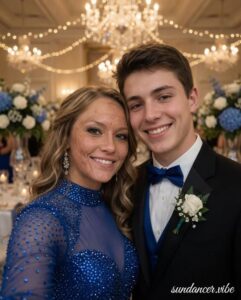
I wore a dark blue dress with long sleeves that hid the burns on my arms. My scar still curved from my jawline toward my collarbone, impossible to fully conceal, but for once I stopped trying.
The gymnasium glittered with cheap decorations and dim lights. Music pounded through the floor while couples laughed beneath silver streamers.
I spent the first hour pretending to enjoy myself near the punch table.
Then Caleb Turner walked toward me.
Every girl in school liked Caleb. He was tall, quiet, kind in a way that didn’t feel performative. Unlike most popular boys, he never mocked anyone to entertain his friends.
Still, I assumed he was approaching someone behind me.
“Hey,” he said nervously.
I looked over my shoulder.
There was nobody there.
“Hey,” I answered awkwardly.
He shoved his hands into his pockets. “You look really nice tonight.”
For a second I forgot how to breathe.
“Thanks.”
The silence stretched.
Then he asked, “Do you want to dance?”
I genuinely thought he was joking.
Not because I considered myself ugly exactly, but because boys like Caleb didn’t usually ask girls like me to dance in front of an entire class.
“You mean me?” I blurted.
He smiled slightly. “Yeah. You.”
Heat rushed into my face.
Around us, music swelled louder while students moved beneath colored lights.
I expected someone to laugh.
Nobody did.
So I placed my hand in his.
And for three whole minutes, I forgot about my scars.
Caleb wasn’t awkward or overly careful the way people usually became around me. He didn’t stare at my face with forced politeness. He simply danced like this was the most natural thing in the world.
“You seem surprised,” he said quietly.
“I am.”
“Why?”
I looked away. “People usually don’t…”
“Don’t what?”
“Notice me.”
He frowned softly.
“I noticed you a long time ago.”
My heart stumbled strangely at those words.
After the song ended, we stayed near the edge of the dance floor talking. Mostly about ordinary things. Teachers we hated. Graduation. College applications.
Normal conversation.
Normal enough that I almost forgot who I was for a little while.
Then everything changed.
Near midnight, Caleb’s parents arrived at the prom looking pale and frantic.
At first I thought something terrible had happened to a family member.
Then I saw the police officers behind them.
The music stopped.
Students turned toward the entrance in confusion.
Caleb froze beside me.
His mother pointed directly at him.
“That’s him.”
The room erupted into whispers.
An officer approached Caleb calmly. “We need you to come with us.”
“For what?” he asked.
His father looked sick.
“We told them what you said,” he whispered.
Caleb’s expression changed instantly.
And suddenly fear crawled up my spine.
The officer turned toward me next.
“Lena Hart?”
My stomach dropped.
“Yes?”
“We need to ask both of you some questions regarding the apartment fire on Willow Street fourteen years ago.”
The world tilted sideways.
The fire.
No one had spoken about the fire publicly in years.
My mother arrived at the school twenty minutes later, breathless and terrified. She kept demanding explanations while officers spoke quietly with the principal.
Eventually we were escorted into a separate room where Detective Harris introduced himself.
“There’s no immediate danger,” he assured us. “But new information recently surfaced regarding the Willow Street fire investigation.”
I sat frozen beside my mother.
Caleb looked equally shaken.
Detective Harris opened a folder carefully.
“Mr. Turner informed us his son witnessed something the night of the fire but never reported it.”
My chest tightened painfully.
Caleb stared at the floor.
“I was nine,” he whispered. “I thought maybe I imagined it.”
“What did you see?” Harris asked gently.
Caleb swallowed hard before looking at me.
“I saw someone leaving the building right before the explosion.”
The room went silent.
The fire had always been ruled accidental — faulty wiring in an old apartment complex. That’s what everyone believed.
That’s what I believed.
Detective Harris slid an old photograph across the table.
“This building underwent review several years ago for potential insurance fraud,” he explained. “At the time we lacked sufficient evidence. But Caleb’s statement reopened certain questions.”
My mother looked suddenly pale.
Painfully pale.
“Mom?” I whispered.
She didn’t answer.
Detective Harris noticed too.
“Mrs. Hart,” he said carefully, “is there something you’d like to tell us?”
Her hands trembled violently.
“No.”
But the word sounded weak.
Unconvincing.
The detective studied her for a long moment before closing the folder.
“We’ll continue tomorrow,” he said quietly.
That night my mother barely spoke during the drive home.
Rain streaked across the windshield while tension filled every inch of the car.
Finally I asked, “What’s going on?”
“Nothing.”
“That’s obviously not true.”
She gripped the steering wheel tighter.
“Mom.”
Her voice cracked unexpectedly.
“Some truths destroy families, Lena.”
I stared at her in shock.
“What does that mean?”
But she refused to answer.
I barely slept.
All night memories returned in fragments — smoke filling hallways, heat against my skin, someone screaming my name through flames.
I remembered waking in the hospital wrapped in bandages while doctors whispered outside my room. I remembered my father crying beside my bed.
Three years later he died in a construction accident.
At least that’s what I had always been told.
The next morning Detective Harris asked us to return to the station.
This time the atmosphere felt heavier.
More serious.
A sealed folder waited on the table.
The detective opened it slowly.
“The second person seen leaving the building was identified through enhanced security footage recovered from a nearby business.”
My mother stopped breathing beside me.
Then Harris turned the photograph around.
It was my father.
I stared at the image until my vision blurred.
“No,” I whispered.
But deep down I already knew it was real.
My father stood outside the apartment building minutes before the fire spread through the structure. His expression looked tense.
Guilty.
My mother covered her face with shaking hands.
“How long have you known?” I asked her quietly.
Tears slid through her fingers.
“Since the beginning.”
The betrayal hit harder than I expected.
“You lied to me my entire life.”
“I was trying to protect you.”
“From what?”
She looked at me helplessly.
“From hating him.”
Detective Harris spoke carefully.
“Your father was connected to a fraudulent insurance scheme involving unsafe electrical repairs. The fire was intended to damage part of the property after hours so building owners could collect renovation payouts.”
I felt physically sick.
“No,” I whispered again.
“He believed the building was empty,” Harris continued softly. “But the fire spread faster than expected due to code violations.”
The room blurred around me.
Every surgery.
Every nightmare.
Every moment spent hiding my face from strangers.
All because adults wanted money.
Then came the part that shattered me completely.
“Your father reentered the building when he realized tenants were still inside,” Harris said. “Witnesses saw him trying to reach the upper floors.”
My mother sobbed openly.
“He tried to save you,” she whispered.
I couldn’t process it.
How could someone cause the very thing they later died trying to stop?
My father suddenly became impossible to categorize.
Not a villain.
Not a hero.
Just a flawed human being whose terrible mistake destroyed countless lives.
Outside the station, cold wind whipped across the parking lot.
My mother reached for me.
I stepped away instinctively.
“You let me believe this was random,” I said.
“She begged them not to arrest him,” Detective Harris added quietly behind us. “There wasn’t enough evidence then, and several records disappeared during the investigation.”
I looked at my mother in disbelief.
“You knew innocent people suffered.”
“She loved him,” Harris said simply.
My mother looked broken.
“I loved your father,” she whispered. “And I was terrified of losing both of you.”
“But you lost him anyway.”
The words cut through both of us.
I walked away before she could answer.
For hours I wandered through town numb with anger and confusion. Eventually, without fully deciding to, I found myself outside Caleb’s house.
He opened the door before I knocked.
“You okay?” he asked softly.
“No.”
He stepped aside immediately.
His home smelled like coffee and old books. Safe. Ordinary. I envied that feeling.
We sat at the kitchen table in silence for several minutes.
Then I finally asked, “Why didn’t you tell anyone what you saw?”
Caleb looked miserable.
“Because I thought it was my fault.”
“What?”
“I saw your dad arguing with another man near the stairs before the fire,” he explained quietly. “Then I smelled smoke. I didn’t understand what was happening.”
He rubbed his hands together nervously.
“When people started panicking, your dad ran back inside screaming there was still a little girl upstairs.”
My chest tightened painfully.
“I kept thinking if I’d warned someone sooner maybe…” His voice cracked. “Maybe things would’ve been different.”
“You were nine years old.”
“I know that now.”
Rain hammered softly against the windows.
For a while neither of us spoke.
Then Caleb looked at me carefully.
“You know what I remember most from that night?”
I shook my head.
“The firefighters carried you out unconscious,” he said. “But even then, you looked like you were fighting to survive.”
Tears burned unexpectedly behind my eyes.
People usually described me as tragic.
Damaged.
Brave.
Nobody had ever described me as strong.
“I hated my scars for years,” I admitted quietly.
He frowned. “Why?”
“Because they changed everything.”
“Maybe,” he said gently. “But they’re not the first thing I notice about you.”
I looked at him skeptically.
“You’re terrible at lying.”
He laughed softly.
“Okay, they’re maybe the second thing.”
I laughed too.
A real laugh.
And somehow that mattered more than I could explain.
Over the following weeks, the investigation exploded across local news.
The apartment building owner and two contractors were arrested for fraud, criminal negligence, and evidence tampering. Financial records revealed years of corruption involving unsafe repairs across multiple properties.
Reporters camped outside our house.
Neighbors whispered constantly.
Online strangers called me inspirational, miraculous, heartbreaking.
None of them understood.
The scars themselves had never been the worst part.
The worst part was growing up wondering why disaster had chosen me specifically.
Now I knew the answer.
It hadn’t been fate.
It had been greed.
My mother changed after the arrests.
She stopped sleeping.
Sometimes I heard her crying quietly through the walls late at night.
One evening I found her sitting alone at the kitchen table staring at an old photograph of my father holding me as a toddler.
“He adored you,” she whispered without looking up.
I leaned against the doorway silently.
“He made a terrible mistake,” she continued. “But he loved you.”
I wanted to stay angry.
Part of me still was.
But grief is complicated when love and betrayal exist together.
“Why didn’t you tell me?” I finally asked.
She wiped her eyes slowly.
“Because every year it became harder. I kept hoping the truth would stay buried.”
“But it didn’t.”
“No.” She looked at me sadly. “The past never stays buried forever.”
For the first time since learning everything, I sat beside her instead of walking away.
And slowly we talked.
Really talked.
About my father’s debts.
About the pressure he faced.
About the shame she carried protecting his memory while fearing the truth.
“I hated myself after the fire,” she admitted quietly. “Not because of your scars. Because I defended him.”
I stared at the photograph.
My father looked so ordinary in it.
Just a smiling man holding his daughter.
That was the hardest part.
Terrible people are easier to understand when they look monstrous.
But most tragedies are caused by ordinary people making selfish decisions and believing they can control the consequences.
A month later the official report concluded.
The Willow Street fire was ruled intentional negligence connected to insurance fraud and criminal safety violations.
Several lawsuits followed.
Reporters kept asking if justice brought closure.
But closure wasn’t real life.
There was no magical moment where pain disappeared because the truth finally surfaced.
There was only understanding.
And understanding is quieter than people expect.
One evening near the end of summer, Caleb drove me to the empty lot where the apartment building once stood.
Most of the structure had been demolished years earlier. Weeds pushed through cracked pavement while sunset painted the ruins gold.
“This is where I saw the firefighters bring you out,” Caleb said softly.
Wind moved gently around us.
I stared across the empty space where my childhood once existed.
For years I believed the fire defined me completely.
The scars.
The fear.
The loneliness.
Everything.
But standing there now, I realized survival had shaped me more than destruction ever could.
Caleb glanced at me carefully.
“What are you thinking?”
“That I spent so long believing I was ruined.”
“And now?”
I looked down at the scar tracing my hand.
“Now I think maybe being hurt and being ruined aren’t the same thing.”
A small smile appeared on his face.
The sun dipped lower behind the broken concrete.
Then Caleb held out his hand.
“Dance with me again?”
I laughed softly through tears.
“There’s no music.”
“So?”
“There’s no prom either.”
“I liked this girl before prom,” he replied.
My chest tightened warmly.
So there we were, standing in the middle of the place that once destroyed my life, swaying slowly beneath an open sky while evening light stretched long shadows around us.
No decorations.
No audience.
No pity.
Just two people connected by the same terrible night choosing, somehow, not to let it define the rest of their lives.
And for the first time since the fire, I finally understood something important.