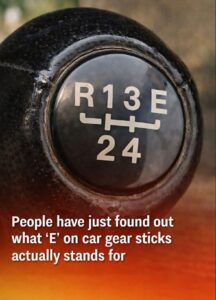
For many drivers today, the gear selector is something taken completely for granted. You get in the car, shift into Drive, and go. There is no need to think about engine load, fuel mapping, or efficiency modes because modern vehicles quietly handle all of that in the background. But if you go back far enough—into the era before fully computerized transmissions—you might stumble across something strange on certain gear sticks: a single letter that didn’t seem to belong there.
That letter was “E.”
To modern eyes, it looks confusing. Out of place. Even wrong. Most drivers today associate gear labels with the familiar sequence: P, R, N, D. Anything beyond that feels like a modification, an aftermarket addition, or a design quirk. So when people first encounter “E” on older vehicles, the reaction is almost always the same—what does that even mean?
For a long time, that question spread without a clear answer. Online forums filled with guesses. Some thought it meant “Extra gear.” Others assumed it stood for “Emergency mode.” A few even connected it to early experiments with electric systems. But the real explanation, once uncovered, turned out to be much more grounded in automotive history—and much more interesting in what it reveals about how driving itself has changed.
The “E” stood for Economy.
And behind that simple label was an entire philosophy of driving that no longer exists in the same form today.
The Era When Drivers Controlled Efficiency Manually
To understand why an “Economy” gear existed at all, you have to think about how cars behaved before modern automation. Older transmissions were far less adaptive. They didn’t constantly analyze road conditions or optimize fuel usage in real time. Instead, they followed fixed mechanical patterns that depended heavily on driver input and gear selection.
Fuel efficiency was not something the car managed for you—it was something you actively influenced.
That’s where the “E” mode came in.
In vehicles equipped with this feature, selecting “E” would adjust the transmission behavior to prioritize low engine RPMs. In simple terms, the car would shift earlier, stay in higher gears longer, and avoid aggressive acceleration patterns. The goal was not performance—it was conservation.
On highways, this made a noticeable difference. Instead of the engine working harder at lower gears, it would “relax” into a steady, fuel-efficient rhythm. Over long distances, this could translate into meaningful fuel savings, especially in an era when fuel prices and engine efficiency were more variable than today.
Drivers who understood how to use it effectively could extend their range significantly without changing their driving habits dramatically. It was, in essence, an early attempt at giving drivers a built-in efficiency assistant—long before computers took over that role.
Why the “E” Mode Slowly Disappeared
As automotive engineering advanced, the need for a dedicated economy gear began to fade. Several major technological shifts made it obsolete:
First, automatic transmissions became smarter. Instead of fixed behavior patterns, they began using sensors and control modules to adjust shift timing dynamically.
Second, fuel injection systems replaced carburetors, allowing engines to regulate fuel delivery with far greater precision.
Third, onboard engine control units (ECUs) started analyzing throttle input, road load, speed, incline, and temperature in real time.
In short, the car itself became capable of doing what the “E” mode once did manually—but more efficiently, more accurately, and without requiring driver intervention.
The result was inevitable: the separate economy setting became redundant.
Manufacturers no longer needed to give drivers a switch for efficiency because efficiency was now built into the system by default. Over time, the “E” gear quietly disappeared from dashboards, replaced by seamless automation that made its existence unnecessary.
But like many transitional technologies, it didn’t vanish because it failed—it vanished because it was absorbed.
The Psychology Behind Why Drivers Still Miss It
Even though modern cars are objectively more efficient, many drivers who experienced older systems still remember the “E” mode with a sense of control. That feeling is important.
Pressing a physical or mechanical selector and seeing a direct change in vehicle behavior created a clear cause-and-effect relationship. You did something, and the car responded. There was no hidden algorithm or invisible optimization layer. Everything was tangible.
Today’s systems are different. Efficiency happens silently in the background. A modern driver may be getting better fuel economy than ever before, but they don’t “feel” it happening. There is no visible action to confirm it.
That psychological gap is one reason features like “E” left a lasting impression. They made efficiency visible.
The Unexpected Return of “E” in a New Era
Interestingly, the story does not end with disappearance. In today’s automotive world, the letter “E” has returned—but with a completely different meaning.
Instead of “Economy,” it now overwhelmingly represents Electric.
Electric vehicles have redefined what driving means. There is no traditional gear system in most EVs. Instead of multiple shifting ratios, many electric cars use single-speed transmissions, delivering power instantly through electric motors.
In this new context, “E” is no longer about conserving fuel. It represents an entire shift away from fuel altogether.
Where the old “E” once helped manage combustion engines more efficiently, the new “E” represents the elimination of combustion entirely.
It now stands for:
- Electric propulsion
- Energy efficiency
- Environmental transition
- Electrified mobility systems
The symbolism has shifted as dramatically as the technology itself.
From Mechanical Control to Algorithmic Intelligence
The contrast between old “E” modes and modern EV systems highlights a deeper transformation in automotive design philosophy.
Older systems gave drivers direct mechanical influence over efficiency. You made a choice, and the engine responded.
Modern systems rely on predictive optimization. The vehicle constantly calculates the most efficient operation based on hundreds of variables the driver never sees.
In a sense, control has not disappeared—it has moved.
Instead of being placed in the hands of the driver, it has been distributed into software systems that continuously adjust performance in real time.
This shift explains why simple features like the “E” gear feel almost nostalgic. They represent a time when driving was more physically connected to decision-making.
Why Simple Letters Carry So Much Meaning
It might seem strange that a single letter on a gear stick can carry so much historical and technological weight. But that is often how design evolves.
A symbol like “E” is not just a label—it is a snapshot of engineering priorities at a specific moment in time.
- In the past, “E” meant manual efficiency control.
- During transition periods, it became obsolete.
- In the present, it represents electrification and future mobility.
The meaning changed not because the letter changed, but because the systems around it did.
What This Says About the Future of Driving
The story of the “E” gear reflects something larger than automotive history. It reflects how technology gradually removes visible control points while increasing underlying capability.
As vehicles continue to evolve toward full autonomy, even familiar elements like gear selectors may eventually disappear entirely. Future drivers may not shift gears, select modes, or even interpret mechanical feedback in the traditional sense.
Instead, transportation will become increasingly seamless—managed by systems that prioritize safety, efficiency, and traffic coordination at a scale no individual driver can manually match.
And yet, remnants of older systems will likely remain in language, design, and memory—just like the “E” did.
A Small Letter That Captures a Big Transition
Looking back, the “E” on gear sticks was never just a technical feature. It was a bridge between eras.
It belonged to a time when efficiency required attention, when drivers actively shaped fuel consumption, and when mechanical systems still revealed their logic through direct interaction.
Its disappearance marked the rise of automation. Its reappearance in electric vehicles marks the beginning of a new chapter entirely—one where “efficiency” is no longer something you select, but something the entire system is built around.
So the next time you see an “E” in a modern vehicle context, it no longer points backward to fuel-saving tricks of the past.
It points forward.
Toward a driving world where the concept of economy has been absorbed into something larger, faster, and fundamentally electric.