Few things capture attention faster than discovering a strange, unfamiliar creature inside the home.
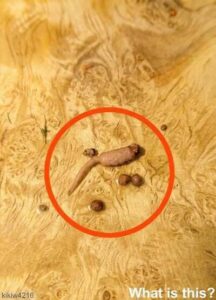
When people encounter a small pink organism with a soft, segmented body and a long, tail-like appendage dragging behind it, the reaction is often immediate confusion — and sometimes outright panic. Its appearance seems almost unnatural at first glance. The creature does not resemble common household insects, worms, or pests most people recognize easily. Social media posts featuring photographs of these odd larvae frequently spark speculation ranging from parasites to alien organisms.
But despite its unsettling appearance, the mysterious “pink tail creature” is usually something far less alarming and far more fascinating.
In many cases, the organism is identified as a rat-tailed maggot, the larval stage of a harmless hoverfly, most commonly the species known scientifically as Eristalis tenax.
Although its nickname sounds unpleasant, the creature itself is entirely harmless to humans and animals. In fact, it plays an important role in ecosystems, decomposition, and even pollination later in its life cycle.
Its unusual appearance reflects one of nature’s most remarkable adaptations rather than anything dangerous.
At first glance, the rat-tailed maggot barely resembles what people expect from an insect larva. Its body is typically pale pink, beige, or slightly translucent, with a soft cylindrical shape that appears almost gelatinous under certain lighting. Some specimens may look cream-colored or gray depending on their environment and stage of development.
But the feature that draws immediate attention is the long, thin extension protruding from one end of the body.
Most people naturally assume this structure is a tail.
In reality, it is something much more specialized.
The appendage is actually a respiratory siphon — essentially a biological snorkel that allows the larva to breathe while submerged underwater. This remarkable adaptation enables the rat-tailed maggot to survive in oxygen-poor environments where many other organisms would struggle to live.
The siphon can extend significantly longer than the body itself and functions by reaching the water’s surface while the larva remains safely submerged beneath mud, sludge, or decaying organic material.
The creature’s actual head is located at the opposite end of the body and contains feeding structures designed to filter microorganisms and decomposing matter from its environment. Small dark pellets often found near these larvae are typically waste material or debris from the places where they developed, not eggs or parasites as some people fear.
Understanding where rat-tailed maggots come from helps explain why they occasionally appear indoors.
These larvae thrive in moist environments rich in organic material and stagnant water. Common habitats include clogged drains, compost piles, neglected gutters, standing water containers, manure-rich environments, ponds, wastewater areas, and decomposing vegetation.
Unlike many household pests, rat-tailed maggots are not attempting to infest homes intentionally.
Their appearance indoors is usually accidental.
Sometimes they are washed through plumbing systems. Other times they crawl away from their wet habitat while searching for a dry location to complete the next stage of their development. Because they cannot survive long in dry indoor conditions, finding one crawling across a floor, countertop, or wall often means it has already left the environment where it normally lives.
Most will not survive indoors for extended periods.
Although the larval stage appears strange, the adult form of this organism looks entirely different.
Rat-tailed maggots eventually transform into hoverflies through a process called complete metamorphosis. Like butterflies and many other insects, hoverflies pass through four distinct life stages:
Egg.
Larva.
Pupa.
Adult fly.
After spending time feeding and growing within stagnant water or decomposing material, the larva leaves its aquatic environment and searches for a dry place where it can pupate. During this stage, the body hardens into a protective casing while dramatic internal changes occur.
Eventually, an adult hoverfly emerges.
The transformation is so extreme that most people would never guess the adult fly and the larva belong to the same species.
Adult hoverflies often resemble bees or wasps due to their yellow-and-black striped bodies, but unlike stinging insects, hoverflies are harmless. They cannot sting or bite humans. Their resemblance to bees serves as a protective adaptation that discourages predators.
Many hoverflies spend their adult lives visiting flowers and feeding on nectar and pollen.
This makes them valuable pollinators.
In fact, hoverflies play a surprisingly important ecological role that most people never notice. While the larval stage helps break down decaying organic matter and recycle nutrients, the adult flies assist in pollination across gardens, farms, and natural ecosystems.
Some hoverfly species are considered highly beneficial in agriculture because they pollinate crops while also helping control pest populations during certain life stages.
The rat-tailed maggot specifically contributes to decomposition processes by feeding on microorganisms and organic waste found in stagnant water environments. In ecosystems, decomposition is essential because it recycles nutrients back into soil and water systems where plants and other organisms can reuse them.
Without decomposers, organic waste would accumulate rapidly.
Creatures that appear unpleasant at first glance often perform some of nature’s most important cleanup work behind the scenes.
Interestingly, the presence of rat-tailed maggots can sometimes reveal environmental conditions nearby. Because they prefer oxygen-poor aquatic habitats rich in decaying material, finding them may indicate standing water, clogged drainage systems, or areas where organic buildup has accumulated unnoticed.
This does not necessarily mean a home is dirty or unsafe.
It simply means conditions somewhere nearby temporarily supported their development.
Despite their unusual appearance, rat-tailed maggots are not dangerous.
They do not bite.
They do not sting.
They do not infest human tissue.
They do not attack pets.
They do not damage furniture, walls, or household materials.
And contrary to some exaggerated online claims, they are not parasitic worms or invasive organisms capable of spreading through homes aggressively.
Fear surrounding these larvae often results from unfamiliarity rather than actual risk.
Human beings naturally react strongly to organisms that appear visually unusual or difficult to identify. Evolutionary psychology suggests people tend to distrust unfamiliar creatures instinctively, especially those associated with decay, water, or insect life cycles.
Social media amplifies these reactions dramatically.
Photographs of strange organisms spread rapidly online, often accompanied by alarming speculation before accurate identifications appear. People unfamiliar with insect biology may mistake rat-tailed maggots for parasites, mutant worms, or dangerous larvae simply because the breathing siphon looks so unusual.
Without proper explanation, imagination quickly fills gaps in understanding.
In reality, encounters with rat-tailed maggots are relatively common in areas where moisture and organic material accumulate. Most people simply never notice them because the larvae remain hidden within drains, compost systems, ponds, or stagnant water environments throughout most of their development.
Occasionally, however, one leaves its aquatic habitat and becomes unexpectedly visible indoors.
When that happens, the situation rarely requires alarm.
If someone discovers a rat-tailed maggot inside the home, the response can remain simple and calm. The larva can be removed using tissue paper, gloves, or another disposable item and placed outdoors or discarded safely.
Afterward, it is reasonable to inspect nearby areas for standing water or clogged drainage systems that might support additional larvae.
Preventative maintenance can help reduce future encounters.
Cleaning drains regularly removes organic buildup where larvae sometimes develop. Emptying containers holding stagnant water limits breeding environments outdoors. Maintaining gutters and ensuring proper drainage around homes also reduces moist habitats attractive to hoverflies seeking places to lay eggs.
However, aggressive pest control measures are usually unnecessary.
Rat-tailed maggots do not establish infestations inside dry indoor environments the way cockroaches, termites, or certain other pests can. Most indoor appearances involve isolated individuals rather than large hidden populations.
One of the most fascinating aspects of encounters like this is how they reveal hidden biodiversity existing quietly around us every day.
Modern life often creates the illusion that humans live separately from natural ecosystems, especially indoors. Yet countless organisms continue carrying out essential ecological functions beneath our awareness in gardens, waterways, soil systems, compost piles, and drainage networks surrounding human environments.
The rat-tailed maggot serves as a reminder that nature remains active even in overlooked spaces.
Its strange appearance reflects millions of years of evolutionary adaptation rather than anything unnatural. The respiratory siphon, for example, represents an extraordinary biological solution to surviving in low-oxygen aquatic habitats. Few organisms possess such specialized breathing mechanisms.
And despite how unsettling the larva may initially appear, the adult hoverfly emerging later from that same creature often becomes something people admire casually while watching flowers in gardens during summer afternoons.
The contrast between larval and adult stages highlights one of the most remarkable realities in biology:
Transformation can make organisms nearly unrecognizable from one phase of life to another.
For scientists and nature enthusiasts, rat-tailed maggots offer valuable insight into insect adaptation, wetland ecology, decomposition systems, and pollinator life cycles. Their ability to survive in polluted or oxygen-poor environments has even made them subjects of environmental studies examining water quality and ecosystem resilience.
To most homeowners, however, the experience remains much simpler.
A strange pink creature appears unexpectedly.
Concern follows.
Then curiosity.
And finally, relief after learning the organism is harmless.
Perhaps that progression reveals something important about how people interact with the natural world generally. Fear often emerges first when something unfamiliar enters human spaces. But understanding frequently transforms fear into fascination once context replaces uncertainty.
The rat-tailed maggot may never become a beloved household visitor, but it deserves far less alarm than its appearance inspires.
Rather than representing danger, it reflects the hidden complexity of ecosystems quietly functioning around us all the time.
Its existence helps recycle waste, support pollination, and sustain environmental balance in ways most people never witness directly.
And while discovering one indoors may feel startling initially, the reality is far less dramatic than social media speculation often suggests.
The mysterious pink “tail creature” crawling across a floor or countertop is not a parasite, monster, or dangerous invader.
It is simply a rat-tailed maggot — an unusual but harmless stage in the life of a hoverfly carrying out the ancient biological processes of feeding, transforming, and eventually emerging into one of nature’s quiet pollinators.
Sometimes the strangest discoveries turn out to be reminders not of danger, but of how much hidden life continues thriving unnoticed all around us.