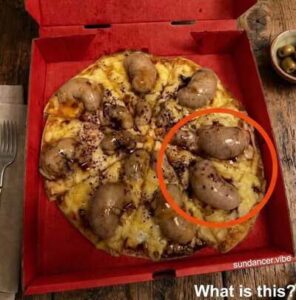
Pizza is one of the few foods that feels universally familiar. Whether ordered from a neighborhood restaurant, baked at home, or shared during gatherings with friends and family, it carries a sense of comfort and predictability that most people rarely question. You open the box, smell the warm combination of baked dough, melted cheese, and savory toppings, then immediately reach for a slice without hesitation.
Most of the time, pizza looks exactly the way we expect it to.
Golden crust. Melted cheese. Crisp edges. Familiar textures.
That consistency is part of what makes it so satisfying.
But occasionally, something appears slightly different—different enough to interrupt that automatic sense of comfort. One of the most common examples is the appearance of strange-looking bubbles or blisters rising across the surface of the pizza.
For many people, especially when the bubbles are large or unusually rounded, the reaction is immediate uncertainty.
Is it undercooked?
Overcooked?
Burned?
Was there something wrong with the cheese or dough?
At first glance, these raised patches can seem unusual enough to trigger hesitation. Food is deeply tied to visual expectations, and even small changes in appearance can make familiar meals suddenly feel unfamiliar.
Yet despite how strange these bubbles may look, they are usually not signs of a problem at all.
In fact, they are often evidence that several natural cooking processes worked exactly as they were supposed to.
The science behind pizza bubbles is surprisingly fascinating because it combines chemistry, heat, fermentation, moisture, and structure in a way most people never think about while eating.
It all begins with the dough.
Pizza dough is alive long before it ever reaches the oven. During preparation, yeast feeds on sugars within the dough and produces carbon dioxide gas as a byproduct. Those gases become trapped inside the dough’s elastic gluten network, creating countless tiny air pockets throughout the structure.
This process is called fermentation.
The longer and more effectively the dough ferments, the more developed those pockets become. Good fermentation improves flavor, texture, and elasticity while also setting the stage for what happens later in the oven.
Even after the dough is stretched into shape, many of those microscopic pockets remain trapped beneath the surface.
At room temperature, they stay relatively stable.
But the moment the pizza enters a hot oven, everything changes rapidly.
Heat transforms the dough almost instantly. The gases trapped inside begin expanding as temperatures rise. At the same time, moisture within the dough converts into steam. This combination of expanding air and evaporating water creates internal pressure throughout the crust.
In most areas, that pressure disperses evenly.
But in some spots, pockets of gas and steam become temporarily trapped beneath layers of cheese or within certain sections of dough. As pressure builds, the surface lifts upward, forming rounded bubbles or blisters.
What looks unusual from the outside is actually a visible demonstration of physics happening in real time.
The bubbles are essentially steam-and-air pockets expanding under intense heat.
Cheese also plays an important role in this process.
When cheese melts, it forms a soft, stretchy layer across the pizza’s surface. Depending on the type of cheese used, that melted layer may trap pockets of steam underneath it. Moisture released from both the cheese and toppings contributes further to pressure buildup.
Certain cheeses are especially prone to bubbling because of their moisture content and elasticity. Fresh mozzarella, for example, often creates dramatic bubbling effects due to the way it melts and releases steam.
The oven itself matters too.
Traditional pizza ovens, particularly wood-fired or high-temperature stone ovens, can reach temperatures far hotter than standard home ovens. These intense temperatures cause gases inside the dough to expand more aggressively and moisture to vaporize more rapidly.
The result is faster puffing, crispier crusts, and more noticeable bubbles.
In many professional pizza kitchens, those bubbles are not considered flaws at all. Some chefs actually welcome them because they can indicate proper fermentation and strong oven performance.
Large blisters, charred air pockets, and uneven bubbling are especially common in artisan-style pizzas where natural dough development is prioritized over perfect visual uniformity.
Ironically, the very features that sometimes make customers nervous are often signs of authentic pizza-making techniques.
The appearance of bubbles can also vary depending on how the pizza is assembled.
If toppings are distributed unevenly, some areas of dough receive more direct heat exposure than others. Thinly topped sections may blister more easily, while heavier topping areas remain flatter because additional weight suppresses expansion.
Even small details influence the outcome.
How long the dough rested.
How much moisture remained in the sauce.
The thickness of the crust.
The hydration level of the dough.
The temperature of the oven stone.
The amount of oil used.
Every factor contributes to the final texture and appearance.
That complexity is part of what makes pizza so interesting despite its simplicity.
No two pizzas are ever truly identical.
Even when made from the same recipe, small differences in temperature, humidity, fermentation, or baking time can produce noticeable variations. One pizza may emerge perfectly smooth, while another develops dramatic bubbles across the surface.
These differences are not necessarily mistakes.
They are part of the natural unpredictability of cooking with heat, yeast, and moisture.
There is also an important psychological aspect to how people react to unusual-looking food.
Human beings rely heavily on visual familiarity when judging what feels safe or appetizing. We develop mental expectations for how certain foods should look, smell, and behave. When something deviates from those expectations—even slightly—it can trigger doubt.
That instinct exists for good reason. Throughout history, visual cues helped humans identify spoiled or unsafe food.
But in modern cooking, harmless variations can sometimes activate the same uncertainty.
A pizza bubble becomes suspicious not because it is dangerous, but because it interrupts visual predictability.
Once people understand the science behind it, however, perception often changes immediately.
What initially appeared strange becomes interesting.
What looked like a flaw becomes evidence of the cooking process itself.
This shift in understanding highlights something larger about food and perception.
Many of the textures, colors, and appearances we enjoy most are actually the result of controlled chemical reactions and physical transformations. Bread rises because gas expands inside gluten structures. Steak browns because proteins and sugars react under heat. Pastries become flaky because layers of butter release steam between dough sheets.
Cooking is full of invisible science becoming visible.
Pizza bubbles are simply one of the easier examples to observe directly.
They reveal the interaction between fermentation, heat, steam, elasticity, and moisture in a way most foods conceal more subtly.
And despite how dramatic they sometimes appear, they rarely affect flavor negatively at all.
In some cases, they may even improve texture.
Areas where bubbles form can create light, airy pockets beneath the cheese, adding contrast between crispy surfaces and softer interiors. Some bubbles char slightly, producing deeper roasted flavors that many pizza enthusiasts actively seek out.
That variation contributes to the personality of the pizza itself.
Perfect uniformity is not always the goal in cooking.
Sometimes the most memorable foods are the ones with slight irregularities—the uneven crust, the unexpected crisp edge, the blistered surface, the variation that reminds us something was handmade rather than mechanically produced.
This idea extends far beyond pizza.
Many foods celebrated for quality contain imperfections that indicate authenticity. Artisan bread often develops uneven air holes. Handcrafted pottery contains slight asymmetry. Natural wood furniture displays irregular grain patterns.
Perfection, in many cases, is less interesting than character.
The bubbles on pizza reflect that same principle.
They are not defects but visible reminders that heat and ingredients interacted dynamically rather than mechanically.
For people who make pizza professionally, understanding these reactions becomes an art form. Bakers learn to manipulate dough hydration, fermentation time, oven temperature, and ingredient balance to produce specific textures and appearances intentionally.
Some styles aim for smooth consistency.
Others intentionally encourage blistering and bubbling because it creates desirable texture.
This explains why pizzas from traditional Neapolitan-style restaurants often look dramatically different from mass-produced chain pizzas. Artisan methods allow more natural variation, while industrial methods prioritize consistency and predictability.
Neither approach is inherently wrong—they simply emphasize different goals.
Still, the next time strange bubbles appear on a pizza, it may help to see them differently.
Instead of wondering whether something went wrong, consider what those bubbles actually represent:
Air trapped during fermentation.
Steam expanding under heat.
Cheese melting and stretching.
Moisture evaporating.
Dough transforming.
Physics becoming visible through food.
What seems mysterious at first is actually a fascinating glimpse into how cooking works beneath the surface.
And perhaps that is part of what makes ordinary meals more interesting than we realize.
Even familiar comfort foods contain layers of science, craftsmanship, and unpredictability quietly shaping every bite. Most of the time, we simply do not stop long enough to notice them.
The bubbles on pizza remind us that even the simplest meals are alive with transformation.
Not flaws.
Not mistakes.