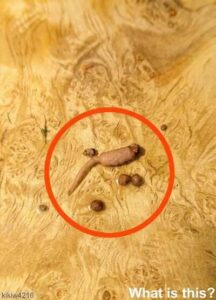
Discovering a strange creature inside your home can instantly trigger concern, especially when the organism looks unlike anything you have seen before. For many people, the sight of a pale pink, elongated larva with a thin tail-like extension crawling across a floor, sink, or wooden surface feels deeply unsettling. Its unusual appearance often sparks fears about parasites, dangerous insects, contamination, or hidden infestations.
Yet despite the alarming look, the explanation behind these mysterious creatures is usually far less threatening—and far more fascinating—than most people initially imagine.
In many cases, the strange organism turns out to be a rat-tailed maggot, the larval stage of a type of hoverfly most commonly associated with the species Eristalis tenax. Although the name “rat-tailed maggot” sounds unpleasant and its appearance can seem disturbing at first glance, the creature is actually harmless to humans and pets. More importantly, it plays a surprisingly important role in nature that most people never notice.
What often begins as panic or confusion can quickly become an opportunity to learn about one of nature’s more unusual survival adaptations.
At first glance, the rat-tailed maggot barely resembles what people typically imagine when they think of an insect larva. Its body is thick, cylindrical, and slightly translucent, often appearing pale pink, beige, or gray depending on its environment. The texture can seem soft or gelatinous, making it look almost artificial or worm-like to the untrained eye.
But the feature that truly captures attention is the long, thin appendage extending from one end of its body.
Most people naturally assume this extension is a tail.
In reality, it is something far more specialized.
The “tail” is actually a respiratory siphon—a breathing tube that functions almost like a snorkel. This remarkable adaptation allows the larva to breathe air while remaining submerged in water or sludge where oxygen levels are extremely low.
The siphon can extend significantly beyond the body itself, giving the creature its unusual appearance and its memorable nickname.
This adaptation exists because rat-tailed maggots thrive in environments that many other organisms struggle to survive in. They commonly develop in stagnant water, decaying organic matter, clogged drains, manure-rich areas, compost piles, or other moist habitats filled with decomposing material.
These environments often contain very little oxygen.
The siphon solves that problem perfectly.
While the larva remains submerged and feeding below the surface, the breathing tube reaches upward into the air, allowing it to survive in conditions that would suffocate many other aquatic organisms.
The darker end of the body contains the feeding structures and head region. The larva feeds by filtering microorganisms, bacteria, and organic debris from its environment, essentially helping break down decaying matter.
In many photographs or encounters, people also notice tiny brown pellets nearby and assume they might be eggs or parasites. In reality, these are usually waste particles or debris from the larva’s feeding environment.
Despite how alarming the creature may appear indoors, its presence is typically accidental.
Rat-tailed maggots are not household pests in the traditional sense.
They do not invade homes intentionally, build nests in furniture, or seek out humans or pets. Instead, they usually enter indoor environments because they were accidentally carried in through plumbing systems, drains, standing water sources, or moist organic material.
Common places where they develop include:
- Clogged drains
- Compost piles
- Rain barrels
- Blocked gutters
- Standing water containers
- Septic or wastewater areas
- Ponds with decaying vegetation
- Animal waste accumulation areas
Occasionally, a larva may crawl away from its moist environment while preparing for the next stage of its life cycle. Because they cannot survive long in dry indoor conditions, finding one crawling across a floor or countertop usually means it has already left its natural habitat and is nearing transformation.
That transformation is one of the most fascinating parts of the creature’s existence.
Like many flies, rat-tailed maggots undergo complete metamorphosis, progressing through four distinct life stages:
Egg.
Larva.
Pupa.
Adult fly.
The larval stage—the strange “pink creature” people discover—is only one temporary phase in a much larger biological process.
After spending time feeding and growing in water or sludge-rich environments, the larva eventually leaves the moisture behind and searches for a drier location where it can pupate safely.
During pupation, the organism transforms dramatically.
Inside a hardened casing, the larva reorganizes entirely into its adult form: a hoverfly.
The adult hoverfly looks nothing like the larva that preceded it.
In fact, most people would never guess the connection between the two stages.
Hoverflies, members of the family Syrphidae, are often mistaken for bees or wasps because many species display yellow-and-black striped patterns. However, unlike bees or wasps, hoverflies are harmless flies that cannot sting.
Many hoverflies are actually beneficial pollinators.
They visit flowers frequently, transferring pollen between plants while feeding on nectar. In gardens and agricultural settings, they help support plant reproduction and crop productivity.
This dramatic contrast between larval and adult forms highlights one of nature’s most extraordinary evolutionary strategies.
A creature that begins life feeding in oxygen-poor sludge eventually becomes an agile flying pollinator moving gracefully between flowers.
The ecological role of rat-tailed maggots is also far more important than many people realize.
Although their appearance may seem unpleasant, these larvae function as decomposers. By feeding on decaying organic material and microorganisms, they help break down waste and recycle nutrients back into ecosystems.
Without decomposers like these, organic waste would accumulate far more rapidly in natural environments.
In certain wastewater systems and nutrient-rich habitats, the presence of rat-tailed maggots can even serve as an environmental indicator, reflecting conditions where oxygen is limited but organic material is abundant.
Their ability to survive in such difficult environments demonstrates a highly specialized evolutionary adaptation that few organisms possess.
Despite all of this, many people still react strongly when encountering one indoors.
Part of that reaction stems from unfamiliarity.
Humans are naturally cautious around organisms that appear strange, especially when they do not match recognizable patterns. Creatures with unusual body shapes, movements, or textures often trigger instinctive discomfort because the brain struggles to categorize them quickly.
Social media amplifies this reaction dramatically.
Images of unfamiliar organisms frequently spread online accompanied by exaggerated claims, incorrect identifications, or frightening speculation. Harmless creatures are sometimes described as parasites, invasive threats, or dangerous mutations simply because they look unusual.
Without accurate context, fear spreads easily.
Rat-tailed maggots are often misidentified as:
- Parasitic worms
- Alien-like organisms
- Small snakes
- Dangerous larvae
- Mutated insects
- Sewage parasites
But their distinctive breathing siphon is one of the clearest identifying features separating them from truly harmful organisms.
Importantly, rat-tailed maggots do not pose meaningful health risks to people or pets.
They do not:
- Bite
- Sting
- Spread disease directly
- Infest human tissue
- Attack animals
- Damage furniture or structures
Their presence is more of an environmental clue than a danger.
Usually, it simply indicates that somewhere nearby there may be standing water, decaying organic material, or a moist environment supporting their development.
If someone encounters one inside the home, the response can remain calm and simple.
There is no need for panic.
The organism can be removed gently using tissue paper or a container and disposed of outdoors. Cleaning the area afterward with soap, water, or mild household cleaner is typically sufficient.
More importantly, homeowners may want to inspect potential moisture sources nearby.
Preventative measures include:
- Cleaning drains regularly
- Removing standing water
- Maintaining gutters
- Emptying unused containers outdoors
- Preventing buildup of decaying organic material
- Improving water drainage around the home
Because rat-tailed maggots cannot establish thriving infestations in dry indoor spaces, pesticides or aggressive extermination efforts are generally unnecessary.
In many ways, encounters with organisms like these serve as reminders of how much hidden biodiversity exists around us constantly.
Even ordinary homes and neighborhoods exist alongside incredibly complex ecosystems filled with organisms performing essential ecological functions invisible to most people.
Nature is not separate from daily human life.
It operates quietly all around us—in drains, gardens, ponds, compost piles, soil, and waterways.
Most of the time, these systems remain unnoticed until one unusual creature accidentally crosses into human space and briefly demands attention.
The rat-tailed maggot is a perfect example of this hidden complexity.
Its strange body shape, unusual breathing adaptation, and dramatic transformation into a hoverfly reflect millions of years of evolutionary specialization. What initially appears disturbing becomes, upon closer understanding, an example of nature’s incredible adaptability.
The creature’s life cycle also illustrates an important truth about appearances in nature.
Many organisms look frightening simply because humans are unfamiliar with them—not because they are actually dangerous.
Understanding often replaces fear with curiosity.
And curiosity can transform even unsettling encounters into opportunities for learning.
The adult hoverflies that emerge from these larvae provide additional ecological benefits beyond pollination as well. Some hoverfly species help control garden pests because their larvae feed on aphids and other plant-damaging insects. This makes hoverflies valuable contributors to both natural ecosystems and agriculture.
Ironically, one of nature’s more visually unsettling larvae eventually becomes an insect many gardeners actively appreciate.
This transformation also explains why the larval and adult stages seem almost impossible to connect mentally. The slimy, worm-like aquatic decomposer eventually becomes a fast-moving airborne pollinator that resembles a harmless bee.
Nature frequently hides extraordinary complexity beneath appearances.
For homeowners who encounter a rat-tailed maggot unexpectedly, the experience often shifts dramatically once the organism is correctly identified. What initially caused panic or disgust can quickly become fascinating once its biology and ecological role are understood.
That shift in perspective matters.
Fear often thrives in uncertainty.
Knowledge changes the emotional experience entirely.
Instead of imagining infestation, disease, or danger, people begin seeing the creature as part of a broader ecological system quietly functioning in the background of daily life.
And perhaps that is the most interesting aspect of encounters like these.
They remind us that the natural world is far more intricate, adaptable, and interconnected than most people realize.
Even a tiny larva crawling across a bathroom floor carries an evolutionary story involving decomposition, aquatic survival, transformation, pollination, and ecological balance.
What first appears alarming may actually be evidence of nature functioning exactly as intended.
In the end, the mysterious pink “tail” creature is not a parasite, monster, or hidden threat.
It is simply a rat-tailed maggot—a harmless stage in the life cycle of a hoverfly, equipped with one of nature’s more unusual breathing adaptations.
Its appearance may be strange.
Its name may sound unpleasant.
But its role in the environment is both beneficial and surprisingly important.
And with a little understanding, what once looked frightening can instead become something genuinely fascinating: a small glimpse into the hidden complexity of life quietly existing all around us every single day.