The drive home felt longer than usual, though the roads were nearly empty.
For twenty straight minutes, I replayed the same sentence over and over in my mind, hearing it with unbearable clarity each time.
“But he’s not married.”
The woman at the pottery studio had not sounded angry when she said it.
That was the problem.
If she had rolled her eyes, smirked, or delivered the line with obvious bitterness, I probably could have dismissed it as jealousy or drama. Instead, she had looked genuinely confused, almost concerned, as though I had made a factual mistake she felt obligated to correct.
That calm certainty followed me all the way home.
By the time I pulled into the driveway, my chest felt tight enough to crack.
I sat in the parked car for several moments staring blankly through the windshield while my baby shifted heavily against my ribs. At seven months pregnant, emotions already felt impossible to regulate. Everything was heightened. Anxiety hit harder. Fear spread faster. Thoughts spiraled more easily.
And now one stranger had managed to plant doubt inside a marriage I had trusted completely.
Inside the house, everything looked painfully normal.
The dishwasher hummed quietly in the kitchen. Tiny toys covered the living room carpet. A folded pile of laundry waited on the couch beside a half-finished coloring book from our toddler.
Ordinary life surrounded me.
Meanwhile, my mind felt like it was collapsing inward.
I dropped my purse onto the counter and began pacing immediately.
Maybe she was confused.
Maybe she had mistaken my husband for someone else.
Maybe it was an old story from years before we met.
Maybe there was some explanation so obvious that I would laugh at myself later for panicking this badly.
But another possibility kept crawling back no matter how hard I tried pushing it away.
What if she was telling the truth?
I picked up my phone at least five times intending to call my husband immediately.
Every time, I stopped myself.
I didn’t want to accuse him blindly over the phone.
I didn’t want my voice shaking while he sat somewhere calmly denying everything.
Most of all, I didn’t want to hear hesitation before I could see his face.
So I waited.
And waiting was torture.
The pottery class itself had started so normally.
It was supposed to be a harmless girls’ afternoon — soft music, iced coffee, ceramic mugs, and exhausted mothers trying to reclaim tiny pieces of themselves outside diapers, school pickups, and grocery lists.
At first, the conversation around the table drifted through the usual topics.
Pregnancy symptoms.
Terrible sleep schedules.
Toddler meltdowns.
Funny relationship stories.
Then someone jokingly asked if anybody had dramatic birth stories.
That was when the woman across from me started laughing.
“Oh, I’ve got one,” she said.
Everybody leaned in immediately.
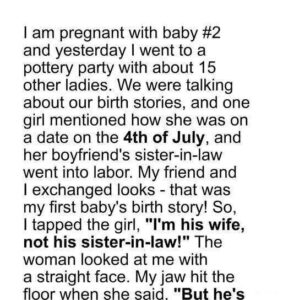
She explained that years earlier, she had briefly dated a man she really liked. They had plans to spend Fourth of July together, but during dinner his phone rang. Apparently his sister-in-law had gone into labor unexpectedly, and he rushed to the hospital before dessert even arrived.
Everyone laughed politely.
Including me.
Because the story sounded strangely familiar.
Too familiar.
Smiling, I casually interrupted.
“Oh my God,” I said. “That was probably my husband. My son was born on Fourth of July.”
The woman looked at me instantly.
At first, she seemed confused.
Then concerned.
Then genuinely puzzled.
“But he’s not married,” she said slowly.
The entire table went silent.
I still remembered the exact feeling in my stomach when she said it.
Like missing a step in the dark.
I laughed awkwardly at first because my brain rejected the possibility immediately.
“No, definitely married,” I said, holding up my hand automatically. “Ten years.”
But she kept staring at me.
Not aggressively.
Not emotionally.
Just confused.
“What’s his name?” she asked carefully.
The moment I answered, color drained from her face.
And suddenly I couldn’t breathe properly anymore.
Now, standing in my kitchen hours later, I kept replaying that expression repeatedly.
Recognition.
Absolute recognition.
When the front door finally opened that evening, my heart slammed painfully against my ribs.
My husband stepped inside carrying grocery bags and talking before he fully entered the room.
“You would not believe traffic today—”
Then he saw my face.
Everything about him changed immediately.
The bags lowered slowly onto the floor.
His expression tightened.
“What happened?”
I had imagined this confrontation a hundred different ways during the afternoon.
In every version, I stayed calm.
Composed.
Measured.
Instead, fear took over the moment I looked at him.
“Who is she?” I blurted out.
His forehead creased instantly.
“What?”
“The woman from the pottery studio.”
Confusion flickered across his face.
“I don’t know what you mean.”
My voice shook despite my effort to steady it.
“She told a story about dating a guy who left dinner because his sister-in-law went into labor on Fourth of July.”
Recognition hit him instantly.
That tiny flicker was enough to make my stomach drop.
“You know her,” I whispered.
He exhaled slowly and rubbed one hand over his face.
“Before we do this,” he said carefully, “tell me exactly what happened.”
So I did.
Every word.
Every detail.
The pottery studio.
The conversation.
The birth story.
The silence.
The moment she calmly informed me my husband wasn’t married.
By the time I finished, he was sitting heavily at the kitchen table with both hands clasped together tightly.
He looked exhausted already.
Not angry.
Not defensive.
Just deeply tired.
Finally, after several painful seconds, he spoke quietly.
“I dated her.”
The admission landed hard even though I had already expected it.
“How long?”
“A few weeks.”
I folded my arms tightly across my chest.
“A few weeks is still dating.”
“I know.”
“Did you sleep with her?”
“Yes.”
The honesty hurt, but strangely it also steadied me.
At least he wasn’t trying to dodge the truth.
“When was this exactly?”
“Before you and I started dating seriously.”
I stared at him carefully.
“Seriously?”
“We were friends first,” he reminded me gently. “Remember?”
I did remember.
Painfully well.
Our relationship had grown slowly at first.
Years earlier, we had circled each other awkwardly through mutual friends before anything romantic officially happened.
Still, fear continued clawing through me.
“That doesn’t explain why she thought you weren’t married.”
“You’re right,” he admitted immediately.
No argument.
No excuses.
Just agreement.
That softened something inside me despite myself.
“Then explain it,” I whispered.
He leaned back slowly in the chair and sighed.
“We went out a handful of times. Nothing serious for me, honestly. Then your brother called me that night because your water broke and nobody could find his keys.”
I blinked in confusion.
“My water?”
He nodded.
“You barely remember anything from that night.”
That was true.
My son’s birth existed in my memory like flashes through fog — hospital lights, contractions, panic, nurses, exhaustion, fear.
“I was with her when the call came,” he continued carefully. “I left immediately.”
I stared at him.
“And then?”
“And then our son was born. You and I got closer. Everything changed really fast after that.”
I swallowed hard.
“And her?”
His silence answered before his words did.
“I never really ended it properly.”
The room fell silent.
Not because of betrayal.
Because of disappointment.
“You just disappeared?”
He winced immediately.
“When you say it like that—”
“Because that’s what happened.”
He nodded slowly.
“You’re right.”
Again, no defensiveness.
No attempts to rewrite history.
Just uncomfortable truth.
“At the time,” he said carefully, “it genuinely felt casual enough that I didn’t think there needed to be some huge conversation. We’d only gone out a few times.”
“But maybe it wasn’t casual to her.”
“I know that now.”
I sat down across from him heavily, exhaustion finally beginning to overpower panic.
The terrifying stories my brain had built all afternoon started unraveling slowly.
There was no secret family.
No double life.
No years-long affair.
No hidden children.
Just messy human behavior.
Poor communication.
Emotional assumptions.
Still, the hurt remained real.
“You have any idea what today felt like?” I asked quietly.
His expression collapsed instantly.
“I can imagine.”
“No,” I whispered. “I don’t think you can.”
Tears finally burned behind my eyes.
“One minute I’m painting mugs and talking about baby names. The next minute some stranger calmly tells me my husband isn’t married.”
“I’m sorry.”
“I thought my entire life was about to fall apart.”
That was the moment everything inside me cracked.
Not elegant crying.
Not graceful tears.
Real crying.
Pregnant, overwhelmed, emotionally exhausted crying.
The kind that leaves your whole body shaking because fear has nowhere else to go anymore.
My husband moved beside me immediately.
“I’m so sorry,” he whispered again.
And somehow, despite everything, I believed him.
Because this did not feel like betrayal.
It felt like immaturity.
Like carelessness.
Like someone younger failing to understand how unfinished endings can linger painfully inside other people long after they move on.
That distinction mattered more than I expected.
For a long time, we sat quietly together while the emotional storm slowly settled around us.
Eventually, the absurdity of the situation finally surfaced.
I laughed first.
A weak, shaky laugh through tears.
My husband looked confused for a second before he started laughing too.
“I almost died at a pottery studio,” I muttered.
“You think I planned this?”
“She remembered your favorite shirt.”
He groaned immediately.
“Not the gray shirt.”
“Yes, the gray shirt.”
“That was a great shirt.”
I laughed harder despite myself.
And just like that, some of the tension finally broke.
Not completely.
Not magically.
But enough to breathe again.
Later that night, lying awake beside him, I kept thinking about how fragile certainty really is.
One sentence.
That was all it took.
One unexpected sentence from a stranger and suddenly every memory inside my marriage had felt vulnerable.
That terrified me.
But another realization stayed with me too.
This was not really a story about cheating.
It was a story about unfinished conversations.
About assumptions.
About how people can experience the exact same relationship completely differently.
To my husband, she had been someone he dated briefly before life shifted dramatically.
To her, maybe he had represented possibility.
Hope.
Maybe even heartbreak.
Neither perspective was entirely wrong.
Just painfully mismatched.
The next morning, sunlight spilled softly across the kitchen while I made coffee feeling emotionally wrung out but strangely peaceful.
My husband wrapped his arms carefully around me from behind.
“You okay?” he asked quietly.
I leaned against him for a moment before answering.
“Yeah,” I admitted. “Just embarrassed.”
“You didn’t do anything embarrassing.”
“I accused you of secretly maintaining another life because of pottery paint.”
He laughed softly into my shoulder.
“To be fair, it does sound dramatic.”
“Pregnancy hormones deserve partial blame.”
“Fair.”
I turned toward him then.
“One thing, though.”
“What?”
“You absolutely owe people closure when relationships end.”
His expression turned sheepish immediately.
“Yes, ma’am.”
“I’m serious.”
“I know.”
And I think he truly did know after that.
Because sometimes life teaches lessons in strange ways.
Not through catastrophic betrayal.
Not through screaming matches or dramatic exits.
But through uncomfortable misunderstandings that force people to examine the emotional messes they accidentally leave behind.
Weeks later, my finished pottery mug finally came home from the kiln.
Across the side, in slightly uneven blue letters, were the words:
CHAOS COORDINATOR
Originally, the phrase had seemed funny because motherhood itself felt chaotic.
Now the mug meant something entirely different.
Every time I see it sitting in our kitchen cabinet, I remember the terrifying afternoon one sentence nearly shattered my sense of reality before truth slowly stitched everything back together.
And strangely enough, I’m grateful for that now.
Not because the experience was enjoyable.
It absolutely wasn’t.
But because it reminded me what trust actually looks like.
Trust is not pretending fear never appears.
It is not perfection.
It is not spotless histories or flawless decisions.
Real trust is what happens after panic arrives.
After uncomfortable truths surface.
After mistakes become impossible to avoid.
It is two people sitting across from each other anyway and choosing honesty before defensiveness.
Choosing accountability before pride.
Choosing difficult conversations before silence.
That pottery party could have destroyed my marriage if lies had followed fear.
Instead, honesty arrived first.
And honesty changed everything.
Years from now, when our children are older and someone asks about the strangest misunderstanding our family ever survived, I already know exactly which story we’ll tell.
The one involving pottery paint.
Pregnancy hormones.
A forgotten Fourth of July.
One unforgettable gray shirt.
And a sentence so shocking it nearly stopped my heart completely:
“But he’s not married.”