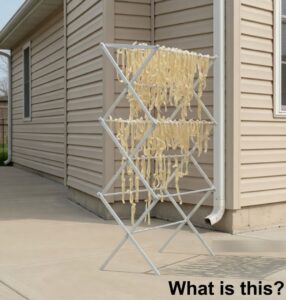
The first time I noticed them, I almost kept walking.
It was early evening in Mesa, Arizona, during that strange hour when the brutal desert heat finally begins loosening its grip on the neighborhood. The sidewalks still radiated warmth from the day, but the sky had softened into streaks of orange and pink above rows of nearly identical stucco homes.
My wife, Claire, had stayed home with a migraine, so I went on my usual evening walk alone.
At the corner of our subdivision stood a pale yellow house with faded blue shutters and a side patio partially visible through a wooden gate. I had passed that house hundreds of times over the years without paying much attention to it.
But that night, something hanging against the patio wall stopped me cold.
Long pale strands.
Rows of them.
Dangling motionless in the fading sunlight.
I slowed instinctively.
At first glance, they looked strangely organic — uneven in shape, slightly twisted, pale and lifeless against the stucco wall. There were dozens hanging side by side from metal rods, swaying faintly in the breeze.
Something about the image unsettled me immediately.
I stood there staring much longer than any reasonable person should while sprinklers clicked rhythmically nearby and palm trees rustled softly overhead.
Then I continued walking home trying to ignore the strange discomfort crawling under my skin.
Later that night, while Claire reheated leftovers in the microwave, I casually mentioned what I had seen.
“There are these weird things hanging next door to Teresa’s patio,” I said. “Like… long white strips or something.”
Claire barely looked up.
“Maybe she’s drying squid.”
I laughed.
At least outwardly.
But privately, the image stayed with me.
There had been something eerie about how still they looked.
The next morning, while driving to work, I slowed slightly as I passed the same house.
They were still there.
Same position.
Same pale dangling rows.
The wind shifted them gently against the wall.
Somehow, that made it worse.
Ordinary objects usually move. People rearrange them, bring them inside, replace them, or use them for whatever purpose they serve.
But these things simply remained there continuously.
By Friday, I realized I had started checking automatically every time I passed the street.
At first, I convinced myself it was harmless curiosity.
It wasn’t.
It was the beginning of a genuinely ridiculous obsession.
The following week, things escalated embarrassingly fast.
I changed my walking route intentionally so I could pass the house at different times of day.
Early morning.
Late afternoon.
After sunset.
Every single time, the hanging strands remained exactly where they were.
My imagination started filling in explanations faster than logic could stop them.
Animal hides.
Decorations.
Some kind of preserved bait.
Something biological I didn’t understand.
One afternoon, I actually slowed my car nearly to a stop trying to peer through the side gate into the backyard before realizing how insane I looked.
I remember gripping the steering wheel afterward and thinking:
You are a forty-six-year-old man spying on patio decorations.
What exactly has happened to you?
But even then, I couldn’t stop thinking about them.
The homeowner was an older woman named Teresa.
We had exchanged polite waves over the years, but we’d never spoken beyond quick greetings. She mostly kept to herself, tending flowers in the front yard or quietly carrying groceries inside.
And somehow, because I didn’t know her, my imagination turned her into a mystery instead of a person.
Claire found the entire thing hilarious.
“How are the terrifying patio worms today?” she asked one evening while setting the dinner table.
“They still plotting against civilization?”
I rolled my eyes dramatically.
But secretly, I had started avoiding looking directly at the patio after dark.
One especially windy evening, the hanging strands twisted sharply while shadows stretched across the wall, and I actually crossed the street because the sight made my chest tighten irrationally.
That was the moment I realized the situation had become absurd.
But still, I couldn’t let it go.
Fear rarely begins logically.
Sometimes it starts with not understanding something simple and allowing imagination enough silence to become louder than reality.
Soon, I started noticing details that made the mystery feel even worse.
A faint smell drifting through the neighborhood that I convinced myself was decay, though it was probably garlic from someone’s dinner.
The fact that Teresa wore gloves while handling the strands.
The way neighborhood dogs occasionally paused near the fence.
Every completely ordinary detail became supporting evidence for a bizarre private horror story existing entirely inside my own head.
By week three, I had reached peak stupidity.
It happened on a Saturday afternoon while helping my neighbor Leonard move patio furniture into his garage before a dust storm rolled through.
Leonard had lived in the neighborhood forever and somehow knew everybody’s business without appearing to try.
After we finished, we stood in his driveway drinking bottled water while hot wind pushed dry leaves across the pavement.
Of course, my eyes drifted automatically toward Teresa’s patio again.
The hanging strands swayed gently in the heat exactly as always.
Before I could stop myself, I asked casually:
“Hey… have you ever wondered what those things are?”
Leonard followed my gaze for maybe half a second.
Then he burst into violent laughter.
Not polite laughter.
Full-body, nearly-dropping-his-water-bottle laughter.
I stared at him while his face turned bright red.
“Oh my God,” he wheezed between breaths. “You thought those were something weird?”
Heat rushed instantly into my neck.
“Well… what are they?”
That only made him laugh harder.
“Pasta,” he gasped eventually. “Homemade noodles.”
I blinked at him.
“What?”
“Teresa makes pasta from scratch,” he explained while wiping tears from his eyes. “She dries it outside because her grandmother taught her that way.”
I stared back toward the patio.
And suddenly everything transformed.
Not worms.
Not preserved hides.
Not some horrifying mystery.
Just homemade noodles drying naturally in the Arizona heat.
Leonard could barely breathe from laughing.
“You seriously spent weeks thinking Teresa had mutant creatures hanging beside her patio?”
“I never said mutant.”
“But you definitely thought something.”
I refused to answer.
Internally, however, I replayed every ridiculous theory I had privately invented over the previous month.
The entire time, an elderly woman had simply been making homemade pasta while I quietly transformed her cooking routine into a suburban horror movie.
That should have been the end of it.
Unfortunately, it somehow became even more embarrassing afterward.
The next morning, Teresa herself caught me staring.
I was walking past the house pretending very badly not to glance toward the patio when she stepped outside carrying a large metal mixing bowl dusted with flour.
“You want to know what they are?” she called kindly before I could escape.
I froze immediately like a teenager caught doing something stupid.
“Uh… noodles?”
She smiled warmly.
“Good. Last year somebody thought I was drying squid.”
I laughed so hard I nearly doubled over from equal parts relief and humiliation.
After that conversation, something unexpected happened.
Instead of avoiding Teresa out of embarrassment, I started stopping to talk with her regularly during my evening walks.
The strange mystery that had once genuinely unsettled me became oddly comforting.
She explained that her family originally came from northern Italy and that making homemade pasta had been a tradition passed down for generations.
Every few weeks, she spent entire afternoons mixing flour and eggs by hand before rolling long ribbons of dough and hanging them outside to dry naturally in the desert air.
“Arizona heat is perfect for it,” she told me proudly one evening while adjusting the strands. “Dries them beautifully.”
Standing closer now, the noodles looked almost elegant.
Thin pale ribbons curled softly in the warm air while faint smells of flour, basil, and garlic drifted from the kitchen window nearby.
I could hardly believe these were the same objects that had fueled weeks of irrational paranoia.
Claire found the whole thing hysterical.
Unfortunately, she told everyone.
Friends.
Coworkers.
Her sister.
At one point, even the cashier at our grocery store somehow learned her husband had spent nearly a month emotionally distressed by fettuccine.
“To be fair,” I argued repeatedly, “they looked weird from far away.”
Nobody defended me.
Leonard started greeting me by asking:
“Seen any suspicious linguine lately?”
Even Teresa joined the joke eventually.
One afternoon, she handed me a paper bag full of fresh noodles and said completely seriously:
“Careful transporting these. They become aggressive after sunset.”
I laughed so hard I nearly dropped the bag.
But underneath the embarrassment, the entire experience forced me to recognize something uncomfortable about myself.
For weeks, I had projected fear onto something harmless simply because it looked unfamiliar.
Instead of asking one simple question, I invented elaborate explanations shaped entirely by imagination and anxiety.
And honestly, people do that constantly.
Not just with strange objects.
With each other too.
We notice something unfamiliar.
Something we don’t fully understand.
And instead of moving closer with curiosity, we build stories from a distance.
Stories are easier than conversations.
Fear is easier than vulnerability.
Assumptions feel safer than asking questions.
Eventually, reality catches up — usually with at least some embarrassment attached.
A few weeks later, Teresa invited Claire and me over for dinner.
By then, the “mystery noodles” had become neighborhood legend, so I expected teasing all evening.
What I didn’t expect was how warm her home would feel.
The moment we stepped inside, the smell of garlic, tomatoes, basil, and fresh bread wrapped around us completely. Family photographs lined the walls. A small radio played softly near the kitchen sink.
And the same patio that had once terrified me now held trays of herbs and rows of drying pasta glowing softly in the sunset.
Teresa moved through the kitchen with the calm confidence of someone who had repeated the same loving ritual for decades.
During dinner, she told us stories about learning to cook beside her grandmother as a little girl. About immigrating to Arizona. About losing her husband years earlier and continuing the pasta tradition because it made the house feel less empty afterward.
Then, while spooning noodles into bowls, she said something that stayed with me long after the evening ended.
“People think loneliness is loud,” she said softly. “But usually it’s very quiet. Cooking helps.”
That sentence changed the way I saw those hanging noodles forever.
Suddenly they no longer looked strange.
They looked human.
They looked like memory.
Like grief transformed into routine.
Like tradition surviving quietly through repetition and care.
And I realized how easily I had turned another person’s comfort into something frightening simply because I didn’t understand it.
On the walk home later that night, Claire slipped her hand into mine.
“So,” she asked casually, “how were the terrifying patio worms?”
I groaned immediately.
“You’re never letting this go, are you?”
“Absolutely not.”
Honestly, I didn’t want her to.
The story had become too funny — and too meaningful — not to keep alive.
Now every time I walk past Teresa’s house, I still glance automatically toward the patio.
The noodles sway gently in the desert breeze exactly as they did the first evening I noticed them weeks ago.
But instead of dread tightening my chest, I feel something closer to affection.
Sometimes Teresa waves from the doorway with flour still dusting her hands.
Sometimes she sends us home with fresh pasta wrapped carefully in paper bags.
And every now and then, when the sunset hits those hanging noodles just right, I remember how completely convinced I once was that something deeply sinister waited behind that patio wall.
I laugh every single time.
Because for nearly a month, I accidentally transformed homemade pasta into a full suburban horror story fueled entirely by imagination and absolutely no common sense whatsoever.
And honestly, there’s probably a lesson hidden somewhere inside all of that about fear, assumptions, and how quickly unfamiliar things become frightening when viewed from too far away.
Or maybe the lesson is simpler.
Maybe sometimes the terrifying mystery destroying your peace of mind is just an elderly woman quietly making noodles exactly the way her grandmother taught her decades earlier