Uncategorized · April 19, 2026 · Comments off
In 1981, the world believed it was witnessing the beginning of a fairytale.
A young woman—Princess Diana—stepped into a life defined by tradition, visibility, and expectation. At just nineteen, she became the center of global attention almost overnight. Her image was carefully observed, her expressions endlessly analyzed, her story shaped by headlines long before she had the chance to define it for herself.
Her engagement to Prince Charles captivated millions. To the public, it appeared to be a perfect union: youth and grace meeting legacy and duty. The narrative was irresistible—romance, destiny, continuity.
When they married later that summer, the spectacle only reinforced that belief. Watched by hundreds of millions worldwide, the ceremony was framed as a moment of renewal for the monarchy—a symbol of hope wrapped in centuries-old tradition.
But beneath the grandeur, something more complicated was already taking shape.
Not publicly.
Not dramatically.
But quietly.
Diana entered this world not only as a public figure but as a young woman still learning about relationships, trust, and emotional complexity. What the world celebrated as a dream come true was, for her, already becoming layered with uncertainty.
One of the most widely remembered early moments came months before the wedding.
March 1981.
An airport.
A farewell.
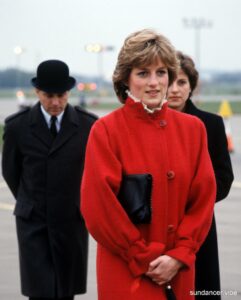
Photographs from that day quickly became iconic. Diana stood in a red coat, visibly emotional, tears in her eyes as she said goodbye to Charles, who was leaving for a five-week royal tour.
To the public, the moment felt deeply relatable—a young woman in love, overwhelmed by temporary separation. The press described it as tender, heartfelt, even reassuring. Charles kissed her on both cheeks, a gesture widely interpreted as affectionate. Diana’s tears were framed as proof of devotion.
The story seemed simple.
But with time, that moment has taken on a more complex meaning.
Years later, through recordings and interviews, Diana shared her own perspective on that period of her life. Her reflections suggested that her emotions at the airport may not have been solely about separation.
According to her accounts, in the hours leading up to Charles’s departure, she became more aware of his ongoing emotional connection with Camilla Parker Bowles.
It was not described as a dramatic confrontation. There were no public scenes or visible conflict. Instead, it unfolded in a way that was subtle but difficult to ignore—through tone, familiarity, and the nature of communication between them.
For Diana, this appeared to confirm something she had already sensed: that her relationship was not as straightforward as it seemed from the outside.
Shortly afterward, another incident reportedly deepened her concerns. During Charles’s absence, Diana became aware of a gift—a bracelet—intended for Camilla. Whether interpreted as a token of friendship or something more personal, the discovery had a significant emotional impact on her.
It was not simply about the object itself.
It was what it suggested.
Attention directed elsewhere.
A connection that had not fully faded.
Moments like these did not immediately unravel the relationship. But they introduced doubt—quietly, persistently.
There was also a reported meeting between Diana and Camilla before the wedding. Outwardly polite, even cordial, it carried an undercurrent that Diana later described as unsettling. Camilla’s familiarity with Charles’s life and routines hinted at a longstanding bond that had not disappeared.
For Diana, still very young and new to this world, these experiences were difficult to process.
They did not align with the fairytale she had been told—or the one the world continued to believe in.
Over time, historians and biographers have revisited these early moments with greater nuance. The airport scene, once seen purely as romantic, is now often viewed through a more complex lens.
Those tears may still reflect affection.
But they may also reflect uncertainty.
Emotional strain.
A growing awareness that the reality of her relationship differed from its public image.
Diana would later speak openly about the challenges within her marriage. Her well-known remark—“There were three of us in this marriage”—came years later, but it reflected feelings she suggested had roots much earlier.
What is often overlooked is that these realizations did not arrive suddenly.
They developed gradually.
Through small moments.
Subtle signals.
Experiences that, on their own, might have seemed manageable—but together formed a clearer picture.
Despite these doubts, Diana moved forward. The reasons were complex: personal hope, external pressure, and the immense expectations placed upon her. At nineteen, stepping away from such a highly visible future would have been extraordinarily difficult.
To the world, she appeared certain.
Privately, she was navigating uncertainty.
Looking back, the airport goodbye stands as more than just a romantic image. It represents a moment where public perception and personal experience may have diverged.
What seemed like a simple farewell may also have been something heavier—a moment shaped not only by affection, but by questions that had yet to be resolved.
That is what gives the image its lasting power.
Not just what it shows—
but what it may conceal.
Diana’s story would continue to unfold in that space between appearance and reality, between expectation and lived experience. And it is within that tension that her life continues to resonate.
Because it reminds us of something enduring:
That even the most carefully constructed narratives can exist alongside more complicated truths—
quiet, unspoken, and deeply human.