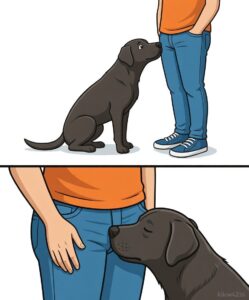
Dogs experience the world in a fundamentally different way from humans. While people rely primarily on sight and sound, dogs rely heavily on scent. Their noses are not just simple tools for detecting odors—they are highly advanced biological systems capable of interpreting complex chemical information embedded in the environment.
What may feel awkward or intrusive to humans, such as a dog sniffing a person’s private area, is actually a natural and instinctive behavior rooted in biology, communication, and evolution.
To understand this, it helps to appreciate just how powerful a dog’s sense of smell really is. Humans have roughly five to six million olfactory receptors in their noses. Dogs can have anywhere from about 100 million to over 300 million, depending on the breed. This gives them an ability to detect odors at concentrations far beyond human capability.
For a dog, smelling is not a vague impression—it is detailed analysis.
Every person carries a unique scent profile made up of chemicals influenced by genetics, diet, environment, hormones, and emotional state. Dogs are capable of breaking down these scent signatures into meaningful information, almost like reading a biological “data set.”
Certain areas of the human body produce stronger and more complex scent signals. The armpits and groin region contain apocrine glands, which release sweat that interacts with skin bacteria to produce distinctive odors. These areas can therefore provide a richer source of scent information than other parts of the body.
Dogs are not reacting to “privacy” in the human sense. Instead, they are simply drawn to areas where the most chemical information is available.
Pheromones—chemical signals released by the body—also play a role in this process. While their role in human communication is still debated in science, many animals rely heavily on them for social and reproductive signaling. Dogs are highly sensitive to these chemical cues.
Inside a dog’s nose is a specialized structure called the vomeronasal organ (or Jacobson’s organ), which helps detect certain chemical signals beyond ordinary smell. This allows dogs to gather additional layers of information about other animals and humans.
Through scent, dogs may be able to detect a range of biological and emotional indicators, including hormonal changes, stress levels, and even certain medical conditions. In fact, trained detection dogs are already used in real-world settings to identify diseases such as cancer or to alert people with diabetes to changes in blood sugar.
When a dog sniffs a person closely, it is often gathering identity information, much like a human checking a face or voice. Smell is the dog’s primary method of recognition and social understanding.
This is why dogs often focus on areas that carry the strongest scent signals when meeting someone new. It is not inappropriate behavior in canine terms—it is communication.
From a human perspective, however, this can feel uncomfortable due to cultural norms around privacy and personal space. Humans assign social meaning to body areas, while dogs do not share those concepts.
In dog-to-dog interactions, sniffing is a normal and essential greeting behavior, especially around the rear area, where scent information is highly concentrated. When dogs extend this behavior to humans, they are simply applying the same natural communication system.
Importantly, this behavior is not related to dominance or “bad manners.” It is instinctive, not intentional in a human sense.
Dogs are not trying to embarrass or invade privacy—they are trying to understand.
Training can help manage this behavior in socially appropriate ways. Calm redirection, such as asking for a sit or offering a hand to sniff instead, can guide the dog toward acceptable greeting behavior. Positive reinforcement helps reinforce these alternatives over time.
Providing dogs with appropriate outlets for their natural sniffing behavior—such as walks, scent games, and exploration—also helps satisfy their instinctive needs.
This behavior highlights one of the most remarkable aspects of dogs: their deep connection to humans. Over thousands of years of domestication, dogs have become highly attuned not only to human behavior but also to subtle chemical changes in our bodies.
They can often sense emotions, detect stress, and recognize familiar individuals with extraordinary accuracy.
Rather than being viewed as inappropriate, this behavior can be understood as a reflection of how differently dogs perceive the world. What seems simple to us is incredibly rich and detailed to them.
There are many misconceptions about this behavior. It is not a sign of poor training, aggression, or dominance. It is also not related to attraction or intention in a human sense. It is simply sensory exploration.
Understanding this can shift how we interpret dog behavior. Instead of frustration, it can create curiosity about how much information dogs are constantly processing that remains invisible to us.
In the end, a dog sniffing a person is not acting out of rudeness—it is engaging in one of its primary ways of understanding the world.
And behind that simple moment is a reminder of something profound:
Dogs live in a sensory universe far richer than our own, where every scent tells a story we can barely begin to imagine.