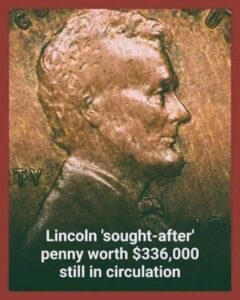
Among the countless coins that pass through human hands every day without a second thought, few people realize that some of the most valuable pieces of American monetary history may still be hiding in plain sight. One of the most fascinating examples is the elusive 1944 Steel Wheat Penny, a coin born from a rare minting anomaly during a period of transition in U.S. coin production. While most pennies from 1944 were struck in bronze, a small number were accidentally produced using leftover steel planchets from the previous year, creating one of the most sought-after error coins in American numismatics.
To understand why this coin is so extraordinary, it is essential to revisit the historical context of the early 1940s. During World War II, the United States faced severe shortages of critical materials, including copper, which was needed for military equipment such as wiring, ammunition components, and communication systems. In response, the U.S. Mint made a significant change in 1943, switching penny production from copper-based bronze to zinc-coated steel. These steel cents were easy to identify due to their silvery appearance and magnetic properties. However, this transition was not perfectly clean, and by 1944, when the Mint reverted back to bronze composition, remnants of steel blanks remained in the production system.
It is believed that a small number of steel planchets from 1943 were accidentally fed into the coin presses during early 1944 production runs. When struck with the 1944 date dies, these leftover blanks became 1944-dated steel pennies. Unlike the common bronze pennies of that year, these steel versions stood out due to their unusual color and metallic behavior. Instead of the warm reddish-brown tone of copper, they appeared grayish or silver-like, similar to their 1943 counterparts.
What makes the 1944 Steel Wheat Penny especially remarkable is its extreme rarity. Numismatic experts estimate that only a handful were ever produced across all U.S. mints, with confirmed examples originating from Philadelphia, Denver, and San Francisco. Each surviving specimen has been carefully documented, authenticated, and in many cases sold for extraordinary sums at auction. Depending on condition, provenance, and mintmark, these coins have been valued anywhere from tens of thousands of dollars to well over $300,000, with exceptional examples potentially commanding even higher prices in private sales.
The allure of this coin does not stem solely from its monetary value. It also represents a tangible connection to a pivotal moment in American history. The wartime economy forced industries across the nation to adapt rapidly, and even the U.S. Mint, one of the most stable and precise institutions in the country, was not immune to logistical challenges. The existence of the 1944 Steel Penny serves as a reminder that large-scale industrial systems, no matter how carefully managed, are still vulnerable to human error and mechanical oversight.
Collectors are particularly drawn to the mystery surrounding how these coins escaped into circulation unnoticed. Minting facilities in the 1940s were not as technologically advanced as they are today. Coin blanks were transported in bulk, and changes in metal composition required careful coordination between suppliers, warehouses, and production lines. In such a complex environment, it is not difficult to imagine how a small batch of steel blanks could have been overlooked during the transition back to bronze coinage.
Once these rare coins entered circulation, they blended in with everyday currency for a short time before their unusual appearance began to attract attention. Unlike bronze pennies, steel cents are magnetic, which provides one of the simplest methods of identification. Over time, as coin collectors and hobbyists became aware of the anomaly, the hunt for these rare pennies intensified. People began testing old coins with magnets, examining wheat pennies stored in jars, and carefully inspecting inherited coin collections passed down through generations.
Despite widespread awareness among collectors today, the possibility remains that undiscovered examples could still exist. Many rare coins are found not in active circulation but in forgotten places—old piggy banks, estate collections, antique shop bulk lots, or even coin rolls obtained from banks. Because steel pennies are not visually identical to bronze cents from 1944, they can sometimes be overlooked by individuals unfamiliar with their significance.
The value of a 1944 Steel Wheat Penny depends heavily on several key factors. Condition is one of the most important considerations, as coins with minimal wear and strong original surfaces are significantly more desirable. Authentication is also critical, as counterfeit versions and altered coins are relatively common in the marketplace. Some individuals attempt to modify steel pennies from other years or alter bronze pennies to mimic rare errors, making professional verification essential before any valuation or sale.
One of the most famous aspects of this coin’s history is the recurring story of accidental discovery. Over the decades, there have been documented cases of individuals finding rare pennies in unexpected places. Some were discovered in inherited collections, while others were found in loose change or old jars stored away for years. In nearly every case, the initial reaction is disbelief, followed by professional authentication that confirms the coin’s extraordinary identity.
The excitement surrounding such discoveries contributes to the enduring popularity of coin collecting in general. Numismatics, the study and collection of currency, is one of the oldest hobbyist fields in the world. It combines history, economics, metallurgy, and human curiosity into a single pursuit. Coins like the 1944 Steel Wheat Penny represent the pinnacle of this hobby, where a small, seemingly ordinary object can carry immense historical and financial significance.
Another important factor in the coin’s mystique is its connection to its predecessor, the 1943 Steel Penny. While millions of those were produced and remain relatively common, the transition back to bronze in 1944 created the conditions for rare anomalies to occur. This brief overlap period between two production systems is what allowed the steel 1944 cents to exist at all. Without that transition, these coins would never have been struck.
As interest in rare coins continues to grow, fueled by online marketplaces, auction houses, and television programs about treasure hunting, the 1944 Steel Wheat Penny remains one of the most iconic examples of hidden value in everyday objects. It serves as a reminder that history is not always confined to museums or textbooks; sometimes it can be found in the most ordinary places, waiting to be recognized.
For collectors, the appeal goes beyond financial gain. Owning or even encountering a coin like this represents a direct link to a moment of industrial history shaped by global conflict and human adaptation. Each surviving specimen is not just a piece of metal, but a witness to a time when even the smallest objects reflected the pressures of a world at war.
Experts caution, however, that while the possibility of finding such a coin is real, it is extremely unlikely. The vast majority of 1944 pennies in circulation are standard bronze issues, and only a tiny fraction of steel examples are known to exist. Nonetheless, the dream of discovery persists, and that dream continues to inspire people to take a second look at their spare change.
Ultimately, the story of the 1944 Steel Wheat Penny is about more than rarity or value. It is about the intersection of history, chance, and human curiosity. It reminds us that extraordinary things can emerge from ordinary circumstances, and that sometimes, the smallest objects carry the largest stories. Whether sitting unnoticed in a forgotten jar or preserved carefully in a collector’s case, this coin remains a powerful symbol of how history can hide in plain sight, waiting for someone curious enough to recognize its significance.