In a world filled with increasingly sophisticated technology, it is often the simplest objects that reveal the greatest lessons about thoughtful design. Every day, people interact with hundreds of items without giving much thought to how they were created, why they look the way they do, or what hidden purposes might be built into their seemingly ordinary forms. From the shape of a coffee mug handle to the ridges on a bottle cap, countless design decisions quietly influence our daily lives. Among these overlooked objects is the humble nail clipper, a tool so familiar that most people rarely stop to examine it closely.
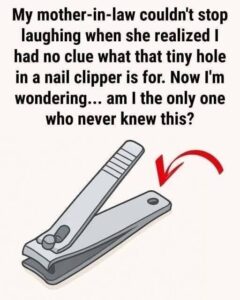
At first glance, a nail clipper appears to be one of the simplest devices imaginable. It consists of two metal arms, a cutting edge, and a lever that creates the force necessary to trim fingernails and toenails. Its function is straightforward, its appearance unremarkable, and its operation nearly universal. Yet hidden within this small grooming tool is a tiny circular hole located at the end of the lever—a feature that millions of people see every day without ever questioning its purpose.
For many users, the hole seems insignificant. Some assume it exists purely for decoration, while others never notice it at all. However, this small opening is actually the result of thoughtful engineering and practical problem-solving that has evolved over generations. Its presence demonstrates how even the most ordinary objects often contain layers of intentional design that reflect human needs, manufacturing considerations, historical habits, and ergonomic principles.
The most widely recognized purpose of the hole is portability. Nail clippers are among the smallest personal care tools commonly carried by individuals. Their compact size makes them convenient, but it also makes them easy to lose. Anyone who has searched through a drawer, travel bag, or bathroom cabinet for a missing nail clipper understands this challenge.
The hole offers an elegant solution.
By allowing a key ring, chain, lanyard, or small hook to pass through it, the clipper can be attached to a keychain, travel pouch, backpack, or grooming kit. This simple modification transforms the clipper from a loose item into an organized accessory that remains accessible whenever needed.
The brilliance of this design lies in its simplicity. Rather than requiring additional parts or complicated mechanisms, a small circular opening provides a practical solution to a common everyday problem. It adds functionality without increasing cost, weight, or complexity.
This approach reflects one of the most important principles in industrial design: achieving maximum usefulness with minimal modification.
Designers often strive to create features that serve meaningful purposes while remaining unobtrusive. The hole on a nail clipper exemplifies this philosophy perfectly. It occupies almost no space, requires very little additional manufacturing effort, and yet dramatically improves the user’s ability to organize and carry the tool.
Beyond portability, the hole can also contribute to usability.
Although many people never use it this way, the opening can provide an additional grip point during operation. Individuals with limited hand strength, arthritis, or reduced dexterity may find that inserting a fingertip through the hole offers greater stability and control when trimming nails.
This extra leverage can be particularly useful when clipping thicker toenails, which often require more force than fingernails. The added control helps reduce slipping and improves precision during use.
Such subtle ergonomic benefits illustrate how successful products often accommodate a wide range of users without dramatically altering their appearance. A feature that seems insignificant to one person may prove highly valuable to another.
The history of the nail clipper further highlights why the hole became such a persistent design element.
Long before modern bathrooms and personal grooming kits became commonplace, people often carried essential tools directly on their person. During the late nineteenth and early twentieth centuries, compact personal items such as pocket watches, small knives, grooming tools, and sewing accessories were frequently attached to chains, belts, or specialized carrying devices.
Portability was not merely convenient—it was essential.
In an era when people traveled frequently by foot, train, or carriage, carrying useful tools ensured they would be available whenever needed. The hole in the nail clipper made it easy to attach the tool to watch chains or personal accessories, reducing the risk of loss while increasing accessibility.
As lifestyles evolved and homes became equipped with dedicated storage spaces, the practical necessity of carrying grooming tools everywhere diminished. Yet the hole remained because it continued to offer value. Features that successfully solve recurring human problems tend to survive long after the original context has changed.
This persistence reveals an important truth about good design: useful solutions often outlive the conditions that inspired them.
The continued presence of the hole across generations demonstrates how effective ideas become integrated into products so thoroughly that they eventually appear natural and inevitable.
Manufacturing considerations provide another fascinating perspective.
Modern nail clippers are typically produced in enormous quantities. Factories manufacture millions of units each year using highly efficient production methods designed to ensure consistency, durability, and affordability.
Within these manufacturing processes, seemingly minor design features can provide significant advantages.
The hole may assist with positioning, alignment, handling, or transportation during certain stages of production. Components can be suspended, guided, or organized more efficiently when attachment points are available. While consumers primarily experience the hole as a convenience feature, manufacturers may also benefit from its presence during assembly and packaging.
This dual-purpose functionality helps explain why the feature has endured for so long.
Industrial designers often favor elements that serve multiple objectives simultaneously. Features that benefit both manufacturers and users tend to be especially resilient because they create value at every stage of a product’s lifecycle.
The nail clipper offers a remarkable example of this principle.
The same small opening contributes to portability, organization, ergonomics, and production efficiency while adding virtually no cost to the finished product.
Few design features achieve so much with so little.
The hole also illustrates a broader lesson about the nature of innovation.
When people think about innovation, they often imagine revolutionary technologies, groundbreaking inventions, or dramatic transformations that reshape entire industries. While such developments certainly occur, much of human progress results from incremental improvements that refine existing tools.
The nail clipper itself evolved through centuries of experimentation with personal grooming devices. Earlier methods of nail maintenance involved knives, scissors, files, and specialized cutting tools that were often less convenient or less safe.
Over time, inventors refined these designs, gradually creating more effective and user-friendly solutions.
The modern nail clipper emerged not through a single dramatic breakthrough but through countless small improvements accumulated across generations.
The tiny hole represents one of those improvements.
It may seem insignificant compared to the cutting mechanism itself, yet it demonstrates how innovation frequently occurs through thoughtful refinement rather than radical reinvention.
This concept extends far beyond grooming tools.
Many of the products people use daily achieve their effectiveness through hundreds of small design decisions that collectively improve convenience, safety, efficiency, and user satisfaction.
Door handles, pens, toothbrushes, scissors, measuring cups, and countless other objects contain subtle features developed through years of observation and refinement.
Most users never notice these details because successful design often becomes invisible.
When something works exceptionally well, people tend to focus on the result rather than the design choices that made the result possible.
The nail clipper serves as a powerful example of this phenomenon.
Its simplicity can make it appear almost self-evident, yet every curve, angle, spring, and opening reflects deliberate decisions shaped by experience and practicality.
The hole is particularly fascinating because it encourages us to look more closely at familiar objects.
Once its purpose becomes clear, many people begin noticing other examples of hidden functionality in everyday products. They realize that ordinary objects are often far more sophisticated than they initially appear.
This shift in perspective can foster greater appreciation for design itself.
Industrial design is often described as the intersection of function, aesthetics, engineering, and human behavior. Successful products must satisfy all of these requirements simultaneously. They must perform their intended tasks effectively, remain comfortable to use, appeal visually to consumers, and be practical to manufacture.
Achieving this balance is far more difficult than it appears.
The best designs often seem effortless precisely because so much thought has gone into eliminating unnecessary complexity.
The nail clipper exemplifies this ideal.
Its design has remained remarkably consistent for decades because it already performs its function extremely well. Rather than constantly reinventing the tool, manufacturers have focused on small refinements that enhance convenience while preserving simplicity.
The enduring presence of the hole reflects this philosophy of continuous improvement.
In today’s world, where products are often marketed based on novelty and technological sophistication, the nail clipper offers a refreshing reminder that innovation does not always require complexity. Sometimes the most effective solutions are the simplest ones.
A tiny opening in a metal lever may not seem impressive at first glance, yet it embodies principles that designers strive to achieve across countless industries: efficiency, versatility, durability, and user-centered thinking.
Perhaps the most remarkable aspect of the hole is how quietly it performs its role.
It does not attract attention. It does not require instructions. It does not advertise its usefulness.
It simply exists, ready to provide benefits whenever needed.
This quiet effectiveness represents one of the highest achievements in design.
The most successful features are often those that become so seamlessly integrated into daily life that users forget they were ever designed at all.
As a result, the tiny hole on a nail clipper becomes more than a simple opening in a piece of metal. It becomes a symbol of thoughtful engineering, practical problem-solving, and the enduring value of human ingenuity.
The next time you pick up a nail clipper, take a moment to notice that small circular detail. What appears insignificant at first glance is actually the product of decades of refinement, generations of experience, and a deep understanding of human needs.
It serves as a reminder that extraordinary design often hides within ordinary objects, quietly improving our lives without demanding recognition. In a world captivated by the newest and most complex innovations, the nail clipper’s tiny hole proves that sometimes the smartest ideas are also the simplest, demonstrating how a single thoughtful detail can transform an everyday tool into a lasting example of timeless industrial design.