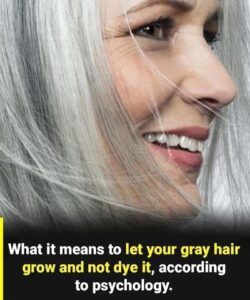
The True Psychological Meaning of Letting Gray Hair Go Natural
Letting gray hair grow naturally is often misunderstood as a simple grooming decision or a sign of giving up on appearance. In reality, for many people, it reflects something far deeper: a psychological transition that touches identity, self-worth, emotional development, and one’s relationship with time itself. In a culture that has long elevated youth as the primary standard of beauty and value, choosing to stop coloring gray hair can represent a quiet but meaningful shift in how a person relates to themselves and the world.
For decades, gray hair has been framed through a narrow cultural lens. It has often been associated with aging, decline, and loss of attractiveness. Entire industries have been built around the idea that gray hair should be concealed rather than embraced. Hair dye products are marketed not just as cosmetic enhancements, but as tools to restore confidence and vitality. This framing subtly reinforces the belief that natural aging is something to manage rather than accept.
Yet human psychology rarely aligns perfectly with external messaging. As individuals move through different stages of life, they often begin to reassess values they once accepted without question. Letting gray hair grow in naturally frequently emerges during these reflective periods, when people start to evaluate the emotional cost of maintaining a certain appearance versus the internal comfort of authenticity.
Identity and the Meaning of Appearance
Hair is one of the most visible components of identity. It communicates age, style, personality, and even social belonging. Because of this, altering hair color is not a neutral act—it is a form of identity expression. Covering gray hair can feel like preserving a version of oneself that aligns with societal expectations of youthfulness and vitality.
However, maintaining dyed hair over many years can also create a subtle psychological divide. There is the “present self,” shaped by lived experience, and the “maintained self,” curated for external perception. Over time, this maintenance can become emotionally tiring for some individuals. The cycle of coloring roots, scheduling appointments, and monitoring regrowth can begin to feel less like self-care and more like self-preservation against aging itself.
Choosing to embrace gray hair can therefore represent a reintegration of identity. It reduces the gap between internal experience and external appearance. Rather than presenting a modified version of oneself, the individual allows their outward appearance to reflect their actual life stage. This alignment can bring a sense of psychological coherence, where identity feels less divided and more unified.
Emotional Relief and Psychological Ease
One of the most commonly reported emotional effects of letting gray hair grow naturally is relief. This relief is not necessarily tied to appearance itself, but to the removal of ongoing maintenance pressure. Dyeing hair regularly requires time, money, and attention. More importantly, it requires a repeated acknowledgment of aging as something that must be corrected or concealed.
When that cycle is stopped, many people experience a subtle but meaningful reduction in internal stress. There is no longer a need to plan around regrowth or worry about visible roots. This absence of constant monitoring can create a sense of ease. Psychologically, this shift often aligns with broader emotional acceptance—an ability to tolerate change without feeling compelled to intervene.
This does not mean that individuals who dye their hair are experiencing distress. Rather, it highlights that for some people, the act of letting hair go gray naturally removes a layer of self-imposed expectation. The emotional experience is less about appearance and more about permission: permission to exist without continuous modification.
Aging and Cultural Pressure
Modern society often sends conflicting messages about aging. On one hand, aging is portrayed as natural and inevitable. On the other hand, visible signs of aging are frequently discouraged, especially in media and advertising. This creates a tension where individuals are encouraged to “age gracefully,” but only under certain visual conditions.
Gray hair sits directly within this tension. For men, it is often framed as distinguished or mature. For women, it has historically been treated more critically, sometimes associated with loss of attractiveness or relevance. These differing standards reflect deeper cultural assumptions about gender, value, and visibility.
Choosing to go gray, particularly for those who have been conditioned to conceal it, can therefore take on the meaning of quiet resistance. It is not always a deliberate act of protest, but it can function as one. It challenges the idea that worth is dependent on maintaining a youthful appearance and suggests instead that value can evolve over time rather than diminish.
The Psychological Relationship With Time
At a deeper level, letting gray hair grow naturally reflects a changing relationship with time. Youth-centered cultures often emphasize control over aging—through skincare, fitness, diet, and cosmetic interventions. While there is nothing inherently negative about self-care, an excessive focus on resisting visible aging can create anxiety around time itself.
Gray hair becomes one of the most visible reminders that time is passing. Accepting it can therefore represent acceptance of time as a lived experience rather than an enemy to be managed. This shift is psychologically significant. It moves individuals from a mindset of resistance toward one of integration.
Instead of viewing aging as a loss of identity, it can be reframed as accumulation—of experience, memory, emotional depth, and perspective. In this sense, gray hair becomes less a signal of decline and more a marker of continuity. It shows that life is ongoing and that identity is expanding rather than shrinking.
Authenticity and Internal Alignment
One of the strongest psychological themes associated with going gray is authenticity. Authenticity refers to the alignment between inner values and external behavior. When individuals feel that their appearance reflects who they truly are, there is often a sense of ease and honesty in self-presentation.
For some, continuing to dye gray hair may feel aligned with personal expression, creativity, or aesthetic preference. For others, it may feel like a disconnect from their evolving sense of self. Letting gray hair grow naturally can therefore become an act of internal alignment rather than external statement.
This alignment is not about rejecting beauty standards altogether, but about choosing which standards feel personally meaningful. It reflects autonomy—the ability to define oneself rather than be entirely defined by cultural expectations.
Confidence Beyond Appearance
A common misconception is that embracing gray hair represents a decline in self-care or confidence. In many cases, the opposite is true. For individuals who choose this path intentionally, confidence often shifts away from appearance-based validation and toward more stable internal foundations.
This form of confidence is less dependent on external approval and more rooted in self-acceptance. It is the confidence that comes from no longer needing to constantly adjust oneself to fit an idealized image. Instead of asking, “Do I look young enough?” the question becomes, “Do I feel like myself?”
Over time, this internalized confidence can extend beyond appearance and influence other areas of life, including communication, boundaries, decision-making, and interpersonal relationships.
Social Perception and Changing Norms
Although traditional views on gray hair still exist, social perceptions are gradually shifting. In many communities, natural gray hair is increasingly seen as stylish, elegant, or empowering. Public figures and influencers who embrace gray hair have contributed to reshaping these perceptions.
However, cultural change is uneven. In some environments, gray hair may still be interpreted through older associations. This means that choosing to go gray can involve navigating varied social responses. For some individuals, this experience strengthens resilience and self-trust, as they learn to maintain personal choices regardless of external interpretation.
A Symbol of Life Experience
Ultimately, gray hair can be understood as a visible record of time lived. Each strand carries no literal story, but collectively they represent years of experience, adaptation, and survival. From this perspective, gray hair is not a flaw to correct but a natural outcome of being alive.
When individuals choose to let it grow naturally, they are not simply changing their appearance. They are reframing what that appearance means. Instead of seeing gray hair as something that reduces attractiveness, it can be seen as something that reflects depth.
This reframing is at the heart of the psychological shift. It transforms gray hair from a symbol of loss into a symbol of continuity.
Conclusion
Letting gray hair grow naturally is not a universal choice, nor is it intended to replace other forms of self-expression such as hair dyeing or styling. Rather, it represents one of many ways individuals navigate identity, aging, and authenticity in a visually driven culture.
For many, the decision reflects emotional maturity, psychological ease, and a growing comfort with impermanence. It can signal a release from constant maintenance, a redefinition of beauty, and a deeper acceptance of time as part of life rather than something to resist.
In the end, gray hair is not just about color. It is about meaning. And the meaning each person assigns to it reveals far more about identity, values, and self-perception than appearance alone ever could.