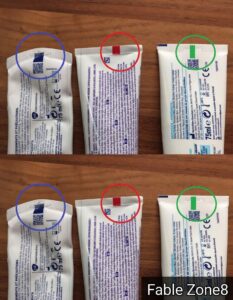
If you’ve ever looked closely at a tube of toothpaste, you may have noticed a small colored square or stripe near the sealed end. These markings—often green, blue, red, or black—have become the subject of widespread curiosity and, more recently, viral claims online.
According to these claims, the color supposedly reveals what the toothpaste contains. Green is said to mean “natural,” blue suggests a mix of natural and medicinal ingredients, red indicates a combination of natural and chemical components, and black is often described as “all chemicals.”
It’s a simple explanation.
It’s easy to remember.
And it’s completely inaccurate.
Where the Myth Comes From
The popularity of this idea isn’t accidental. It reflects a broader desire for quick, easy ways to make informed decisions—especially when it comes to health products.
Ingredient lists can be long and filled with unfamiliar names. For many people, decoding them feels overwhelming. A color-based shortcut offers an appealing alternative: just glance at the tube and decide.
But the reality of how toothpaste is made—and how it is regulated—doesn’t support this theory at all.
What Those Colored Marks Actually Mean
The colored squares or stripes on toothpaste tubes are known in the packaging industry as “eye marks” or “registration marks.”
They have nothing to do with ingredients.
Instead, they serve a purely technical purpose.
During manufacturing, toothpaste tubes are produced on high-speed assembly lines. Large sheets of packaging material are printed, then cut, folded, and sealed into individual tubes.
To do this accurately, machines need reference points.
That’s where the colored marks come in.
Optical sensors on the machines detect these marks to determine:
- Where to cut the packaging
- Where to fold the material
- Where to seal the tube
Without these marks, the process would be far less precise, leading to misaligned labels or defective packaging.
In simple terms:
👉 The marks are for machines—not for consumers.
They are part of the production process, not a hidden code about what’s inside the product.
Why the Idea Spread So Quickly
The persistence of this myth highlights how easily misinformation can take hold—especially when it aligns with existing beliefs or concerns.
Several factors contributed to its spread:
1. Simplicity
The explanation is straightforward and easy to understand. It reduces a complex topic into a simple visual rule.
2. Fear of “Chemicals”
Many people are wary of synthetic ingredients. The idea that a black stripe signals “all chemicals” taps into that fear—even though everything, including natural substances, is made of chemicals.
3. Social Media Amplification
Posts that claim to reveal “hidden truths” tend to attract attention and shares, regardless of accuracy.
4. Lack of Manufacturing Awareness
Most consumers are unfamiliar with packaging processes. Without that context, the marks appear mysterious and open to interpretation.
What Toothpaste Is Really Made Of
To understand why the color-code theory doesn’t work, it helps to look at what toothpaste actually contains.
Toothpaste is a carefully formulated product designed to support oral health. Each ingredient has a specific function:
- Abrasives help remove plaque and surface stains
- Humectants keep the paste moist
- Surfactants create foam for even distribution
- Flavoring agents improve taste
- Preservatives extend shelf life
Most importantly, many toothpastes include Fluoride, which plays a key role in preventing tooth decay.
This complexity cannot be reduced to a single color marking on the packaging.
Why Fluoride Matters
Among all toothpaste ingredients, Fluoride is one of the most widely studied and recommended.
It works by:
- Strengthening tooth enamel
- Making teeth more resistant to acid attacks
- Helping repair early stages of decay
Dental professionals around the world generally recommend fluoride toothpaste for most people, unless there are specific medical reasons to avoid it.
When choosing a toothpaste, the presence of fluoride is far more important than any external marking.
What You Should Focus on Instead
If the colored stripe doesn’t matter, what does?
Here are the factors that actually influence the quality and suitability of a toothpaste:
1. Ingredient List
This is the most reliable source of information. It tells you exactly what the product contains.
2. Your Specific Needs
Different toothpastes are designed for different purposes:
- Sensitivity relief
- Whitening
- Gum care
- Cavity prevention
Choosing the right one depends on your oral health.
3. Fluoride Content
As mentioned, fluoride plays a crucial role in protecting teeth.
4. Professional Advice
Dentists can recommend products based on your individual condition, such as enamel strength or gum health.
The “Natural” Label Question
Many consumers are drawn to toothpastes labeled as “natural.” While these products may avoid certain synthetic ingredients, the term itself is not always strictly defined.
This means:
- “Natural” can vary between brands
- It does not automatically mean safer or more effective
- It still requires checking the ingredient list
Some people prefer to avoid ingredients like sodium lauryl sulfate (SLS) or artificial additives. That’s a valid personal choice—but it should be based on verified information, not packaging myths.
A Broader Lesson About Misinformation
The toothpaste stripe myth is a small example of a much larger issue.
In today’s digital world, information spreads quickly—but accuracy doesn’t always keep up.
Simple explanations are appealing, especially when they promise to reveal hidden knowledge. But they can also oversimplify complex topics in misleading ways.
Developing the habit of questioning and verifying information is essential—not just for choosing toothpaste, but for making informed decisions in general.
Why Packaging Can Be Misleading
Packaging is designed for two main purposes:
- Functionality (protecting and containing the product)
- Marketing (attracting attention and conveying brand identity)
It is not designed to encode secret information for consumers.
The colored mark on a toothpaste tube is simply a technical feature used during production. It is not intended to communicate anything about the formula.
The Bottom Line
The colored stripes or squares on toothpaste tubes are not indicators of ingredients, safety, or quality.
They are manufacturing guides used by machines.
Relying on them to make decisions can lead to confusion and misinformation.
Instead, focus on what truly matters:
- The ingredient list
- The presence of Fluoride
- Your personal dental needs
- Professional recommendations