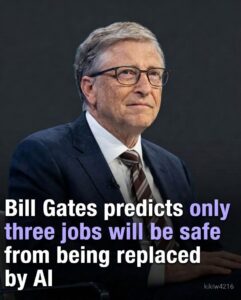
As artificial intelligence continues to advance at an unprecedented pace, conversations about the future of work have moved from speculation to urgent reality. Across industries, businesses are integrating AI-powered tools into daily operations, changing how tasks are performed and redefining the skills that employers value. While concerns about automation replacing jobs remain widespread, technology leaders such as Bill Gates believe the story is far more complex—and far more optimistic—than many people realize.
According to Gates, artificial intelligence will undoubtedly transform the labor market, but it will not eliminate the need for human workers. Instead, it will fundamentally change the nature of work itself. The professionals who succeed in the coming decades will be those who learn how to combine uniquely human strengths with the capabilities of intelligent machines.
Throughout recent interviews, public appearances, and written commentary, Gates has emphasized that the world is entering an era he describes as one of “free intelligence.” In this future, access to expert-level knowledge and sophisticated problem-solving tools will become widely available to people regardless of geography, income level, or educational background. This shift has the potential to democratize expertise on a scale never before seen in human history.
The implications are enormous.
For centuries, specialized knowledge has been concentrated among highly trained professionals. Doctors, lawyers, engineers, teachers, and consultants spent years acquiring expertise that was inaccessible to most people. Artificial intelligence is beginning to change that reality by making advanced information instantly available through digital tools.
However, Gates argues that access to information alone is not enough. Human judgment, empathy, creativity, and ethical reasoning will become increasingly valuable as AI handles more routine cognitive tasks.
Rather than replacing people, AI is expected to serve as a powerful partner.
The workers who learn how to leverage that partnership effectively will likely become the leaders of the next economic era.
One of the sectors Gates discusses most frequently is healthcare.
Artificial intelligence has already demonstrated remarkable abilities in medical diagnosis, image analysis, and treatment planning. Modern AI systems can identify patterns in medical scans, evaluate patient records, and generate recommendations with impressive speed and accuracy.
In some cases, these systems rival the performance of highly trained specialists.
Yet Gates believes this technological progress will not eliminate the need for doctors and healthcare professionals.
Instead, it will elevate their role.
Future physicians may spend less time reviewing routine data and more time focusing on patient relationships, complex decision-making, and personalized care. While AI can analyze symptoms and suggest treatment options, it cannot fully understand the emotional realities that patients experience during illness.
A patient receiving a serious diagnosis often needs reassurance, compassion, and guidance.
Those human interactions remain difficult to automate.
Similarly, nurses, therapists, counselors, and caregivers are expected to remain essential because healing involves far more than technical expertise.
Healthcare professionals who embrace AI tools while maintaining strong interpersonal skills may become more effective than ever before.
Mental health services represent another area where human qualities remain irreplaceable.
Although AI chatbots and digital assistants can provide support and basic guidance, genuine emotional understanding requires a level of empathy and lived experience that machines cannot authentically replicate.
As awareness of mental health issues continues to grow worldwide, demand for psychologists, counselors, social workers, and emotional wellness specialists may increase significantly.
These careers rely heavily on trust, human connection, and nuanced communication.
Technology can assist them, but it cannot fully replace them.
Education is another field where Gates sees tremendous opportunity.
For decades, educators have struggled to provide personalized learning experiences for large groups of students with diverse needs and abilities.
Artificial intelligence may help solve this challenge.
Advanced tutoring systems can adapt lessons to individual learning styles, identify knowledge gaps, and provide immediate feedback. Students may soon have access to personalized educational support around the clock.
This development could dramatically improve learning outcomes and expand access to quality education.
Yet Gates emphasizes that teachers will remain indispensable.
The role of educators will evolve from information delivery to mentorship, inspiration, and guidance.
The best teachers do much more than present facts.
They motivate students.
They build confidence.
They encourage curiosity.
They foster creativity.
They teach collaboration and social skills.
These responsibilities require emotional intelligence and human understanding that extend beyond what current AI systems can provide.
As a result, educators who integrate technology while focusing on mentorship and personal development may thrive in the years ahead.
The business world is already experiencing significant AI-driven transformation.
Tasks involving data analysis, administrative work, scheduling, report generation, and customer support are increasingly being automated.
Many companies now use AI to process information faster and more efficiently than traditional methods allow.
While some jobs may disappear, new opportunities are emerging.
Gates predicts strong demand for professionals who can manage, supervise, and optimize AI systems.
Organizations will need individuals capable of understanding both technology and human needs.
This includes AI trainers, AI ethics specialists, prompt engineers, system designers, policy advisors, and technology strategists.
These careers require technical literacy combined with critical thinking and ethical judgment.
As AI becomes more powerful, questions surrounding fairness, privacy, accountability, and transparency will become increasingly important.
Professionals who can navigate these challenges may play a crucial role in shaping the future of technology.
Creativity is another area where Gates sees significant potential.
Many people assume that creative professions are vulnerable to automation because AI can generate images, music, videos, and written content.
While AI has certainly expanded creative possibilities, Gates believes human creators will remain central to cultural innovation.
Technology can produce variations and assist with production, but originality often emerges from uniquely human experiences, emotions, and perspectives.
Artists, writers, filmmakers, designers, musicians, and storytellers bring context and meaning to their work.
They understand culture.
They interpret emotions.
They challenge assumptions.
These abilities remain difficult for machines to replicate authentically.
In the future, successful creative professionals may use AI as a collaborative tool rather than viewing it as a competitor.
By automating repetitive tasks, AI can free creators to focus on vision, strategy, and innovation.
This partnership may lead to entirely new forms of artistic expression.
Leadership is another skill set expected to become increasingly valuable.
As organizations adopt advanced technologies, leaders must navigate uncertainty, manage change, and inspire teams through periods of transformation.
Machines can provide information and recommendations, but leadership involves motivating people, resolving conflicts, and making decisions under complex circumstances.
These responsibilities depend heavily on emotional intelligence.
Effective leaders understand human behavior, organizational culture, and interpersonal dynamics.
As workplaces become more technologically sophisticated, these human-centered leadership skills may become even more important.
Gates frequently emphasizes adaptability as one of the most critical abilities for future success.
Technological change is accelerating.
Skills that are valuable today may become less relevant tomorrow.
Workers who embrace continuous learning will likely enjoy greater career resilience.
This means developing a mindset focused on growth and flexibility.
Rather than mastering a single set of skills and relying on them indefinitely, professionals may need to update their knowledge regularly throughout their careers.
Lifelong learning is no longer optional.
It is becoming essential.
Governments, educational institutions, and employers are increasingly recognizing this reality.
Many organizations now invest heavily in reskilling and upskilling programs designed to help workers adapt to technological change.
According to Gates, these investments will be critical to ensuring that the benefits of AI are broadly shared.
Climate and sustainability-related careers also appear poised for growth.
As societies confront environmental challenges, demand is increasing for professionals who can develop innovative solutions.
Renewable energy specialists, environmental engineers, sustainability consultants, and climate adaptation planners combine technical expertise with human problem-solving abilities.
Artificial intelligence may assist these professionals by analyzing data and modeling scenarios, but strategic planning and implementation still require human leadership.
The transition toward cleaner energy systems is expected to create millions of jobs worldwide.
Many of these roles involve both technology and hands-on work that cannot be easily automated.
Similarly, skilled trades may remain highly resilient.
Electricians, plumbers, construction managers, technicians, and maintenance professionals perform tasks in dynamic physical environments.
While robotics and automation will continue advancing, many practical challenges require adaptability and situational judgment that machines struggle to replicate consistently.
As infrastructure evolves to support new technologies, demand for skilled workers may remain strong.
One of Gates’ most important messages concerns inequality.
He acknowledges that AI could create significant disruptions if societies fail to prepare adequately.
Workers displaced by automation may face economic hardship without appropriate support systems.
For this reason, he advocates investments in education, workforce training, and social policies that help people transition into emerging opportunities.
Preparing for the AI era requires more than technological innovation.
It requires thoughtful planning and inclusive economic development.
The goal should not simply be increasing productivity.
It should be improving quality of life and expanding opportunity.
Despite challenges, Gates remains fundamentally optimistic about the future.
Throughout history, technological revolutions have transformed labor markets.
Agricultural societies evolved into industrial economies.
Industrial economies transitioned into information-based systems.
Each transition created uncertainty, but it also generated new opportunities and higher standards of living.
Artificial intelligence represents the next major transformation.
Like previous technological breakthroughs, it will eliminate certain tasks while creating entirely new categories of work.
The ultimate outcome will depend on how individuals, organizations, and governments respond.
Those who embrace adaptability, develop human-centered skills, and learn to collaborate effectively with intelligent technologies may find themselves uniquely positioned for success.
Empathy, creativity, communication, leadership, ethical reasoning, and complex problem-solving are becoming increasingly valuable.
These are not weaknesses in an AI-driven world.
They are strengths.
The future belongs not to those who compete directly against machines, but to those who understand how to work alongside them.
As Gates frequently suggests, technology should be viewed as a tool for amplifying human potential rather than replacing it.
The age of artificial intelligence is not simply a story about automation.
It is a story about transformation.
It is about reimagining work, expanding access to knowledge, and creating new possibilities for human achievement.
The professionals who thrive in this new era will be those who combine technological fluency with the qualities that make us uniquely human.
In the years ahead, success may depend less on what we know and more on how effectively we learn, adapt, collaborate, and connect with others. Those who cultivate these abilities will help shape a future where humans and AI work together to solve problems, improve lives, and unlock opportunities that were once unimaginable.