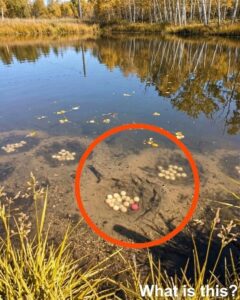
The unusual sight in this pond has drawn attention due to the presence of clustered round formations sitting just beneath the shallow water’s surface.
At first glance, they appear mysterious—like carefully arranged eggs, small organic spheres, or even artificial objects placed deliberately in groups. Some areas resemble circular nests or crater-like depressions in the mud, giving the entire scene an almost surreal appearance when viewed from above.
However, the most likely explanation is far more natural.
These formations are consistent with amphibian egg clusters, commonly laid by frogs or toads during breeding season. In freshwater environments, many species reproduce by releasing eggs into still or slow-moving water, where they gather together in protective gelatinous masses. From above, these egg clusters can easily appear as small white, translucent, or pale spheres grouped tightly together.
This jelly-like coating is not accidental—it plays an important biological role. It protects the developing embryos from predators, stabilizes moisture levels, and allows oxygen exchange within the water. Depending on lighting conditions and water clarity, these clusters can look surprisingly uniform and organized, sometimes resembling man-made objects.
The darker circular marks surrounding the clusters are likely natural features of the pond bed. These could be patches of disturbed sediment, decaying plant matter, or soft mud shaped by the movement of small aquatic animals. In shallow wetlands, even minor disturbances can create patterns that appear unusual when viewed from above.
A small red object visible in the scene adds to the curiosity, but it is most likely unrelated to the egg clusters. It could be plant debris, a fragment of organic material, or a piece of natural litter carried into the pond by wind or water flow.
Ponds like this often become critical breeding habitats for amphibians. During seasonal reproduction periods, frogs and toads return to shallow, calm waters to lay eggs, ensuring the next generation has the best chance of survival. These environments are rich in nutrients and relatively free from strong currents, making them ideal nurseries for early life stages.
Without direct sampling, species identification remains uncertain. Different frog species produce different egg patterns—some form large floating mats, while others create smaller clustered groups or strands. Environmental conditions such as temperature, water quality, and vegetation also influence how these clusters appear.
What may initially seem strange or unexplained is, in most cases, a glimpse into a highly organized natural process occurring just beneath the surface.
Scenes like this highlight how much unseen life exists in ordinary ecosystems. A simple pond, quiet and still, can contain complex cycles of reproduction, survival, and transformation happening continuously out of sight.
Rather than something artificial or unknown, this discovery most likely represents a healthy, active breeding site—reminding us that even the most familiar environments often conceal quiet but essential natural processes.