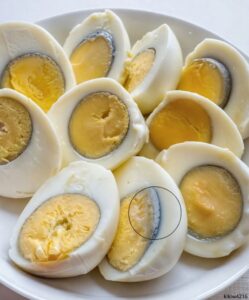
If you’ve ever sliced into a hard-boiled egg and noticed a greenish-gray ring around the yolk, it can look like something went wrong in your kitchen. The eggs are still edible, but the appearance is unappetizing and often confusing.
The good news is simple: this is not a safety issue. It’s a cooking technique issue.
That green ring is one of the most common hard-boiled egg results—and it has a clear scientific explanation.
What Causes the Green Ring?
The green or grayish ring forms when eggs are overcooked or held at high temperature for too long after boiling.
Inside an egg are two key elements:
- Sulfur (mainly in the egg white)
- Iron (mainly in the yolk)
When eggs are exposed to excessive heat, these compounds react and form iron sulfide, which appears as a green-gray layer around the yolk.
This reaction is harmless—but visible.
Is It Safe to Eat?
Yes.
A green ring does not mean the egg is spoiled, toxic, or unsafe.
It simply means:
- The egg was cooked too long
- Or it cooled too slowly after boiling
The only real changes are:
- Texture becomes drier or chalky
- Flavor becomes slightly more sulfuric
- Appearance is less appealing
Why It Happens So Easily
Even small timing mistakes can cause it. Common causes include:
- Leaving eggs boiling for too long
- Not using an ice bath after cooking
- Cooking at high heat instead of gentle simmering
- Leaving eggs in hot water after turning off the stove
- Very fresh eggs (which can retain heat differently)
Essentially, it’s not about “bad eggs”—it’s about residual heat continuing the cooking process.
How to Prevent the Green Ring
Perfect hard-boiled eggs are easy once you follow a consistent method.
1. Start in cold water
Place eggs in a pot and cover with cold water.
2. Bring to a boil gently
Avoid aggressive boiling, which increases overcooking risk.
3. Turn off heat and time carefully
Once boiling starts, remove from heat and cover.
- 9–10 minutes: soft, creamy yolk
- 11–12 minutes: fully set yolk
4. Use an ice bath immediately
Transfer eggs into cold or ice water for 5–10 minutes.
This step is key—it stops the cooking instantly.
Why Cooling Matters So Much
Even after heat is removed, eggs stay hot internally. Without cooling:
- The yolk continues cooking
- Sulfur continues reacting with iron
- The green ring becomes more pronounced
An ice bath stops this process immediately, preserving a bright yellow yolk.
Common Myths About the Green Ring
There are several misunderstandings about this phenomenon:
❌ “It means the egg is old”
Not true. Fresh eggs can develop green rings too.
❌ “It means the egg is unsafe”
False. It is purely cosmetic.
❌ “It’s a chemical contamination issue”
Incorrect. The compounds involved are naturally present in eggs.
Does It Affect Nutrition?
Not meaningfully.
Eggs remain:
- High in protein
- Rich in vitamins and minerals
- Nutritionally valuable even when overcooked
The main loss is texture and taste quality, not nutrition.
How Chefs Avoid It
Professional kitchens prevent green rings by:
- Using precise timers
- Cooking at controlled temperatures
- Immediately chilling eggs in ice water
- Avoiding “sit in hot water” methods
Consistency—not guesswork—is the key.
A Simple Kitchen Lesson
The green ring is a perfect example of how small timing differences can noticeably affect food.
It teaches a simple truth:
Cooking is not just heat—it’s timing, temperature, and stopping at the right moment.
Once you understand that, perfect eggs become repeatable, not accidental.
Final Thoughts
If your eggs have a green ring around the yolk, don’t worry—you didn’t do anything dangerous. You simply cooked them a bit too long or cooled them too slowly.
With a few small adjustments:
- Gentle heat
- Accurate timing
- Immediate cooling
You can consistently get:
- Bright yellow yolks
- Tender whites
- Clean, restaurant-quality results
And the green ring becomes something you only see in old photos—not your kitchen.