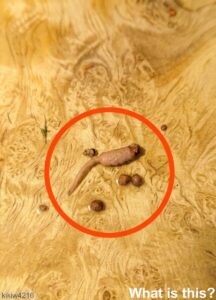
At first glance, encountering a strange, pink, elongated creature with a thin tail-like extension on a household surface is enough to unsettle anyone. Its unusual shape, slightly translucent body, and the presence of small brown pellets nearby can easily trigger concern, with many մարդիկ jumping to conclusions about parasites, dangerous insects, or unknown infestations. However, what appears alarming at first is, in reality, a fascinating and harmless organism: the larval stage of a hoverfly, commonly known as a rat-tailed maggot, most often belonging to the species Eristalis tenax.
Despite its unsettling nickname, this creature is not dangerous. It does not bite, sting, or transmit disease. Instead, it represents an elegant example of adaptation and ecological function, quietly playing an important role in breaking down organic matter in the environment.
The most distinctive feature of this larva is its long, thin “tail,” which is not a tail at all but a specialized breathing tube called a siphon. This structure allows the larva to survive in low-oxygen environments such as stagnant water, drains, or decomposing organic նյութ. By extending this siphon to the surface, the larva can access air while its body remains submerged in nutrient-rich material. This adaptation is a remarkable solution to living in environments where most organisms would struggle to survive.
Its body, typically soft and slightly pink or translucent, contains internal structures that may be faintly visible, contributing to its unusual and sometimes eerie appearance. The darker end is the head region, equipped with mouthparts designed for filter-feeding. Rather than hunting or harming other organisms, the larva feeds on bacteria and decaying նյութ, helping to recycle nutrients back into the ecosystem.
The small brown pellets often found nearby are not eggs or signs of infestation but are simply waste material—known as frass—or bits of organic debris from its environment. Their presence may look concerning, but they are a normal byproduct of the larva’s feeding activity.
Finding such a larva indoors usually means it has been accidentally transported from a nearby moist environment. Common sources include clogged drains, standing water in gutters, կոմ্পոստ piles, or նույնիսկ փոքր ջրով լի տարաներ around the home. Heavy rain or પાણી movement can displace these larvae, bringing them into spaces where they would not normally survive. Once removed from their влажный habitat, they cannot live long, which is why they are often discovered in unexpected places like floors, sinks, or wooden surfaces.
Understanding their life cycle adds another layer of appreciation. Rat-tailed maggots undergo complete metamorphosis, eventually transforming into adult hoverflies from the family Syrphidae. These adult flies are often mistaken for bees due to their striped appearance, but they are entirely harmless and, importantly, beneficial. Hoverflies are excellent pollinators, visiting flowers and contributing to the reproduction of many plants, including crops. In this way, the seemingly unpleasant larva becomes a valuable contributor to ecosystems once it matures.
Their ecological role extends beyond pollination. As larvae, they act as decomposers, breaking down organic waste in المياه الغنية بالمغذيات environments. This process helps maintain ecological balance by recycling nutrients and reducing bacterial buildup. In some contexts, they are even used as indicators of water quality because of their ability to tolerate polluted conditions.
Despite their benefits, these larvae are frequently misunderstood. Their appearance leads many people to mistake them for parasitic worms or harmful insects. In reality, they lack the biological features required to infest humans or animals. They are not مرتبطين بأي حالات طبية خطيرة and pose no health risk. This highlights the importance of proper identification, as fear often arises from unfamiliarity rather than actual danger.
Managing their presence is simple and does not require harsh chemicals. If one is found indoors, it can be safely removed using a tissue or کپڑا and disposed of. More importantly, preventing future encounters involves addressing the البيئة التي تدعمها—cleaning drains, eliminating standing water, and maintaining good sanitation practices. These steps not only reduce the likelihood of encountering such larvae but also improve overall household hygiene.
From a broader perspective, encounters like this serve as reminders of how closely human environments are connected to natural systems. Even in urban or घरेलू settings, small pockets of biodiversity exist, often unnoticed until something unusual appears. Rather than viewing these moments with alarm, they can be opportunities for learning and curiosity.
The presence of a rat-tailed maggot is not a sign of danger but a glimpse into a hidden world of ജീവ organisms performing essential ecological functions. It demonstrates how evolution has equipped even the smallest creatures with highly specialized tools for survival. The breathing siphon alone is a testament to nature’s ability to solve complex problems with elegant simplicity.
Ultimately, what begins as a mysterious and unsettling discovery can transform into an appreciation for the intricate balance of life that exists all around us. By understanding what we are seeing, we replace fear with knowledge. And in doing so, we gain a deeper respect for the countless organisms that quietly contribute to the health of our environment every day.