Every Saturday afternoon at exactly two o’clock, the same biker rode his black Harley-Davidson through the cemetery gates. He always wore the same worn leather jacket, dark jeans, and heavy boots. His gray beard moved slightly in the wind as he parked beneath an enormous old oak tree.
Then he would walk directly to my wife’s grave.
Emily.
My wife had been gone for fourteen months, but I still struggled to say her name without feeling a sharp pain in my chest.
She had died from breast cancer at only forty-three years old.
We had been married for twenty years. We had two children, a son and a daughter, and a home filled with the ordinary sounds of family life—arguments over the television, laughter from the kitchen, doors slamming, and someone always asking where the car keys were.
Then cancer took all of that away.
After Emily died, the house became unbearably quiet.
I tried to continue living for our children, but grief followed me everywhere.
That was when I first noticed the biker.
The first Saturday, I assumed he had simply made a mistake.
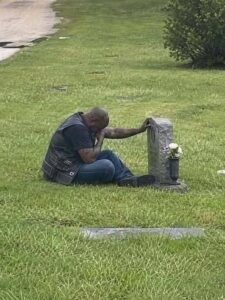
He parked his motorcycle, walked toward Emily’s headstone, and sat beside it.
I watched him from a distance for nearly an hour.
He didn’t leave flowers.
He didn’t place anything on the grave.
He didn’t take photographs.
He simply sat there.
At exactly three o’clock, he stood, touched the top of the headstone gently, and walked back to his motorcycle.
I thought that would be the end of it.
But the following Saturday, he came back.
And then the next one.
And the next.
Soon, it became a strange weekly ritual.
Every Saturday at 2 PM, he arrived.
Every Saturday, he spent exactly one hour beside Emily.
And every Saturday, I watched him from my car.
At first, I was confused.
Then I became suspicious.
Eventually, I became angry.
Who was this man?
Why was he visiting my wife’s grave?
Emily had never mentioned him.
She had been a pediatric nurse. She volunteered at our church, helped neighbors whenever she could, and spent much of her free time caring for children.
She was also incredibly private.
Emily drove an old silver minivan. She hated expensive restaurants. She thought ordering dessert before dinner was an act of rebellion.
She didn’t have a secret life.
At least, that’s what I thought.
But there was this stranger.
A biker.
A man who looked completely out of place in the quiet cemetery.
And somehow, he seemed to mourn my wife as though she had been one of the most important people in his life.
By the third month, I couldn’t take it anymore.
One Saturday, when he finished his usual hour beside Emily’s grave, I got out of my car.
I walked toward him.
He saw me coming and immediately stood.
I stopped a few feet away.
“I’m Emily’s husband,” I said.
His expression changed.
“I think it’s time you tell me who you are.”
For several seconds, neither of us spoke.
Then the man’s eyes filled with tears.
“My name is Mike,” he finally said. “I’m sorry. I never meant to make you uncomfortable.”
“Then why are you here?”
He looked at Emily’s name.
“I come here to say thank you.”
I stared at him.
“Thank you for what?”
Mike wiped his eyes.
“Your wife saved my daughter’s life.”
I felt the anger drain from me.
“What are you talking about?”
He took a deep breath.
“My daughter, Kaylee, was nine years old when she was diagnosed with leukemia.”
He explained that he was a single father who worked as a mechanic. When Kaylee became sick, his entire life changed overnight.
He spent every waking moment at hospitals.
He sold his house.
He emptied his savings.
He borrowed money from friends.
His motorcycle club organized fundraisers to help him pay the medical bills.
But despite everything they did, he was still $40,000 short.
Then one night, Mike found himself sitting alone in a hospital hallway.
He was exhausted.
Terrified.
He had no idea how he was going to save his daughter.
“I remember crying,” he told me. “I was trying not to let Kaylee see me break down. I felt like I had failed her.”
That’s when Emily found him.
She had been working at the hospital that evening.
She sat beside him.
She didn’t rush him.
She didn’t tell him everything would magically be fine.
She simply listened.
Then she placed her hand on his shoulder and said something he never forgot.
“Sometimes miracles happen. Don’t give up hope.”
Two days later, the hospital called Mike.
An anonymous donor had paid the entire remaining $40,000.
Every dollar.
No explanation.
No name.
Nothing.
Mike couldn’t believe it.
He asked the hospital who had donated the money, but they told him they were not permitted to reveal the donor’s identity.
Kaylee continued her treatment.
Months became years.
Eventually, she went into remission.
Three years later, doctors declared her cancer-free.
Mike never forgot the anonymous donation.
He spent years wondering who had done it.
Then Emily died.
After her funeral, Mike finally discovered the truth.
The donor had been Emily.
She had quietly given him the entire $40,000.
She had never told Mike.
She had never told her friends.
And she had never told me.
Not even once.
Mike looked directly into my eyes.
“Your wife saved my little girl,” he said. “And she never asked me for anything in return.”
I couldn’t speak.
For fourteen months, I had been mourning the woman I thought I knew completely.
I had spent twenty years beside her.
I knew how she took her coffee.
I knew which songs made her cry.
I knew how she laughed when she was embarrassed.
I knew she loved our children more than anything.
But I didn’t know this.
I didn’t know that while she was fighting her own illness, she had quietly sacrificed $40,000 to save someone else’s child.
I sat down beside her grave.
Mike sat beside me.
And for the first time since Emily died, I allowed myself to cry without trying to stop.
But these tears were different.
They weren’t only tears of grief.
They were tears of pride.
I looked at Emily’s name carved into the stone and whispered, “I thought I knew everything about you.”
Mike placed his hand on my shoulder.
“She was one of a kind.”
I nodded.
“Yes,” I said. “She was.”
Before he left, Mike told me that Kaylee was now sixteen. She was healthy, attending school, and dreaming of becoming a doctor.
“Every Saturday,” he said, “I come here because I want Emily to know that her miracle is still alive.”
I looked at the motorcycle disappearing through the cemetery gates.
For months, I had wondered why a stranger kept coming to my wife’s grave.
Now I understood.
He wasn’t visiting a grave.
He was visiting the woman who had given his daughter another chance at life.
That evening, I went home and opened one of Emily’s old drawers.
Inside were photographs, birthday cards, receipts, and little things she had saved over the years.
At the very bottom, I found an envelope.
My hands shook as I opened it.
Inside was a handwritten note.
It said:
“Helping someone should never be about being remembered. If you can make someone’s life a little easier, do it. That’s enough.”
I sat there for a long time.
Then I smiled through my tears.
Emily was gone.
But her kindness wasn’t.
It was still living in a teenage girl who had survived cancer.
It was living in a grieving father who visited her grave every Saturday.
And, perhaps most importantly, it was now living in me.
Because I finally understood something about the woman I had loved for twenty years.
She hadn’t wanted recognition.
She hadn’t wanted gratitude.
She had simply seen someone in desperate need and decided to help.
And even after death, her quiet act of kindness was bringing people together.
Every Saturday after that, I stopped watching from my car.
I began sitting beside Emily’s grave too.
Sometimes Mike and I talked.
Sometimes we sat in silence.
And sometimes Kaylee came with him.
Whenever I saw her smile, I thought of Emily.
My wife had left this world too soon.
But she had left something behind that cancer could never take away.
Hope.
And sometimes, the greatest legacy a person can leave is not wealth, fame, or possessions.
Sometimes it is simply another person’s life.