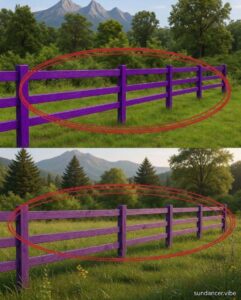
If you are walking through the countryside, hiking along a trail, hunting, or simply exploring a rural area in the United States, you may eventually notice something unusual.
A fence post has been painted purple.
Maybe there is a purple stripe on a tree.
Perhaps several posts along the edge of a property have small sections of purple paint.
At first, you might assume it is decoration.
You might even think someone chose the color simply because it looks distinctive.
But in some parts of the United States, purple paint can communicate a very important message.
It may mean:
Private property. Do not enter without permission.
These markings are commonly associated with what are known as “purple paint laws.”
The idea is relatively simple.
Property owners sometimes use purple paint to mark boundaries and communicate that people should not enter the land without permission.
The system can be particularly useful in rural areas, where traditional signs may be difficult to maintain.
A “No Trespassing” sign can fall down.
A wooden sign can become damaged.
A printed notice can fade in the sun.
A sign attached to a fence can disappear during storms.
Paint, however, can remain visible for a much longer period.
That makes it an appealing way for property owners to identify boundaries.
But there is an important point that every outdoor enthusiast should understand.
Purple paint does not automatically mean the same thing everywhere in America.
Laws governing these markings are determined at the state level.
That means the meaning and legal requirements can vary considerably depending on where you are.
In states that recognize purple paint as a property warning, the law may specify exactly how the markings must appear.
There may be rules concerning the size of the painted marks.
There may be requirements for how high the paint must be placed.
The markings may need to be a certain distance apart.
Some states may allow paint on trees, while others may have different requirements involving posts or fences.
Even the exact shade or type of marking can matter under particular state laws.
So seeing purple paint should not be treated as a universal national sign.
Instead, it should be treated as a potential warning that deserves attention.
Imagine that you are hiking in an unfamiliar rural area.
You come across a trail that appears to continue beyond a fence.
There is no large sign saying “Keep Out.”
The fence looks old.
There are no obvious people nearby.
It might be tempting to climb over and continue walking.
Then you notice several purple markings.
That is the moment to stop.
Don’t assume that the absence of a traditional sign means the land is open to the public.
The purple markings may have been deliberately placed to communicate that the property is private.
Even if you aren’t certain about the legal meaning, respecting the boundary is the safest choice.
This is particularly important because rural property boundaries are not always obvious.
A large wooded property may have no house visible from the road.
A field may appear completely empty.
A forest may look like an extension of a public trail.
But the land could still belong to a private owner.
People sometimes assume that if they cannot see a building, they are free to explore.
That assumption can create problems.
Private property doesn’t stop being private simply because the owner isn’t standing nearby.
Purple paint laws were partly developed to make boundaries easier to communicate.
Instead of requiring property owners to install signs every few yards, paint can provide a visible indication along the edge of the land.
For landowners, this can be practical.
For visitors, it can be an important clue.
However, another misconception is worth avoiding.
Not every purple-painted fence in the country is automatically a legal “No Trespassing” notice.
Someone could paint a fence purple for completely unrelated reasons.
A homeowner might like the color.
A farmer might use paint for marking purposes.
A trail organization could use colored markings for navigation.
A property owner could have painted something as part of a personal project.
The legal significance depends on the laws of the state and the circumstances in which the marking is being used.
That is why context matters.
If the purple paint is clearly being used to mark a property boundary, especially when it appears repeatedly along fences, trees, or posts, it is wise to assume the markings are intentional.
Don’t cross the boundary simply because you aren’t sure.
Instead, find out whether the land is public or private.
If you need to enter private property for a legitimate reason, ask the owner for permission.
This simple step can prevent an unnecessary confrontation.
It can also protect you from potential legal consequences.
Another reason to take these markings seriously is that rural property may contain hazards that aren’t visible from the road.
Private land could include livestock.
Farm equipment may be operating nearby.
There could be wells, ditches, hunting areas, ponds, unstable structures, or other dangers.
A property owner may have a very good reason for restricting access.
Even when there is no immediate danger, unauthorized visitors can disturb animals, damage crops, interfere with equipment, or accidentally create liability concerns for the landowner.
For hikers and outdoor enthusiasts, the safest habit is to know where public access ends.
Before beginning a hike, check the route.
Use official trail maps when possible.
Pay attention to signs.
Respect fences.
And don’t assume that a path is public simply because other people have used it.
If you are hunting, the issue can be even more important.
Hunters often travel through large rural areas where property boundaries can be difficult to distinguish.
A purple marking could be one of several indications that a particular parcel is privately owned.
Hunters should know exactly where they have permission to be and should understand the regulations in the state where they are hunting.
The same applies to photographers, campers, off-road drivers, anglers, and anyone else who spends time outdoors.
A beautiful landscape can be tempting.
A quiet forest can look like an invitation to explore.
But appearance doesn’t determine ownership.
One of the easiest ways to avoid trouble is simply to stop when you encounter a boundary marker you don’t understand.
Take a moment.
Look for additional signs.
Check your map.
If necessary, ask someone who knows the area.
The few minutes spent confirming access can save much more trouble later.
The concept of purple paint also demonstrates how different states can create different approaches to the same practical problem.
Property owners need a reliable way to communicate boundaries.
Visitors need a way to recognize those boundaries.
Traditional signs aren’t always convenient in remote areas.
Paint can provide another option.
But because property laws differ from state to state, travelers should avoid assuming that a rule they learned in one state automatically applies somewhere else.
If you’re traveling across state lines, especially for outdoor recreation, it is worth checking the local trespassing laws before entering unfamiliar land.
What is accepted as a legal property marking in one state may have different requirements elsewhere.
The location, size, spacing, and placement of purple markings can matter.
This is why online explanations that simply say “purple means no trespassing everywhere” can be misleading.
The more accurate lesson is this:
Purple paint can be a legal property warning in some states, but its exact meaning depends on local law.
That distinction is important.
So what should you do if you encounter purple paint while exploring?
First, don’t ignore it.
Second, don’t immediately assume you are allowed to continue.
Third, look for other signs of a property boundary.
Fourth, check local rules if you need to know the legal significance.
And finally, when in doubt, stay on the public side of the boundary.
Respecting private property isn’t only about avoiding fines or legal problems.
It is also about respecting the people who own and maintain the land.
A farmer may have spent decades caring for a field.
A family may own a large wooded property that has been passed down through generations.
A landowner may simply want privacy.
Whatever the reason, a clearly marked boundary deserves to be respected.
The next time you are driving through a rural part of the United States and notice a strange purple stripe on a fence post, don’t dismiss it as decoration.
It may be telling you something important.
It may be a quiet message from the property owner saying that the land beyond that point isn’t yours to explore.
And while the exact legal meaning varies from state to state, one habit will almost always serve you well:
When you see a boundary marker you don’t understand, stop, check, and respect the line.
Sometimes the most important warnings in nature aren’t written in large letters.
Sometimes they’re simply painted purple.