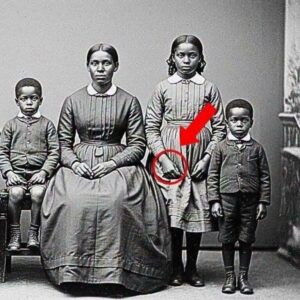
At first glance, the family photograph appears completely ordinary.
A mother sits carefully with her children, everyone dressed in formal clothing and positioned in the stiff, deliberate style common to nineteenth-century portraits.
The faces are serious.
The clothing is carefully arranged.
The furniture appears perfectly placed.
Nothing seems unusual.
Then you look more closely.
Near the older daughter’s hand, something strange appears.
It looks almost like another hand.
But there doesn’t seem to be another person positioned close enough to explain it.
That tiny detail has fascinated people for generations.
Some viewers see it immediately.
Others need several moments before they notice the unusual shape.
Once they see it, however, it becomes difficult to look at the photograph in quite the same way.
The image suddenly feels less like an ordinary family portrait and more like a mystery waiting to be solved.
Naturally, the unusual detail has inspired plenty of speculation.
Could it be a ghostly hand?
Was someone accidentally cropped out of the photograph?
Did the photographer somehow capture an unexplained figure?
Or is there a perfectly ordinary explanation hidden within the technology and photography practices of the nineteenth century?
Before jumping to the supernatural, it is important to understand how dramatically photography has changed.
Taking a photograph in 1872 was nothing like taking one today.
There were no smartphones.
There were no instant photographs.
There was no digital editing.
A photographer couldn’t simply tell a family to smile, press a button, and take another picture if someone moved.
Instead, nineteenth-century photography often required careful preparation and considerable patience.
Exposure times could be long, depending on the photographic process, available light, lens, and other conditions.
Subjects were therefore expected to remain still.
Very still.
For a family portrait, this could be surprisingly difficult.
Adults might manage it.
Children were another story.
Keeping several children motionless long enough for a photograph to be properly exposed could require patience from both the photographer and the family.
Photographers sometimes used posing supports to help people maintain their positions.
These devices could be hidden behind chairs, clothing, or other parts of the composition.
The purpose wasn’t to create anything mysterious.
It was simply practical.
If a person moved during a long exposure, the resulting image could become blurred or distorted.
A posing device could help keep the subject steady.
That historical context matters when examining unusual old photographs.
What looks impossible to modern viewers may actually be the result of equipment, lighting, clothing, or photographic limitations.
There is another possibility as well.
Human vision is remarkably good at finding recognizable shapes.
When we see an unusual pattern, our brains naturally try to turn it into something familiar.
A shadow can resemble a face.
A fold in fabric can look like a hand.
Two overlapping objects can appear to form a completely different shape.
This tendency is known as pareidolia.
It is why people sometimes see faces in clouds, buildings, tree bark, or random patterns.
An old photograph can be especially vulnerable to this effect because the image may contain shadows, grain, fading, scratches, and areas of reduced detail.
When a viewer sees what appears to be an extra hand, the brain immediately searches for a person who could have produced it.
But that doesn’t necessarily mean another person was present.
Clothing could be responsible.
Victorian clothing was often elaborate.
Long sleeves, layered fabrics, gloves, ribbons, folds, and overlapping garments could create shapes that are difficult to interpret.
The family members in an old portrait might also have been positioned closer together than modern viewers realize.
An arm belonging to one person could overlap another person’s body.
A hand could be partially hidden.
A sleeve could create the appearance of an additional limb.
The furniture itself could also contribute to the illusion.
Chairs, armrests, decorative objects, and shadows could blend together during the photographic process.
Another important consideration is the photograph’s physical condition.
A photograph created more than 150 years ago has had a very long life.
It may have been exposed to light.
It may have experienced changes in temperature and humidity.
It may have been stored in an album, handled repeatedly, or reproduced many times.
Small scratches or areas of deterioration can change the appearance of details.
When an image is scanned or photographed again today, those imperfections can become even more noticeable.
A mysterious shape that wasn’t especially striking to the original family might become fascinating to modern viewers examining a digital copy at high magnification.
This is one reason photographs should be studied carefully rather than interpreted from a quick glance.
The human desire to find a mystery in old photographs is understandable.
Historic images provide a direct visual connection to people who lived long before us.
We can see their faces.
We can examine their clothing.
We can observe their homes and surroundings.
But we can never completely hear their conversations or understand everything happening outside the frame.
That missing context creates room for imagination.
An unexplained hand therefore becomes more than a strange shape.
It becomes a question.
Who was standing there?
Was someone removed from the image?
Was there another family member?
Did the photographer make a mistake?
Was it an accident of exposure?
Or is the apparent hand simply an optical illusion?
Without the photographer’s original notes, additional photographs, or reliable documentation about the session, it may be impossible to establish exactly what produced the unusual appearance.
That doesn’t make the photograph meaningless.
In fact, uncertainty is part of its appeal.
The image encourages people to think about the technology and social customs of the period.
Family photography was still relatively new.
Having a formal portrait made could be an important occasion.
Families often dressed in their best clothing and traveled to a photographer’s studio specifically for the experience.
The resulting photograph might become a treasured family possession.
For many people, it could be one of the few images ever made of them.
That makes every surviving nineteenth-century photograph valuable.
Even a seemingly ordinary portrait can contain clues about the people and society of its time.
The serious expressions seen in many Victorian photographs are another detail that can seem strange to modern viewers.
People sometimes assume that everyone looked unhappy because smiling was forbidden.
The reality was more complicated.
Long exposure times made holding a natural smile difficult.
Remaining still was easier with a neutral expression.
Photography was also a formal event, and people often approached it with the seriousness associated with important occasions.
So the family’s solemn appearance isn’t necessarily mysterious.
It may simply reflect the conventions of the period.
The supposed extra hand deserves the same kind of careful consideration.
It is tempting to call it evidence of something supernatural.
But a photograph alone rarely provides enough information to support such a conclusion.
Before accepting an extraordinary explanation, it is worth considering ordinary possibilities.
Could the shape belong to one of the people already visible?
Could clothing be overlapping?
Could a shadow be creating the appearance of fingers?
Could movement have produced an unusual exposure?
Could the photograph have been damaged?
Could the image have been altered during reproduction?
These questions don’t make the mystery less interesting.
They make it more fascinating.
The real story may not be that a nineteenth-century photographer accidentally captured a ghost.
The real story may be that an ordinary family photograph contains a tiny visual puzzle that survived for more than a century.
Every generation that looks at it brings a different perspective.
Someone familiar with old photography may notice technical possibilities.
Someone interested in family history may wonder about an unidentified relative.
Someone fascinated by the supernatural may see something completely different.
And someone simply examining the photograph may notice that the mysterious hand doesn’t quite look like a hand at all.
That is the enduring appeal of historical photographs.
They freeze a moment, but they don’t always explain it.
They preserve faces while leaving countless details outside the frame.
A photograph from 1872 can tell us what people looked like, how they dressed, and how they wanted to present themselves.
But it cannot answer every question.
Perhaps that is why the strange detail has remained so captivating.
More than 150 years after the photograph was taken, people are still looking at the same tiny shape and asking the same basic question:
What exactly are we seeing?
The answer may eventually turn out to be completely ordinary.
It could be an arm, a sleeve, a shadow, an overlapping object, or a quirk of nineteenth-century photographic technique.
Or perhaps the precise explanation will remain uncertain.
Either way, the photograph has accomplished something remarkable.
It has taken a simple family portrait from 1872 and turned it into a conversation across generations.
And sometimes, the smallest detail in an old photograph is enough to keep people looking long after everything else seems perfectly ordinary.