The Final Conversation: A Story of Love, Confession, and Unexpected Truth
Henry had always believed that life would end the way it had been lived—quietly, with order, and with a sense of control. But as he lay in that dim hospital room, surrounded by the soft mechanical rhythm of machines that now dictated his breathing, control was the one thing he no longer had.
The air smelled faintly of antiseptic and old flowers. A card from a distant relative sat untouched on the bedside table. Outside the window, the world continued as if nothing important was happening. But inside the room, everything meaningful in Henry’s life had been distilled into a single presence: Martha.
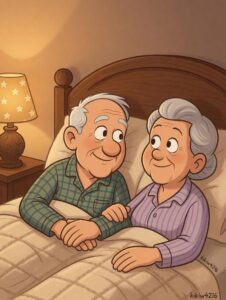
She sat beside him in a wooden chair that had been pulled too close to the bed, as if proximity alone could delay the inevitable. Her hands never left his. Fifty-two years of marriage had reduced themselves to this simple contact—skin against skin, history against memory.
Henry’s eyes fluttered open. It took effort. Even blinking felt like lifting something heavy.
“Martha,” he whispered.
She leaned in immediately. “I’m here.”
There was a long pause. The kind of pause that carries decades inside it.
Then Henry spoke again.
“Before I go… I need the truth.”
Martha didn’t flinch. She had been expecting this moment in some form, though not necessarily now, and not necessarily like this. She nodded slowly.
“Anything,” she said.
Henry swallowed, his throat dry. “Have you ever… been unfaithful to me?”
The question didn’t land like anger. It landed like exhaustion. Like something that had been carried too long and finally had to be put down.
For a moment, Martha didn’t answer. She looked at him—not at the man he was now, fragile and fading—but at the man he had been. The man who once fixed broken fences on weekends, who argued with neighbors about nothing important, who fell asleep on the couch during late-night television.
Then she exhaled.
“Yes,” she said softly. “Three times.”
Henry’s eyes widened slightly. Not in rage. Not in betrayal. But in disbelief that the world still had surprises left for him.
Martha tightened her grip on his hand.
“But Henry… you need to understand something. I never did it lightly.”
He closed his eyes briefly, then reopened them. “Tell me.”
And so she began.
The First Confession: The House That Almost Disappeared
“It was the year we nearly lost the house,” Martha said.
Her voice changed as she spoke, slipping into the rhythm of memory. The hospital room faded around her.
“You remember,” she continued. “You were working yourself to exhaustion. Double shifts. Sometimes triple. But it still wasn’t enough.”
Henry remembered. He remembered the envelopes with red lettering. The silence at dinner tables. The way financial fear makes even ordinary conversations feel like negotiations.
“I went to the bank,” she said.
Henry blinked. “You went alone?”
Martha nodded. “You were too proud. You would’ve never asked. So I did.”
She paused.
“The banker didn’t want to help us. Not at first. But I convinced him.”
Henry studied her face. “Convince… how?”
Martha gave a faint, tired smile. “The kind of convincing you don’t want details about.”
A long silence followed.
Then Henry let out something between a sigh and a laugh.
“You saved our home,” he said.
Martha nodded. “I saved us.”
He stared at the ceiling for a moment. The tension in his face softened.
“I can forgive that,” he said quietly.
And he meant it.
The Second Confession: The Life That Should Have Ended
Henry’s breathing grew uneven again. Martha adjusted his blanket.
“Tell me the second,” he said.
Martha hesitated.
“This one… was harder.”
She leaned forward slightly.
“You were sick, Henry. Really sick. The doctors said the surgery was necessary, but the cost…”
She shook her head. “It was impossible for us.”
Henry remembered fragments. Hospital corridors. Fear disguised as paperwork. Martha holding his hand too tightly.
“I went to see the surgeon,” she said.
Henry frowned. “You convinced him too?”
Martha didn’t answer immediately.
“I didn’t have much choice,” she admitted.
Another silence settled.
Then Henry whispered, “And after that?”
“The next morning,” she said, “the surgery was approved. No bill. No conditions.”
Henry closed his eyes.
For a long moment, he said nothing.
When he finally spoke, his voice cracked.
“You saved my life.”
Martha shook her head slightly. “I just refused to lose it.”
Henry turned his head toward her. “You should’ve told me.”
“And what would you have done?” she asked gently.
He didn’t answer.
Because they both already knew.
He would have been proud. And pride, in their world, had always been expensive.
The Third Confession: The Golf Club Election
Henry took a longer pause before speaking again. The effort was visibly draining him now, but something in him—curiosity, perhaps even mischief—kept him anchored.
“And the third?”
Martha smiled before she spoke. It was different from the earlier smiles. Lighter. Almost playful.
“Oh Henry,” she said softly. “This one is ridiculous.”
That alone made him suspicious.
“Tell me anyway.”
She sighed dramatically.
“Do you remember when you ran for president of the golf club?”
Henry squinted. “Of course I do. I lost by—”
“Seventy-three votes,” she finished.
“Yes,” he said. “Seventy-three.”
Martha nodded slowly.
“I helped you with that.”
Henry frowned. “You campaigned?”
“In a way,” she said.
A pause.
“A very… persuasive way.”
Understanding began creeping into his expression.
“How persuasive?” he asked.
Martha leaned closer.
“Let’s just say seventy-three people suddenly found very good reasons to change their minds.”
Henry stared at her.
Then, unexpectedly, a dry laugh escaped him.
“You’re telling me…” he began.
“Yes,” she said. “Every one of them.”
Henry shook his head slowly, half in disbelief, half in admiration.
“You cheated in a golf club election?”
“I ensured a fair outcome,” she corrected.
That made him laugh again—this time a little stronger.
The sound filled the room in a way nothing else had.
For a moment, the machines didn’t matter. The illness didn’t matter. Only the absurdity of it all remained.
“You’re unbelievable,” Henry said.
“And yet,” Martha replied, “you won.”
He laughed again, then coughed lightly.
When he recovered, he looked at her with something softer now.
“Was any of it ever… for you?” he asked.
Martha shook her head.
“Everything was for us.”
The Silence After Truth
The room quieted again, but it was a different kind of silence now. Not heavy. Not fearful. Something gentler had replaced it.
Henry lay back against the pillows. His eyes were tired, but calmer.
“You know,” he said slowly, “I thought I was the one holding this family together.”
Martha squeezed his hand.
“You were,” she said. “Just not alone.”
Henry turned his head slightly toward her.
“Did I ever thank you enough?”
Martha looked at him for a long time before answering.
“No,” she said honestly. “But you’re trying now.”
That seemed to satisfy him.
Outside, the light shifted. Afternoon moving quietly toward evening.
Henry’s breathing slowed. Not dangerously. Just naturally. Like a story approaching its final page.
“I don’t feel angry,” he said suddenly.
Martha nodded. “I didn’t think you would.”
“I feel…” he searched for the word, “lucky.”
That surprised her.
“Lucky?” she repeated.
He nodded faintly. “Not many men get a lifetime like this.”
Martha blinked quickly, fighting emotion.
“Even with my confessions?” she asked.
Henry gave a faint smile.
“Especially because of them.”