The morning of my wedding began the way every childhood dream had always pictured it—soft light spilling through tall windows, the gentle hum of preparation, and a strange mix of excitement and disbelief that the day had finally arrived. The venue in Asheville was already awake before I was. Outside, white roses lined the garden path like quiet witnesses to something sacred. Inside, makeup brushes tapped softly against porcelain trays, dresses rustled with nervous movement, and voices rose and fell in careful whispers that tried not to disturb the fragile emotional balance of the day.
I remember standing barefoot on the cool wooden floor of the bridal suite, staring at my reflection in the mirror. The dress was everything I had once imagined as a child—ivory silk that caught the light with every small movement, delicate lace tracing patterns along the sleeves, and a veil that felt almost too heavy with meaning. I should have felt like I was stepping into the happiest moment of my life.
Instead, I felt suspended somewhere between anticipation and unease.
My phone had been lighting up since dawn.
At first, I ignored it. Weddings are busy, chaotic, full of messages that don’t matter in the moment. But something about the frequency of the notifications made my stomach tighten.
When I finally looked, the first image froze me.
My mother.
Smiling in a luxury airplane seat, champagne glass raised slightly toward the camera, oversized sunglasses hiding any trace of hesitation. Behind her, my father leaned back comfortably, and beside them, my brother grinned as if nothing else in the world mattered.
The caption beneath the photo was short.
“On our way. Don’t wait up.”
Except they weren’t on their way here.
They were on their way somewhere else entirely.
Then came the second message.
A follow-up photo.
A destination brochure. Ocean views. Private villas. A spontaneous luxury trip they had apparently decided to take instead of attending my wedding.
And finally, a text.
“We thought you’d understand. This opportunity came up last minute.”
I read it once.
Then again.
And again.
But the meaning didn’t change.
They weren’t coming.
For a moment, I didn’t move. The world around me continued as if nothing had shifted. Someone laughed outside the door. A hanger clicked. A distant sound of music being tested floated through the air.
But inside me, something had gone still.
It wasn’t just disappointment. It was recognition.
This wasn’t new.
It was the same pattern I had lived with my entire life—the quiet hierarchy of my family where I always seemed to fall somewhere behind everything else. My brother’s chaos was always excused, always accommodated. My parents’ schedules always came first, their plans always fluid, their presence always conditional.
I had told myself that adulthood would change that.
That my wedding would be different.
That this moment, of all moments, would matter enough for them to stay.
But I was wrong.
A knock on the door pulled me back.
My maid of honor entered cautiously, her expression shifting the moment she saw my face.
“What happened?”
I didn’t answer immediately.
Because I didn’t know how to say it out loud without it becoming real.
“They’re not coming,” I finally said.
The words felt foreign, like they belonged to someone else’s life.
Her face fell instantly, and she crossed the room to me, but I stepped back before she could touch me. I didn’t trust myself not to fall apart completely if I allowed it.
Outside, the ceremony preparations continued. Chairs were being arranged. Guests were arriving. The world was moving toward a moment I now felt strangely disconnected from.
I should have felt like the center of something meaningful.
Instead, I felt like I was standing at the edge of a story I no longer fully belonged to.
When Daniel—my fiancé—texted asking if everything was okay, I couldn’t respond. Not because I didn’t want to, but because I didn’t know how to translate what I was feeling into something he could carry without it breaking him too.
So I said nothing.
And kept moving forward.
Because that’s what you do on a wedding day, even when something inside you has quietly collapsed.
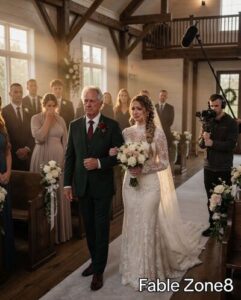
Minutes before the ceremony, I stood just behind the large wooden doors that separated me from the garden aisle. Through the gaps, I could see guests settling into their seats. I could hear the string quartet beginning to play something soft and hopeful.
The air smelled like flowers and anticipation.
And abandonment.
That’s when the door beside me opened.
Daniel’s father stepped in.
He didn’t speak at first. He simply looked at me—really looked at me—in a way that didn’t carry questions or judgment. Just understanding. A steady kind of presence that didn’t demand explanation.
He had always been a quiet man, observant in a way that made him feel grounded in every room he entered. But in that moment, he felt like something more.
He noticed.
“You don’t have to do this alone,” he said simply.
I shook my head immediately. “It’s fine. I can—”
But my voice cracked before I could finish.
He didn’t argue. He didn’t try to fix it. He just stepped closer and offered his arm.
And waited.
Something in me broke open at the simplicity of it.
Not pity.
Not performance.
Just presence.
I hesitated only for a second before I took it.
The music outside changed.
The doors opened.
And I walked.
Every step down that aisle felt like walking through two versions of myself at once—the one who had expected to be surrounded by family, and the one who was learning what it meant to still move forward when they didn’t show up.
Guests turned.
Whispers rose and fell.
But I barely heard any of it.
Because I could feel something steadier beside me.
Daniel saw me first.
His expression shifted instantly, confusion breaking into realization, then emotion so strong it visibly overwhelmed him. He pressed a hand to his mouth, eyes already filling.
But what anchored me wasn’t his reaction.
It was the man beside me.
My father-in-law walking me forward as if this was the most natural thing in the world. As if absence had never been an obstacle. As if I had always belonged there.
When we reached the altar, he squeezed my hand gently.
And let go.
That moment stayed with me more than anything else that day.
Because I realized something I hadn’t understood before:
Belonging is not inherited.
It is given through action.
The ceremony unfolded like something fragile and real at the same time. Vows were spoken through tears. Hands shook. Laughter broke through emotion unexpectedly. And beneath it all, a strange mixture of joy and grief coexisted without resolution.
Because love does not erase absence.
It learns to exist alongside it.
Afterward, when the celebration softened into quieter conversation and fading music, I found myself sitting outside with Daniel’s father.
The air was cooler now. The noise of the day had receded into memory.
He spoke eventually, his voice low.
“I know what it feels like,” he said.
I turned toward him.
He explained, slowly, that he had once been the person who waited for others who didn’t come. That he had learned early in life that showing up for people was not just kindness—it was a choice. A deliberate one.
“I promised myself,” he said, “that if I ever saw someone standing where I once stood, I wouldn’t let them stand there alone.”
I didn’t cry immediately.
But something inside me shifted.
Because for the first time that day, I didn’t feel invisible.
I felt witnessed.
Weeks later, a short clip from the ceremony surfaced online. It wasn’t planned. Just a moment captured and shared—the doors opening, the pause, the arm offered, the walk forward.
It spread quietly at first.
Then widely.
People didn’t just see a wedding moment.
They saw something they recognized.
Abandonment.
And the unexpected form of love that can follow it.
Messages came from strangers who had experienced their own versions of absence—parents who missed milestones, families fractured by distance or indifference, people who understood what it meant to sit in rooms filled with celebration while feeling completely alone.
But what resonated most wasn’t the absence.
It was the presence that replaced it.
My parents eventually called.
Not to apologize.
But to explain.
To rationalize.
To protect how things looked.
And in that moment, something inside me finally settled into clarity.
I stopped waiting for them to become different.
Because I had already been given something else.
Something quieter.
Something stronger.
Presence.
Life after the wedding didn’t become perfect.
But it became honest.
And that honesty changed everything.
Because I learned, slowly, that family is not defined by who arrives when expected.
It is defined by who steps forward when others do not.
And on the day I thought I would break under absence, I discovered something I had never been taught to look for.