The thermometer on my nightstand read 102 degrees.
My throat felt like sandpaper, every muscle hurt, and even lifting my head from the pillow required more energy than I seemed to have.
Downstairs, my children were arguing over the television.
“Mom!” my eight-year-old daughter, Lily, called. “When is Dad coming home?”
“Soon,” I managed.
A few moments later, six-year-old Ethan appeared in my doorway.
“Are we having dinner?”
Immediately, I felt guilty.
Mothers don’t get to put life on pause.
At least, that’s how I had always treated motherhood.
Laundry still exists when you’re sick.
Children still need dinner.
Homework doesn’t disappear because you have a fever.
But that afternoon, walking to the bathroom had left me dizzy.
Earlier, my husband Nathan had texted from work:
Don’t cook tonight. Seriously. Stay in bed. I’ll handle everything when I get home.
So I did something I rarely did.
I ordered dinner.
Pasta with meat sauce for the children.
Steak and potatoes for Nathan.
Chicken soup for me.
Bread.
And a small dessert for Lily and Ethan.
The total came to almost $90.
I hesitated before placing the order.
Ninety dollars wasn’t nothing.
But neither was my health.
Then the front door opened.
The food arrived around 5:30.
I managed to bring everything into the kitchen before returning upstairs.
Ten minutes later, I heard someone enter.
For a second, I thought Nathan had come home early.
Then I heard the voice.
“Where is everyone?”
Angela.
My mother-in-law.
Angela had a habit of arriving without calling.
She believed close family members shouldn’t need invitations.
Normally, I tolerated it.
That evening, I didn’t have enough energy to argue.
“Grandma,” Lily said downstairs, “Mom’s sick.”
Angela walked into the kitchen.
Then everything went quiet.
“You spent ninety dollars on dinner?”
Angela appeared in my bedroom doorway.
Her arms were folded.
“What’s all that takeout downstairs?”
“I’m sick,” I said. “Nathan told me not to cook.”
“You ordered all of that?”
I nodded.
“You spent almost ninety dollars because you didn’t feel like cooking?”
“I have a 102-degree fever.”
Her expression didn’t change.
“A good wife doesn’t waste money on restaurant food just because she doesn’t feel well.”
I stared at her.
“I can barely stand.”
“That doesn’t mean you can’t make soup.”
Despite everything, I laughed.
“I did get soup.”
Then Angela turned and walked downstairs.
I thought the conversation was over.
I was wrong.
I heard the trash can open.
A cabinet slammed.
Then another sound.
I forced myself out of bed and slowly made my way downstairs.
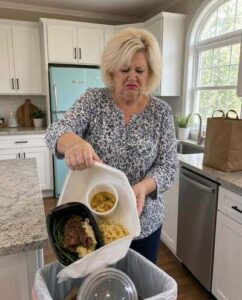
Angela was standing beside the kitchen counter.
The takeout containers were lined up in front of her.
She picked up Nathan’s steak.
“This is ridiculous.”
“Angela, please don’t.”
She opened the trash.
Then dropped it inside.
“Angela!”
Next came the pasta.
Then the potatoes.
Then the bread.
I stared at her in disbelief.
Finally, she reached for my soup.
“No.”
I stepped forward.
“Please. Don’t throw that away. I need it.”
She looked directly at me.
Then dropped the soup into the trash.
Even Lily started crying.
Ethan stared at his grandmother.
“Grandma, why did you do that?”
“Because your mother needs to learn responsibility.”
I wanted to fight back.
I wanted to tell her to leave.
Instead, I stood there shaking from fever and exhaustion.
That evening, my children ate crackers and peanut butter.
I returned upstairs.
And I cried.
Not because of the ninety dollars.
Not even because I was hungry.
I cried because someone had looked at me while I was visibly sick and decided I needed punishment instead of compassion.
Nathan came home around seven.
He knew immediately that something was wrong.
He found me sitting on the edge of our bed.
“What happened?”
I told him everything.
Nathan listened without interrupting.
Then he went downstairs.
I could hear Angela defending herself.
“I was teaching her a lesson.”
Nathan said almost nothing.
A minute later, he returned upstairs.
His expression was completely calm.
Too calm.
He picked up his phone.
“Who are you calling?” I asked.
“Aunt Irene.”
Twenty minutes later, Irene arrived carrying an old casserole dish.
It was scratched and faded.
A strip of yellowing tape remained attached underneath.
Nathan took the dish from his aunt.
Then he turned it over.
Two words had been written on the tape:
ANGELA — TUESDAY
My mother-in-law’s face changed instantly.
“What is that?” I asked.
Nathan looked toward me.
“Something Mom apparently forgot.”
Angela immediately interrupted.
“Nathan, don’t.”
He did anyway.
“When Dad died,” Nathan said, “Mom didn’t have money for groceries.”
Angela looked down.
“You don’t need to tell her that.”
“But she deserves to know.”
Nathan continued.
“Mom had lost her job. She was behind on the mortgage, and she was too embarrassed to tell anyone.”
I looked at Angela.
The woman who had just thrown away nearly ninety dollars of food suddenly looked much smaller.
Irene placed the casserole dish on the counter.
“This was from twenty-two years ago,” she said.
I looked at the faded tape.
“Why does it say Tuesday?”
“Because Tuesday was the day your mother-in-law couldn’t afford dinner.”
Angela closed her eyes.
Irene continued.
“Every Tuesday, I brought her a casserole. Sometimes soup. Sometimes pasta. Whatever I could afford.”
Nathan looked at his mother.
“She accepted it for months.”
Angela’s voice cracked.
“I was going through a difficult time.”
Nathan nodded.
“I know.”
Then he looked at me.
“And there was another person who helped her.”
I waited.
“Your father.”
I stared at him.
“My father?”
Nathan nodded.
“My dad knew Mom was struggling. He didn’t want to embarrass her, so he quietly paid two months of her mortgage.”
Angela looked up.
“I never asked him to.”
“No,” Nathan said. “You didn’t.”
Silence filled the kitchen.
Then Irene said something that made me understand the entire situation.
“Your mother didn’t just need food back then. She needed someone to tell her that being unable to provide for yourself for a while didn’t make you lazy.”
Angela’s eyes filled with tears.
I looked at the woman who had called me lazy less than an hour earlier.
For the first time, I saw something different in her face.
Not anger.
Shame.
Nathan picked up the casserole dish.
“Mom, you taught me something when I was a kid.”
She looked at him.
“You told me that when someone is struggling, you help them. You don’t make them feel worse.”
Angela began crying.
“I know.”
“No,” Nathan said gently. “I don’t think you remembered.”
She looked at me.
Then at the trash can.
“I was wrong.”
The words were quiet.
But they mattered.
She walked toward the trash and looked inside.
“My God.”
She covered her mouth.
“I really did that.”
I nodded.
“You did.”
Angela turned toward me.
“I was angry because I thought you were wasting money.”
“I understand.”
“No,” she said. “You don’t.”
She wiped her eyes.
“I wasn’t angry about the food.”
I waited.
“I was angry because I was jealous.”
That surprised me.
“Jealous?”
She nodded.
“When I was your age, I was terrified of asking anyone for help. I felt ashamed every time someone brought me food.”
Her voice trembled.
“And when I saw those bags downstairs, I remembered how helpless I felt.”
She looked at the floor.
“So I convinced myself you were being lazy because I couldn’t admit that I was remembering myself.”
Nobody spoke.
Then Lily walked over and hugged her grandmother.
“Grandma, Mom was really sick.”
Angela knelt down.
“I know, sweetheart.”
She looked at Lily.
“And I was mean.”
Lily nodded seriously.
“You should say sorry.”
Angela gave a tiny laugh through her tears.
“I should.”
She stood and walked toward me.
“I am sorry.”
I didn’t immediately respond.
She continued.
“You didn’t deserve what I said. You didn’t deserve to have your food thrown away. And you certainly didn’t deserve to feel guilty for taking care of yourself.”
I felt tears gather in my eyes.
“Thank you.”
The next morning, I woke up to the smell of chicken soup.
I slowly walked into the kitchen.
Angela was standing at the stove.
She turned around.
“I made enough for everyone.”
Then she pointed toward a container on the counter.
“And this is yours.”
I smiled.
“Thank you.”
She hesitated.
“There’s something else.”
She pulled an envelope from her purse.
Inside was ninety dollars.
“I know this doesn’t fix what I did,” she said. “But I want you to replace the dinner I threw away.”
I pushed it back toward her.
“You don’t have to.”
“I know.”
She smiled.
“But I want to.”
I accepted the envelope.
Not because of the money.
Because sometimes an apology means more when someone is willing to repair what they broke.
That evening, we all sat around the table.
Angela told the children stories about Nathan when he was little.
Irene brought another casserole dish.
And for the first time, I understood that people can carry old pain for decades without realizing it.
Sometimes they pass that pain onto someone else.
And sometimes, all it takes is one difficult moment to reveal where it came from.
Angela had called me lazy while I lay sick in bed.
But she eventually realized she wasn’t really judging me.
She was judging the frightened, struggling woman she had once been.
And perhaps the most important lesson that night wasn’t about ninety dollars of wasted food.
It was about kindness.
Because one day, any of us might be the person who needs the casserole.
And when that day comes, we should hope someone remembers to bring it.