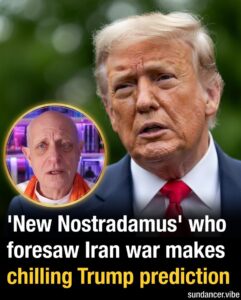
In an age defined by rapid information flow and global uncertainty, bold predictions often gain traction far beyond their original context. The latest example comes from Craig Hamilton-Parker, a figure frequently referred to by followers as a “New Nostradamus.” His recent claim—that a future global crisis could create conditions allowing Donald Trump to secure a third presidential term—has sparked widespread discussion, curiosity, and, in some cases, concern.
At first glance, the prediction appears dramatic, even alarming. It combines geopolitical instability, constitutional disruption, and the possibility of unprecedented political change. But when examined closely, the claim reveals far more about how people process uncertainty than it does about any realistic political outcome.
The Prediction and Its Appeal
Craig Hamilton-Parker has built an audience by offering interpretations of global events through spiritual and intuitive frameworks. His predictions often center on large-scale disruptions—wars, economic shifts, and political upheaval—scenarios that naturally attract attention because they align with real-world anxieties.
In this case, the prediction suggests that a major global conflict or crisis could destabilize existing systems to such an extent that constitutional norms in the United States might be overridden. Within that hypothetical environment, he speculates that Donald Trump could remain in or return to power beyond the standard two-term limit.
The appeal of such a claim is not difficult to understand.
It taps into several powerful psychological currents:
- Fear of instability
- Curiosity about the future
- Distrust in institutions
- Fascination with dramatic, unconventional outcomes
When these elements combine, even highly unlikely scenarios can feel plausible.
What the Law Actually Says
Despite the attention the prediction has received, the legal reality is far more straightforward.
The 22nd Amendment to the United States Constitution clearly states that no person can be elected president more than twice. This rule is not a guideline or tradition—it is a binding constitutional limit.
Changing it would require a formal amendment process involving:
- Approval by two-thirds of both houses of Congress
- Ratification by three-fourths of U.S. states
This is one of the most demanding procedures in American governance. It cannot happen quietly, quickly, or without widespread public awareness and political consensus.
Even during times of crisis, constitutional structures are designed to remain intact. In fact, they exist precisely to prevent the concentration of power that such predictions imply.
Crisis and Constitutional Stability
History shows that crises can test political systems—but they do not automatically dismantle them.
The United States has faced:
- Civil war
- World wars
- Economic depressions
- National emergencies
In each case, while policies and leadership evolved, the core constitutional framework remained in place.
The idea that a single individual could bypass these mechanisms and extend their presidency indefinitely without legal reform does not align with how democratic institutions function.
This doesn’t mean systems are unchangeable—but change occurs through defined processes, not sudden, invisible shifts.
The Role of Belief Systems
A key aspect of this story lies in how predictions are generated.
Craig Hamilton-Parker draws on spiritual traditions such as intuitive readings and astrological interpretations. These approaches are meaningful within certain personal or cultural contexts, but they are not recognized as reliable methods for forecasting political events.
Unlike political science, law, or international relations—which rely on evidence, data, and structured analysis—psychic predictions are inherently subjective.
They are not testable in a consistent way.
They are not bound by accountability.
And they often allow for broad interpretation.
This flexibility can make them appear accurate after the fact, even when they lack precision beforehand.
The Illusion of Predictive Accuracy
Supporters of Craig Hamilton-Parker often point to past predictions that seem to align with real-world events. However, this perception is influenced by a well-documented cognitive bias: selective recall.
People tend to remember:
- Predictions that appear correct
- Statements that match known outcomes
And they often forget:
- Incorrect forecasts
- Vague predictions that never materialized
In many cases, predictions are framed broadly enough that multiple outcomes could be interpreted as “success.”
For example, forecasting “political upheaval” or “major global conflict” is not highly specific—it reflects ongoing possibilities that are frequently discussed in mainstream analysis.
This does not mean the predictions are accurate.
It means they are adaptable.
Media Amplification and Viral Spread
The way such claims spread is equally important.
Modern media ecosystems prioritize engagement. Headlines are often designed to capture attention quickly, emphasizing the most dramatic elements of a story.
As a result:
- Speculation can be presented as possibility
- Possibility can feel like probability
- Probability can be mistaken for inevitability
When a claim involving Donald Trump and constitutional change is framed in a sensational way, it naturally attracts clicks, shares, and discussion.
But in the process, nuance is often lost.
The original context—uncertainty, interpretation, speculation—can be replaced by a simplified narrative that feels more concrete than it actually is.
Fear, Uncertainty, and Human Nature
At a deeper level, the popularity of such predictions reflects how people respond to uncertainty.
When the world feels unstable, individuals often seek:
- Clear answers
- Strong narratives
- A sense of control
Psychic predictions offer something traditional analysis cannot always provide: certainty.
Even when that certainty is not grounded in evidence, it can feel reassuring.
It transforms complex, unpredictable systems into a single storyline—one that is easier to understand, even if it is not accurate.
The Reality of Political Change
Real political change is rarely sudden or mysterious.
It is typically:
- Gradual
- Public
- Debated
- Documented
Changes to constitutional law, especially something as significant as presidential term limits, involve:
- Legal proposals
- Legislative debate
- Public scrutiny
- State-level approval
These processes are designed to be transparent and resistant to rapid shifts.
They do not operate in secrecy or through external prediction.
Separating Possibility From Probability
One of the most important skills in navigating modern information is distinguishing between what is possible and what is likely.
Is it theoretically possible for the Constitution to be amended?
Yes.
Is it likely that such a change would occur quickly, quietly, and under crisis conditions to benefit a single individual?
No.
This distinction matters.
Because without it, speculation can easily be mistaken for realistic forecasting.
Why Stories Like This Persist
Stories like this continue to gain attention for several reasons:
- They are emotionally engaging
They provoke curiosity, concern, and debate. - They align with existing narratives
Political polarization and global uncertainty make dramatic claims feel more believable. - They spread easily online
Social media amplifies content that triggers strong reactions. - They simplify complexity
Instead of navigating complicated systems, they offer a single, compelling storyline.
A Broader Reflection
Ultimately, this story is less about Craig Hamilton-Parker or Donald Trump and more about how information is created, shared, and interpreted.
It highlights:
- The gap between belief and evidence
- The influence of media framing
- The human desire for certainty in uncertain times
Understanding these dynamics is essential—not just for evaluating this claim, but for navigating countless others that emerge in similar ways.
Conclusion: Staying Grounded in Reality
The idea that a global crisis could enable a third presidential term for Donald Trump is not supported by legal, political, or institutional evidence. It remains a speculative scenario rooted in interpretation rather than fact.
But the story’s impact goes beyond its accuracy.
It serves as a reminder of how easily compelling narratives can take hold—especially when they intersect with fear, uncertainty, and curiosity about the future.
In a world where information moves quickly and not always carefully, the most valuable approach is a grounded one:
Question the source.
Examine the evidence.
Distinguish between belief and reality.
Because while predictions may capture attention, it is understanding—not speculation—that ultimately provides clarity.