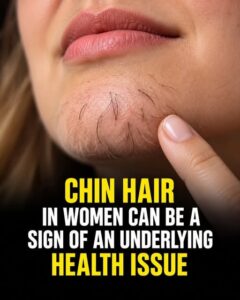
Finding a few dark hairs on the chin can be a completely normal part of life for many women. Facial hair can become more noticeable with age, and genetics play an important role in determining where and how much hair grows.
But when chin or facial hair suddenly becomes thicker, darker, or more widespread, it can sometimes reflect a change in hormone levels.
That doesn’t necessarily mean something is wrong. Hormonal changes can occur naturally at different stages of life. However, a noticeable or rapid change in facial hair growth may be worth mentioning to a healthcare professional, particularly if it occurs alongside other symptoms.
Why Does Chin Hair Become More Noticeable?
Hair growth is influenced by hormones called androgens, which are present in both men and women.
As women age, changes in the balance of hormones can affect hair growth. Estrogen levels may decline during and after menopause, while the relative effect of androgens can become more noticeable.
As a result, some women may develop a few coarse hairs on the chin, upper lip, jawline, or other areas of the face.
This can happen even when hormone levels themselves are not abnormally high.
Genetics also matter. Some women naturally have more facial hair than others, and family patterns can influence when and where coarse hairs appear.
So, finding one or two chin hairs does not automatically indicate a medical problem.
When Facial Hair May Deserve More Attention
Doctors may use the term hirsutism when women develop excessive coarse or dark hair in areas where androgen-dependent hair growth is more typical in men.
The amount of hair considered excessive can vary considerably between individuals and populations.
A gradual increase in a few chin hairs over many years can be a normal part of aging.
A sudden or substantial increase, however, may deserve evaluation.
It becomes particularly useful to talk with a healthcare professional if facial hair appears alongside other changes, such as irregular menstrual periods, significant acne, scalp hair thinning, unexplained weight changes, or other signs of hormonal imbalance.
The pattern and timing of symptoms can help a clinician determine whether further evaluation is appropriate.
Polycystic Ovary Syndrome Is One Possible Cause
One condition associated with increased androgen activity is polycystic ovary syndrome, commonly called PCOS.
PCOS can affect hormone levels and may be associated with irregular periods, acne, increased facial or body hair, and other symptoms.
However, having chin hair alone does not mean someone has PCOS.
Many other factors can influence facial hair growth, and a healthcare professional would consider the overall pattern of symptoms rather than focusing on one isolated sign.
Other Possible Causes
Hormonal changes aren’t the only explanation.
Certain medications can influence hair growth, while some endocrine conditions can also affect androgen levels.
In many cases, however, the cause is simply genetics, normal aging, or a combination of several factors.
That’s why internet searches can sometimes create unnecessary anxiety. A symptom can have many possible explanations, and only an appropriate medical evaluation can determine whether a specific condition is involved.
When a Sudden Change Matters
One detail doctors may pay attention to is how quickly the change occurs.
A few new hairs appearing gradually over several years are very different from rapidly developing coarse facial hair accompanied by other physical changes.
A sudden and pronounced increase in facial or body hair should therefore be discussed with a healthcare professional, particularly if other symptoms appear at the same time.
Rarely, rapid androgen-related changes can be associated with conditions that require medical investigation.
That does not mean that a sudden chin hair automatically indicates a serious disease. It simply means that an unexpected change deserves appropriate attention rather than being automatically dismissed as aging.
What Can You Do About Chin Hair?
If the issue is primarily cosmetic, there are several common ways to manage unwanted facial hair.
Tweezing can work well for a small number of individual hairs.
Shaving is another straightforward option and does not cause hair to grow back thicker, although the blunt tip of a newly shaved hair can temporarily make it feel coarser.
Waxing, threading, depilatory products, laser hair removal, and electrolysis are other options, depending on individual circumstances.
People with sensitive skin should be particularly careful with chemical hair-removal products and follow product instructions closely.
A dermatologist or qualified professional can also discuss longer-term hair-removal options.
Don’t Let a Single Hair Cause Panic
It’s easy to see one unexpected chin hair and immediately wonder whether it signals a hormonal disorder.
Usually, there is no reason to panic.
Human hair growth varies enormously, and a few isolated facial hairs are common.
The more useful approach is to pay attention to changes over time.
Has the amount of hair gradually increased with age?
Are there suddenly many more coarse hairs than before?
Are menstrual cycles changing?
Has new acne appeared?
Is there unexpected scalp hair thinning?
Are there other changes that seem unusual?
Those broader patterns provide much more information than one stray hair.
When to Talk With a Healthcare Professional
Consider discussing increased facial hair with a doctor or dermatologist if the growth is new, rapidly increasing, unusually extensive, or accompanied by other symptoms.
A clinician may ask about your medical history, medications, menstrual cycle, family history, and other physical changes. Depending on the circumstances, they may decide that no testing is necessary or may recommend blood tests to evaluate hormone levels.
The important point is that facial hair should be considered in context.
It is not a diagnosis by itself.
The Bottom Line
A few chin hairs are common and can become more noticeable as women get older. Genetics and normal hormonal changes can both play a role, and many cases are simply a cosmetic issue.
However, new or rapidly increasing coarse facial hair, especially when accompanied by other hormonal symptoms, can sometimes be a reason to speak with a healthcare professional.
The goal isn’t to become alarmed by every change.
It’s simply to understand your own baseline and recognize when something has changed significantly.
A single chin hair may be nothing more than a normal part of getting older.
A sudden pattern of changes, on the other hand, is something worth paying attention to.