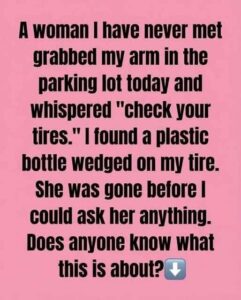
Finding a plastic bottle wedged against one of your car tires can be unsettling. If you have seen viral social media posts about this situation, you may immediately wonder whether someone is trying to steal your vehicle. For years, posts have circulated claiming that criminals deliberately place an empty plastic bottle against a tire as part of a car-theft technique.
According to the story, the bottle is positioned so that it makes a loud popping, crushing, or crackling sound when the vehicle begins moving. The driver supposedly hears the unusual noise, gets out of the car to investigate, and leaves the vehicle vulnerable while the engine is running or the keys remain inside.
The story sounds plausible enough to make people nervous.
However, there is an important distinction between a widely shared warning and a verified, widespread criminal tactic. Although reports and social media posts have repeatedly described the plastic-bottle scenario, there is limited reliable evidence establishing it as a common method used by vehicle thieves.
That does not mean you should ignore an unfamiliar object around your vehicle. It simply means you should respond to the situation based on what you can actually observe rather than assuming that the bottle automatically indicates an attempted theft.
If you discover a plastic bottle near a tire, the first thing to do is remain calm.
Before entering the vehicle or starting the engine, take a moment to look around. Check the other tires, the area immediately around the car, and the surrounding parking space. If the vehicle is parked somewhere unfamiliar, poorly lit, or isolated, pay particular attention to your surroundings.
You do not need to approach anyone or investigate suspicious people yourself.
If you see someone behaving suspiciously near your vehicle, move to a safer location if possible and contact local authorities or security personnel when appropriate.
If the area appears normal and the bottle simply looks like discarded litter, you can still check the vehicle before driving away. Make sure the bottle is not caught underneath the tire, tangled around a wheel, or positioned somewhere that could interfere with movement.
This is especially important because a plastic bottle can become a physical hazard regardless of why it is there. Objects near a tire can potentially affect driving if they become trapped under the vehicle or interfere with a moving component.
Do not deliberately drive over the bottle just to see what happens.
If you can safely remove it without putting yourself in danger, do so. If the bottle appears stuck, or you notice something unusual around the wheel, it may be better to have the vehicle inspected rather than attempting to remove anything forcefully.
Another important point is that a bottle near a tire does not necessarily mean somebody placed it there intentionally.
Parking lots and streets contain all kinds of discarded objects. A bottle can be moved by wind, pedestrians, animals, passing vehicles, or other environmental factors. It may have been lying on the ground and become lodged against the tire by chance.
Context matters.
For example, finding a bottle beside your vehicle in a busy public parking lot is very different from noticing deliberate interference with your vehicle, damage to a lock, tampering with the doors, or other signs that someone has attempted to gain access.
The viral story can sometimes cause people to focus so heavily on the bottle that they overlook more meaningful warning signs.
If you are concerned about vehicle security, it is more useful to follow general safety practices than to rely on one specific internet rumor. Lock your vehicle when leaving it unattended, take your keys with you, avoid leaving valuables visible inside, and park in well-lit or populated areas when possible.
If your vehicle has an alarm, immobilizer, tracking system, or other security feature, make sure you understand how it works and keep it maintained. Modern vehicles may also have manufacturer-specific security functions that can provide additional protection.
You should also pay attention to your surroundings when entering or leaving your vehicle. If something feels unusual, you do not have to investigate immediately. You can return to a safe location, contact someone you trust, or ask nearby security personnel for assistance.
One of the biggest problems with viral warnings is that a repeated claim can begin to feel like established fact simply because people have seen it many times.
A photograph showing a plastic bottle beside a tire does not, by itself, prove that a theft attempt has occurred. A social media post describing a supposed criminal method is not the same as documented evidence showing that the method is common.
That distinction is worth remembering whenever you encounter alarming safety advice online.
At the same time, skepticism about the viral claim should not turn into complacency. Criminal methods can vary, and unusual situations should still be treated thoughtfully. The sensible response is to consider the entire situation rather than automatically accepting or dismissing the explanation.
If you find a bottle near your tire, inspect the vehicle from a safe position. Look for obvious signs of damage or tampering. Check whether anything is obstructing the wheel. Pay attention to your surroundings. If you see something genuinely suspicious, avoid confrontation and seek appropriate assistance.
If everything appears normal, the bottle may simply be litter.
There is also no reason to put yourself in danger to prove whether an internet warning is true. Your safety is more important than identifying the origin of a discarded plastic bottle.
Parents can also use situations like this to teach teenagers and new drivers a useful lesson: unusual objects around a vehicle should be treated thoughtfully, but not every strange-looking situation is evidence of a crime.
The same principle applies to many viral safety stories. A warning may contain a useful reminder about general awareness while exaggerating or simplifying the specific threat. Checking reliable information before sharing such claims can prevent unnecessary fear.
Ultimately, finding a plastic bottle against your tire is not proof that someone is targeting your car. The commonly repeated story about criminals using bottles to distract drivers has circulated widely, but its status as a widespread theft technique is not firmly established by reliable evidence.
The best response is simple: stay alert, inspect your surroundings, avoid confrontation, and make sure the object cannot interfere with your vehicle before driving.
If you notice additional signs of tampering or feel genuinely unsafe, contact local authorities or appropriate security personnel rather than attempting to investigate the situation yourself.