There are cities where history exists mainly in museums and monuments.
And then there are places where history is part of the landscape.
Vicksburg, Mississippi, belongs to the second category.
Perched on bluffs overlooking the Mississippi River, the city has a distinctive setting that helped shape its development, economy, and architecture.
Its historic neighborhoods contain houses from different periods, each reflecting changing tastes, building techniques, family structures, and ideas about what a comfortable home should be.
Walking through these neighborhoods can feel like moving through several chapters of American residential history at once.
A Greek Revival house may stand near an Italianate residence.
A Victorian home may sit only a short distance from a Queen Anne property.
Each has its own personality.
And each can tell a story.
A City Shaped by Its Location
Vicksburg’s position along the Mississippi River played an important role in its growth.
The river connected communities, encouraged trade, and helped make transportation central to the city’s development.
The elevated bluffs also gave the city a distinctive physical character.
Over generations, families built homes that reflected their circumstances and the architectural fashions of their time.
Some houses were modest.
Others were designed to impress.
Many have survived because later generations recognized their historical importance.
Today, these properties offer visitors an opportunity to see how architecture and local history became intertwined.
Greek Revival Influence
Greek Revival architecture became popular in the United States during the nineteenth century.
The style often emphasized symmetry, strong proportions, classical columns, and formal entrances.
These homes were influenced by the architecture of ancient Greece and the classical world.
In a historic city such as Vicksburg, surviving examples provide a glimpse into the architectural preferences of earlier generations.
The style could communicate order, stability, and sophistication.
Even when a home has undergone renovations, original proportions and exterior details can help reveal the period in which it was built.
Victorian and Italianate Details
Victorian-era architecture introduced a wide variety of decorative approaches.
Italianate homes, for example, often featured tall windows, decorative brackets, broad eaves, and other details inspired by Italian villas.
The style could create a strong visual presence without relying on the same classical vocabulary associated with Greek Revival architecture.
Other Victorian homes incorporated more elaborate ornamentation.
As building materials and manufacturing techniques developed, homeowners had access to decorative elements that could be produced and transported more easily.
This allowed residential architecture to become increasingly detailed.
The Queen Anne Era
Queen Anne architecture is perhaps one of the most recognizable Victorian styles.
These houses often feature irregular shapes, varied rooflines, decorative woodwork, porches, towers, and complex combinations of textures.
No two examples necessarily look exactly alike.
The style encouraged visual variety.
For modern visitors, that makes Queen Anne houses particularly interesting because there are so many details to discover.
A porch railing, window surround, decorative gable, or section of patterned siding can reveal the attention builders once gave to even relatively small elements.
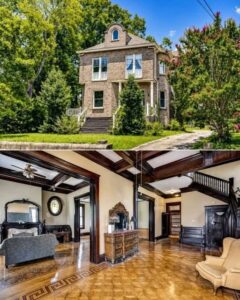
Craftsmanship Inside the Home
The exterior may be what catches a visitor’s eye first, but historic houses often become even more fascinating once you look inside.
Original wood floors can reveal years of use.
Fireplaces show how earlier households heated and gathered within their homes.
High ceilings helped create a sense of openness.
Decorative moldings added visual detail.
Plasterwork and carved wood trim demonstrate the craftsmanship of earlier builders.
These elements were often created with tools and techniques that are difficult or expensive to reproduce today.
The Practical Side of Historic Design
Historic architecture wasn’t always about appearance.
Many features served practical purposes.
Pocket doors, for example, could disappear into the wall when opened, saving valuable floor space.
Large windows helped bring natural light into rooms.
High ceilings could contribute to ventilation.
Porches created shaded outdoor areas where residents could sit during warm weather.
Staircases weren’t simply ways to move between floors.
They could also serve as major architectural features.
Carved railings, turned posts, and carefully shaped woodwork could transform a functional structure into one of the most memorable parts of a house.
Windows With Their Own Character
Old windows can reveal something about historic manufacturing.
Earlier glassmaking processes sometimes produced small distortions or imperfections.
Modern glass tends to be remarkably uniform.
Historic glass can have subtle variations that affect how light enters a room.
These imperfections aren’t necessarily flaws.
They are evidence of how the material was made.
For preservationists, such details can be valuable because they help retain the visual character of an older building.
Houses Were Homes First
Perhaps the most important part of a historic house isn’t the architecture.
It’s the people.
Families lived in these rooms.
Children grew up there.
Guests were welcomed through the front door.
Meals were prepared in kitchens.
Celebrations took place around dining tables.
Arguments happened.
Milestones were remembered.
Ordinary days passed.
That human history can be easy to forget when looking at a beautifully restored property.
A house can become so focused on architectural preservation that its everyday purpose seems distant.
But these buildings were homes before they became historic sites.
Evidence of Everyday Life
Some of the most interesting clues are not necessarily dramatic.
Worn sections of flooring may show where people walked repeatedly.
Old hardware can reveal previous renovations.
Layers of paint can document changing tastes.
Repairs may show how homeowners responded to damage.
A modified doorway might indicate that the use of a room changed over time.
These small details can make a historic property feel much more personal.
They remind us that buildings aren’t frozen in time.
They change with the people who occupy them.
Notable Historic Properties
Vicksburg contains several notable historic residences that help illustrate the city’s architectural heritage.
The Duff Green Mansion, for example, is associated with the city’s antebellum history and has become one of its recognized historic properties.
Anchuca Historic Mansion provides another example of the city’s preserved residential architecture.
The McNutt House, Bazsinsky House, and Corners Mansion add further layers to the architectural landscape.
Together, properties like these demonstrate that historic preservation isn’t about a single architectural style.
Instead, it is about understanding how different periods contributed to the character of a community.
Restoration Is a Balancing Act
Preserving an old house is rarely as simple as leaving everything untouched.
Modern homes require modern systems.
Electrical wiring eventually needs attention.
Plumbing may need replacement.
Heating and cooling systems must be maintained.
Roofs deteriorate.
Foundations require monitoring.
Safety standards change.
A successful restoration often involves balancing these modern requirements with the preservation of historic features.
The goal isn’t necessarily to make an old house look brand new.
In many cases, the goal is to keep its historic character while making it safe, functional, and suitable for continued use.
Why Preservation Matters
Historic homes provide something that new construction cannot easily reproduce: direct evidence of the past.
Books can describe how people lived.
Photographs can show what buildings looked like.
But walking through an actual historic house offers a different experience.
You can see the proportions of the rooms.
You can touch original architectural materials where preservation rules allow it.
You can observe the craftsmanship.
You can imagine how people moved through the space.
That physical connection can make history feel much more immediate.
A Living Architectural Record
Vicksburg’s historic homes aren’t simply collections of old walls and decorative details.
They form part of a larger record of the city’s development.
The architecture reflects changing economic conditions, cultural influences, technology, family life, and construction practices.
Every generation left something behind.
Some features survived.
Others disappeared.
Some homes were restored.
Others were altered beyond recognition.
The result is a constantly evolving architectural landscape.
Looking at the Past With New Eyes
The next time you walk past an old house, it can be worth slowing down.
Look at the windows.
Notice the roofline.
Study the porch.
Look for decorative trim.
Consider the materials.
Think about how many people may have passed through the doorway over the decades.
An old house can look ordinary until you begin asking questions.
Who built it?
Who lived there?
What did the neighborhood look like when the house was new?
What changes did the property experience?
And what remains original today?
Vicksburg’s Enduring Character
The historic homes of Vicksburg offer more than beautiful architecture.
They preserve fragments of everyday life.
Their staircases, fireplaces, windows, floors, doors, and decorative details connect modern visitors with people who lived generations ago.
Preservation ensures that those connections are not completely lost.
And perhaps that is the greatest value of historic architecture.
A house does not need to be famous to matter.
It only needs to have been part of someone’s life.
Vicksburg’s historic neighborhoods continue to demonstrate how buildings can survive as witnesses to changing times.
Their architecture tells one story.
Their residents tell another.
And together, those stories create a richer picture of the city and the generations that shaped it.
For anyone interested in history, architecture, or simply the stories hidden inside old buildings, Vicksburg offers an extraordinary opportunity to look backward while standing firmly in the present.