-
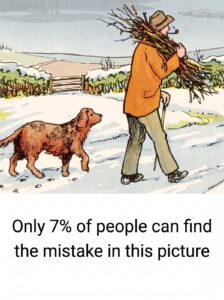
At first glance, this peaceful winter illustration looks completely ordinary. A man is walking through a snowy countryside with his dog, carrying a bundle of wood and holding a cane. A fence stretches across the landscape, while an open field disappears into the winter scenery.
Everything seems perfectly normal.
But there is one small detail that doesn’t make sense.
Can you spot it?
Before reading further, take a moment to examine the picture carefully. Don’t focus only on the man or the dog. Look at the snow beneath them and pay attention to the marks they are leaving behind.
The answer is hiding in plain sight.
Look Carefully at the Footprints
The most important clue is on the ground.
The dog is clearly walking through the snow, and its paws leave visible tracks behind it. Those footprints show that the snow is deep enough to record the movement of someone or something walking across it.
But look at the man.
Although he is walking through exactly the same snowy ground, there are no footprints behind him.
That’s the mistake.
The dog leaves a trail of paw prints, while the man appears to be walking across the snow without leaving any tracks at all.
Once you notice it, the error becomes obvious.
Why Is It So Easy to Miss?
The puzzle works because our brains tend to focus on the overall meaning of an image before examining every individual detail.
When you first look at the illustration, you immediately understand the scene:
A man is walking his dog through the snow.
Once your brain recognizes that simple story, you may stop questioning whether every part of the image is physically consistent.
You notice the man’s clothing, the bundle of wood, the dog, the fence, and the snowy landscape. Everything fits together well enough that the missing footprints can easily disappear into the background.
That’s what makes these visual puzzles so entertaining.
The Dog Gives Away the Answer
Ironically, the dog is the clue that reveals the mistake.
If the dog were also leaving no tracks, the scene might not immediately seem unusual. But because its paws clearly leave marks in the snow, we know that the snow is capable of recording footprints.
That makes the man’s missing tracks much harder to explain.
The two are walking together through the same environment, yet only one leaves evidence of passing through it.
The contrast is subtle, but once you know where to look, it’s impossible to ignore.
How Long Did It Take You?
These puzzles are often more difficult than they appear because they don’t require specialized knowledge.
You don’t need to know anything about science, history, geography, or mathematics.
You simply need to slow down and observe.
Try giving yourself 15 seconds before looking at the answer.
Study the ground.
Follow the path.
Look behind the man.
Look behind the dog.
Then compare the two trails.
If you noticed the missing footprints quickly, you have a sharp eye for visual details.
If you didn’t, don’t worry. The puzzle was designed to make you focus on the larger scene rather than the tiny inconsistency.
Try It With Someone Else
One of the best ways to enjoy an observation puzzle is to show it to someone without giving them any clues.
Ask them a simple question:
“Can you spot the mistake?”
Give them 15 or 30 seconds and watch where their eyes go.
Most people will probably examine the man’s clothes, the dog, the fence, or the surrounding landscape before eventually noticing the ground.
Once they find the missing footprints, they may wonder how they didn’t see them immediately.
That’s part of the fun.
The Bigger Lesson
This simple puzzle demonstrates how easily our attention can be guided by the overall story of an image.
When something looks familiar, we tend to accept it quickly.
A person walking a dog through the snow is such an ordinary scene that our brains don’t automatically question whether the footprints are correct.
But slowing down and examining individual details can reveal inconsistencies that were hiding right in front of us.
So, the next time you encounter an optical illusion or hidden-object puzzle, don’t just look at the picture as a whole.
Look at the small details.
Check the shadows.
Examine the reflections.
Follow the footprints.
Look at the spaces between objects.
Sometimes the answer isn’t hidden in an unusual object at all.
Sometimes, it’s hiding in something that should be there—but isn’t.
And in this snowy scene, that missing detail is the man’s footprints.
Did you spot the mistake before reading the answer?

Related Posts

When something precious is suddenly damaged, the loss can feel much bigger than the physical destruction itself.
For one family, a cracked swimming pool became an unexpected emotional challenge. The pool wasn’t simply part of the backyard. It was connected to years of summer…
Why Drivers Are Putting Washington State Stickers Upside Down—and the Meaning Behind the Unusual Symbol
If you’ve ever driven through the Pacific Northwest, you may have noticed an unusual sticker on the back of a vehicle: the outline of Washington State displayed…
Can You Spot the Hidden Face in This Snowy Forest? Most People Miss It at First
At first glance, this peaceful winter scene looks like an ordinary snowy forest. Snow covers the ground. Tall trees stretch upward in the background. A deer stands…

This Enchanting Old House Sits Beside a Peaceful Creek—Its Timeless Beauty Will Leave You Mesmerized
There are some homes that immediately capture your attention, not because they are enormous or luxurious, but because of the way they seem to belong perfectly to…

They Thought the Widow Was Powerless—But Her Silent Strategy Left Them No Way to Deny the Truth
They thought she was powerless. They saw an older widow living quietly on her own and assumed that damaging her property would have few consequences. To them,…

How Your Nighttime Fan Could Be Affecting Your Sleep Without You Realizing It
Sleeping with a fan running is a familiar nighttime routine for millions of people. On a hot evening, the cool breeze can make a bedroom feel more…