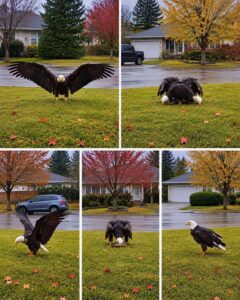
The first photograph looked almost too extraordinary to be real.
Perched on a dead tree above a remote mountain valley was what appeared to be an enormous eagle.
Its silhouette seemed unusually large.
The talons looked powerful.
The wings appeared broad enough to give the bird an almost prehistoric appearance.
Within hours of the photograph circulating online, people began asking the obvious question:
How large was this bird?
Some viewers believed the image showed an exceptionally large eagle.
Others suspected digital manipulation, unusual perspective, or a simple photographic illusion.
Then another photograph appeared.
This time, the bird was flying.
Its wings stretched across the frame as it glided between two mountain ridges.
The second image seemed to strengthen the mystery.
But it also created a more complicated scientific question.
Could anyone actually determine the bird’s size from photographs alone?
One Photograph Started the Mystery
According to the story surrounding the images, a local hiker photographed the bird shortly after sunrise.
The original photographer reportedly thought perspective might be making an ordinary bird appear larger than it really was.
That explanation seemed reasonable.
Photographs can be remarkably deceptive when distances are uncertain.
A bird positioned relatively close to a camera can appear enormous compared with objects much farther away.
A tree, mountain ridge, or building in the background may look like an obvious reference point, even though it is actually separated from the bird by considerable distance.
Without a reliable object at the same distance as the animal, estimating size becomes extremely difficult.
Nevertheless, the photograph was striking enough to attract attention.
Once it was shared more widely, people began comparing the apparent proportions with familiar birds of prey.
Some thought the wingspan looked extraordinary.
Others argued that the image contained no dependable scale reference.
The disagreement was only beginning.
The Second Photograph Changed Everything
The second photograph showed the bird in flight.
That made the animal easier to study visually.
Observers could see more of the wings.
They could examine the apparent body shape.
The flight posture could be compared with known raptors.
But the photograph still couldn’t answer the most important question.
How big was the bird?
A photograph captures angular size, not a direct measurement of physical dimensions.
To calculate the actual wingspan of an animal from an image, researchers would need information about distance, lens characteristics, perspective, or another reliable reference.
Without that information, an apparently gigantic bird can remain exactly that:
Apparently gigantic.
The distinction matters.
A remarkable photograph can justify investigation without proving an extraordinary biological discovery.
Researchers Would Need Much More Than Pictures
Even a collection of convincing photographs wouldn’t establish the existence of a previously unknown giant eagle.
Scientists would need multiple independent observations.
They could look for consistent sightings in the same region.
They could examine high-resolution photographs and video.
They could document the bird’s behavior and flight patterns.
They could collect measurements when possible.
If feathers, droppings, or other biological material were found and could be ethically and legally associated with the animal, genetic analysis might provide additional information.
Experts could also compare physical characteristics with known eagle and vulture species.
The process would require careful documentation.
Extraordinary conclusions require evidence that survives detailed examination.
The Valley Already Had a Story
The photographs became even more intriguing because residents reportedly had their own stories about enormous birds.
For generations, local legends had described giant birds living among the surrounding cliffs and mountains.
Some versions portrayed the creatures as guardians.
Others warned travelers not to approach certain peaks or nesting areas.
Stories like these are common in many cultures.
People have long used dramatic descriptions of animals to explain unusual encounters, dangerous landscapes, or places that were difficult to reach.
That doesn’t make the stories meaningless.
But folklore and scientific evidence serve different purposes.
A legend can identify a place where generations of people believed something unusual existed.
It cannot, by itself, establish the biological identity or size of an animal.
Could an Ancient Memory Be Hidden Inside the Legend?
This became one of the most fascinating questions surrounding the mystery.
People naturally wondered whether the old stories might have originated from real encounters with unusually large birds.
Perhaps residents had repeatedly observed large raptors from a distance.
Perhaps the descriptions became exaggerated as stories passed from one generation to another.
Or perhaps the legends had nothing to do with the photographed bird at all.
There are many possible explanations.
The photographs made the old stories interesting again, but they didn’t establish a connection between them.
That connection would require evidence.
Scientists Turned Their Attention Toward the Valley
If the reports were serious enough to investigate, researchers would have several ways to approach the problem.
Observation points could be established at a distance from nesting areas.
Motion-triggered wildlife cameras could monitor cliffs and forest edges.
Researchers could review historical records for documented sightings of large raptors.
Local observations could be collected and compared.
Photographs could be examined for consistent anatomical features.
Even seemingly minor details could become useful.
The shape of the wings.
The relative length of the tail.
The position of the head during flight.
The pattern of feathers.
The way the bird gains altitude.
The manner in which it approaches a perch.
A single photograph can be ambiguous.
A series of independent observations can provide a much clearer picture.
Eyewitnesses Added More Details
Residents reportedly described seeing unusually large birds around sunrise and late afternoon.
Others remembered broad-winged raptors gliding silently over the valley.
These reports helped maintain interest.
But eyewitness observations of animal size have serious limitations.
Humans aren’t particularly good at estimating the size of distant objects without familiar references.
A bird flying against an open sky can be especially difficult to judge.
There may be no nearby object for comparison.
A bird that appears enormous may simply be much closer than expected.
Clouds and mountain ridges can make distance even harder to estimate.
That’s why scientists generally treat eyewitness reports as leads rather than measurements.
The Photographs Needed Careful Examination
Before assuming anything extraordinary, researchers would also need to establish whether the images were genuine.
That doesn’t necessarily mean assuming they’re fake.
It means examining the available evidence.
Original files can contain metadata.
Image resolution can reveal whether a photograph has been heavily cropped.
Different versions can be compared.
Edges and lighting can sometimes reveal compositing or manipulation.
The photographer’s camera position may help reconstruct perspective.
And if multiple photographs were taken from the same location, their geometry might provide useful information.
A photograph should be investigated before it is interpreted.
Perspective May Be the Biggest Clue
Imagine photographing a small bird sitting very close to the camera.
Behind it, several hundred meters away, is a large tree.
In the resulting image, the bird could appear comparable in size to the tree’s upper branches.
Move the bird farther away and the relationship changes dramatically.
That’s because the camera records angles, not our intuitive perception of physical size.
Telephoto lenses can make distant objects appear visually compressed.
Wide-angle lenses can exaggerate relationships between nearby and distant subjects.
Cropping can remove the very objects that would have provided scale.
This is why apparent size in a photograph shouldn’t automatically be treated as measured size.
What If It Really Were Exceptionally Large?
Even if the bird turned out to be an unusually large individual of a known species, that would be scientifically interesting.
Birds naturally vary in size.
Age, sex, species, subspecies, nutrition, and individual genetics can all contribute to differences in physical dimensions.
Large raptors can already look enormous when viewed from below.
A bird with an impressive wingspan circling over a narrow valley can appear even larger because the surrounding landscape creates a dramatic visual contrast.
An exceptional individual wouldn’t necessarily represent a new species.
That distinction is important.
A New Species Would Require Strong Evidence
Discovering an unknown large bird species would be a major scientific event.
But scientists would not identify a new species simply because an animal looked unusually large in a photograph.
They would need evidence demonstrating that the animal is distinct from known species.
That could involve morphology, genetics, behavior, geographic distribution, or other scientifically defensible characteristics.
If a specimen were ever involved, ethical and legal requirements would also matter.
The burden of evidence would be considerably higher than simply finding another impressive photograph.
Then the Mystery Created Another Problem
As the images spread online, attention could become a threat to the very wildlife people wanted to see.
Photographers might travel into the valley hoping to capture their own evidence.
Social-media creators could arrive looking for dramatic footage.
Others might simply want to see the mysterious bird.
And some visitors might bring drones.
That can create problems for wildlife.
If a large raptor were nesting nearby, repeated human disturbance could cause the bird to abandon a perch or nesting area.
Drones can be particularly disruptive to birds of prey.
Even well-intentioned observers can create pressure when too many people converge on a sensitive location.
Protecting the Bird May Matter More Than Solving the Mystery
Wildlife researchers generally need to balance curiosity with conservation.
If a rare bird is genuinely present, revealing the precise location of its nest could attract crowds.
That might put pressure on the habitat.
The best investigation would therefore avoid unnecessary disturbance.
Researchers could observe from a safe distance.
Camera equipment could be positioned carefully.
Access could be controlled where appropriate.
And sensitive location information could be kept private.
A mystery doesn’t have to be solved at the expense of the animal at its center.
Social Media Made the Story Bigger
The internet is particularly good at turning ambiguous images into dramatic mysteries.
One unusual photograph can quickly become thousands of reposts.
Each retelling can add another detail.
An unusually large bird becomes a “giant eagle.”
A local story becomes an “ancient legend.”
A photograph becomes “proof.”
The original evidence may remain exactly the same while the surrounding narrative grows increasingly dramatic.
That’s why returning to the original photograph and asking basic questions is so important.
What is actually visible?
What can be measured?
What remains uncertain?
What information comes from the photographer?
And what claims were added later by people discussing the image?
The Valley’s Forgotten History Became Part of the Investigation
Regardless of the bird’s eventual identity, the mystery drew attention to a landscape that had previously received little outside interest.
That can have an unexpected benefit.
Historical wildlife records may be revisited.
Old photographs may be examined.
Local knowledge may be documented.
Researchers may discover that the valley has supported important bird populations for decades.
Sometimes an unusual photograph doesn’t reveal a new animal.
Instead, it directs attention toward an ecosystem that had been overlooked.
That can be valuable in its own right.
What the Evidence Could Eventually Reveal
There are several possibilities.
The photographs could depict a known large raptor photographed under unusual conditions.
They could show an exceptionally large individual.
The apparent size could be primarily the result of perspective and lens characteristics.
The images could contain some degree of manipulation.
Or additional investigation could uncover something genuinely unusual.
At this stage, however, photographs without reliable scale measurements cannot establish the bird’s actual dimensions.
And an old legend cannot independently establish the existence of a giant eagle.
Those questions remain separate from the fascinating story surrounding the images.
Why People Couldn’t Stop Looking
Perhaps the most compelling part of the mystery isn’t the possibility of discovering an unknown bird.
It’s the moment when something familiar suddenly looks unfamiliar.
Everyone knows what an eagle is supposed to look like.
Then a photograph appears showing one that seems far larger than expected.
For a moment, ordinary expectations stop working.
People begin asking questions.
Could it be real?
Could it be perspective?
Could the stories have been based on something real?
Could the valley have been hiding an unusual population all along?
Those questions are powerful because they don’t require an immediate answer.
They invite investigation.
The Real Mystery Is Still the Scale
The photograph may show a remarkable bird.
It may show a remarkable photograph.
Those are not necessarily the same thing.
Until researchers can establish the bird’s distance from the camera, compare it with reliable reference objects, document repeated sightings, and examine independent evidence, its apparent size remains uncertain.
That doesn’t make the photograph uninteresting.
Quite the opposite.
It makes the image a reason to investigate rather than a reason to declare the mystery solved.
For now, the valley remains wrapped in a combination of striking photographs, old stories, uncertain measurements, and scientific curiosity.
And perhaps that’s what makes the story so compelling.
The image gives us just enough information to wonder.
But not enough to know.
Sometimes the most intriguing wildlife mysteries begin not with proof, but with a photograph that makes us look twice.