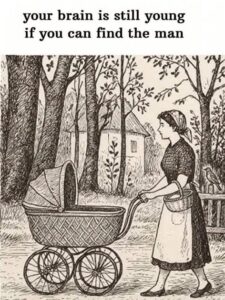
Have you ever looked at a picture and felt completely certain that you had noticed everything, only to discover an important detail that had been hiding in plain sight?
That strange experience is exactly what makes classic optical illusions so fascinating.
At first glance, the image appears to show an ordinary countryside scene. A woman is pushing a baby carriage along a wooded path. Trees surround the walkway, shadows stretch across the landscape, and everything seems peaceful and familiar.
But there is another image hidden within the scene.
Somewhere among the trees, shadows, and outlines is the face of a man.
The challenge is simple:
Can you find him?
If you spot the hidden figure immediately, you may feel impressed with yourself. If you stare at the picture for several minutes without seeing anything unusual, don’t worry. The illusion was designed to make the second image difficult to recognize.
And that’s what makes it interesting.
The puzzle isn’t really about having perfect eyesight.
It is about how your brain decides what you are looking at.
Why Your Brain Misses the Hidden Image
When you first look at the picture, your brain immediately searches for familiar objects.
You see a woman.
You see a baby carriage.
You see trees.
You see a path.
These objects create a clear story, so your brain quickly organizes the visual information into a meaningful scene.
Once that interpretation has been established, your attention tends to stay focused on the obvious elements.
The hidden face becomes much harder to notice because its features are not presented as a separate object.
Instead, they are incorporated into the existing landscape.
A curve in a tree might become part of the face.
A shadow might form an eye.
A branch might create the outline of a forehead.
Several unrelated shapes may combine to create features that only become recognizable when viewed together.
Your eyes can still see those lines.
But your brain doesn’t initially interpret them as a human face.
That’s an important distinction.
Seeing isn’t always the same as recognizing.
The “Young Eyes” Claim
This optical illusion is sometimes accompanied by a playful claim that people with “young eyes” can find the hidden man more easily.
It can sound like a test of age.
But there is no scientific basis for using this puzzle to determine whether someone’s eyes or brain are young.
Finding the hidden image quickly doesn’t prove that someone has better eyesight, a younger brain, or superior intelligence.
Likewise, taking a long time to find it doesn’t mean anything is wrong with your vision or cognitive abilities.
Many factors can influence how quickly someone recognizes a hidden image.
Experience is one of them.
If you’ve solved lots of optical illusions, you may already know what to look for.
You might instinctively examine unusual outlines, negative spaces, shadows, and repeated shapes.
Someone seeing this type of puzzle for the first time may naturally focus on the main scene instead.
Your Brain Loves Familiar Patterns
One reason these puzzles work so well is that the brain is extremely good at recognizing patterns.
This ability is essential to everyday life.
It allows you to recognize a friend’s face in a crowd.
It helps you distinguish a tree from a building.
It allows you to read words even when they are surrounded by distracting information.
It helps you recognize objects from incomplete visual information.
But that same ability can sometimes work against you.
When the brain sees a familiar scene, it tries to make sense of it quickly.
It doesn’t necessarily examine every individual line.
Instead, it builds a useful overall interpretation.
In this puzzle, the first interpretation is a peaceful outdoor scene.
The hidden face doesn’t fit that interpretation, so your brain may effectively ignore the information needed to see it.
The Power of the “Aha!” Moment
Then something happens.
Maybe you notice an unusual curve.
Maybe someone tells you approximately where to look.
Maybe you change your viewing distance.
Suddenly, the shapes begin to connect.
You see the forehead.
Then the eyes.
Then the nose.
And suddenly—
There he is.
The entire image seems to change.
The remarkable thing is that the picture itself hasn’t changed at all.
Only your interpretation has changed.
This is what makes optical illusions so satisfying.
Before the discovery, the hidden face seems impossible to find.
Afterward, it can become so obvious that you may wonder how you ever missed it.
Your brain has simply learned a new way to organize the same information.
Try Looking at the Image Differently
If you haven’t found the hidden man yet, don’t simply stare harder.
Try changing your strategy.
Start by ignoring the woman and the baby carriage.
Instead, examine the background.
Look closely at the trees.
Pay attention to unusual curves.
Search for shapes that resemble facial features.
Don’t necessarily look for an entire face at once.
Look for individual components.
Could one branch form the outline of a nose?
Could a dark area resemble an eye?
Could several separate shapes create the shape of a cheek?
Sometimes recognizing one small feature is enough to unlock the entire illusion.
Look at the Negative Space
Another useful technique is to study the empty areas.
The spaces between branches and objects can sometimes create shapes just as clearly as the objects themselves.
This is called negative space.
In hidden-image puzzles, the negative space can be especially important because the artist may rely on gaps and surrounding outlines to create the second picture.
Instead of asking, “Where is the face?” ask:
“What shapes do the empty spaces create?”
That small change in perspective can make the puzzle much easier.
Change Your Distance
If you’re viewing the picture on a phone or computer, try moving farther away.
Then move closer.
You can also briefly squint.
Reducing the amount of detail reaching your conscious attention can sometimes make the larger hidden shape easier to recognize.
Another useful trick is to look away for a few seconds before returning to the picture.
Your brain may approach the scene differently when you stop continuously searching.
Why Some People Find It Faster
People often compare their results when solving optical illusions.
One person may find the man immediately.
Another may spend several minutes searching.
This difference doesn’t necessarily tell you anything about who has a “better” brain.
Attention works differently from person to person.
Some people naturally scan images systematically.
Others focus on the center first.
Some are highly sensitive to patterns.
Others are better at identifying familiar objects.
Even mood and fatigue can affect visual attention.
If you’re tired or distracted, you may find a puzzle much harder than you would under different circumstances.
So don’t treat your result as a test of intelligence or age.
It’s simply an interesting demonstration of perception.
What the Illusion Really Reveals
The hidden man teaches us something valuable about how the brain handles visual information.
We don’t experience the world as a perfectly detailed photograph.
Instead, our brains constantly organize what we see.
We identify important objects.
We ignore irrelevant details.
We search for familiar patterns.
We make assumptions.
Most of the time, this process is extremely useful.
Without it, ordinary environments would be overwhelming.
But an optical illusion can expose the process by deliberately creating a conflict between what the image appears to be and what else it contains.
At first, your brain says:
“This is a woman walking with a baby carriage.”
Then, after you recognize the hidden face, your brain says:
“This is a woman walking with a baby carriage—and there’s a man’s face hidden in the landscape.”
Both interpretations use the same picture.
The difference is how the information is organized.
So, Did You Find Him?
If you found the hidden man quickly, congratulations.
If you needed a little longer, that’s perfectly fine too.
And if you still can’t see him, don’t assume your eyes are too old or your brain isn’t sharp enough.
This isn’t a scientific age test.
It’s a visual puzzle designed to challenge your attention and make you question what you’re seeing.
Take another look.
Move your eyes away from the obvious objects.
Study the trees.
Examine the shadows.
Look for unusual outlines.
Pay attention to the spaces between things.
Then wait for that wonderful moment when the hidden face suddenly appears.
Because that’s the real trick behind the illusion.
The man wasn’t hiding somewhere outside the picture.