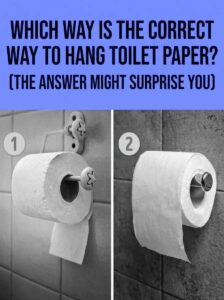
It is one of the smallest decisions in any home, yet it has inspired countless arguments between couples, roommates, friends, and family members. When you replace a toilet paper roll, should the paper hang over the top or underneath?
For some people, the answer is obvious. The paper should hang over the roll, ready to pull forward with a simple movement. For others, placing it underneath feels more natural, practical, and convenient.
Most people never give the matter much thought until they share a bathroom with someone who does things differently. Suddenly, a simple household habit becomes a surprisingly passionate debate.
But is there actually a proper way to hang toilet paper? Is one method more hygienic, easier to use, or more practical than the other?
The answer is a little more interesting than you might expect.
1. The Great Over-or-Under Debate
Walk into almost any household, and you may discover that people have strong opinions about toilet paper.
Those who prefer the overhand method usually argue that it makes the loose end easier to see and grab. The paper hangs in front of the roll, making it simple to pull down the desired amount without searching around the back.
Supporters of the underhand method often appreciate its neat appearance. Depending on the holder’s design and position, the paper may hang closer to the wall, creating a more compact look.
Neither preference is particularly unusual. People develop household routines through habit, experience, and the way they were taught to do things growing up.
If your family always placed the paper over the roll, that arrangement may feel completely natural. If you grew up in a home where the paper hung underneath, the alternative might look strangely wrong.
This is one reason the debate can become so amusing. People sometimes assume their own preference is the obvious choice, forgetting that someone else may have equally familiar reasons for doing things differently.
2. Is There Actually a Correct Way?
Interestingly, there is a historical answer to the question.
In 1891, inventor Seth Wheeler received a United States patent for an improved toilet-paper roll design. The accompanying illustration showed the paper hanging over the front of the roll.
This historical detail is often mentioned by supporters of the overhand method.
However, a patent illustration does not establish a universal rule for every modern bathroom. It shows how the inventor depicted the particular design, rather than proving that the alternative is incorrect.
For ordinary household use, both arrangements can work.
The better choice depends on practical considerations, including the toilet-paper holder, the position of the roll, the surrounding space, and the preferences of the people using the bathroom.
If the paper pulls smoothly and everyone can use it comfortably, there is little reason to treat the orientation as a serious problem.
The debate becomes much less complicated when we distinguish between a personal preference and a genuine practical requirement.
3. Why Many People Prefer the Paper to Hang Over
The overhand arrangement has several practical advantages.
First, the loose edge is generally easier to see. Users can identify the end of the paper quickly without reaching behind the roll.
Second, pulling the paper forward may feel more intuitive, particularly when the holder is positioned in front of the user.
Third, this arrangement can make it easier to tear off a section, depending on the roll, holder, and perforations.
There is also a design consideration. The original patent illustration frequently cited in this debate depicts the paper hanging over the front.
For households with pets, there may be another consideration. Cats that enjoy batting at dangling objects can sometimes unroll toilet paper during their adventures. Depending on the bathroom layout and the animal’s behavior, changing the orientation may or may not help.
Still, the overhand method is not automatically superior in every situation. A poorly positioned holder can make any roll awkward to use, and some designs work equally well with either orientation.
Ultimately, the practical advantage is straightforward: many people find it easier to locate and pull the paper when the loose end hangs in front.
4. Why Others Prefer the Underhand Method
People who prefer the underhand arrangement often have equally understandable reasons.
The paper can hang closer to the wall, which some people find visually neater. In certain bathrooms, this may help keep the loose end away from nearby objects or reduce how much it protrudes into a narrow space.
Some people simply find the arrangement more familiar because it is how they have always used toilet paper.
There may also be circumstances in which the holder’s design makes the underhand position more convenient.
For example, a holder installed in an awkward location might allow the paper to pull more smoothly in one direction than the other.
However, the underhand arrangement does not automatically make a bathroom cleaner or more hygienic. Cleanliness depends on factors such as hand hygiene, the condition of the bathroom, and whether the paper is exposed to contamination.
Both methods can be perfectly reasonable when used in a clean, appropriately maintained bathroom.
5. Does the Direction Affect Hygiene?
This is where the discussion becomes more practical.
Toilet paper is a personal hygiene product, so it makes sense that people want to keep it clean and easy to access.
Some people argue that hanging the paper over the roll makes it less likely to touch the wall. Depending on the holder and the surrounding surfaces, that may be true.
Others believe the underhand position keeps the loose edge tucked away.
In reality, the direction alone does not determine whether toilet paper stays clean. The bathroom environment, the placement of the holder, and how people handle the paper all matter.
A roll positioned close to a frequently touched surface may be exposed to contamination regardless of its orientation.
Likewise, a bathroom with good cleaning habits and a suitably placed holder can accommodate either arrangement.
For a cleaner setup, keep the holder away from areas where it may be splashed, wash your hands appropriately, and replace rolls that become wet or visibly contaminated.
The most useful solution is to focus on the surrounding conditions rather than assuming that one direction guarantees better hygiene.
6. What This Tiny Habit Can Reveal About Relationships
Although toilet paper orientation is not a reliable personality test, the disagreement can provide a funny example of how people handle differences.
Imagine two people moving into their first home together.
One person carefully hangs the toilet paper over the roll. The next morning, the other person changes it to the underhand position.
The first person switches it back.
Within days, the bathroom has become the setting for a silent competition that neither person intended to start.
The problem is not really the toilet paper. It is the assumption that one person’s preference should automatically become the household rule.
Living together means discovering that people have different routines, standards, and ideas about what feels normal.
Some differences matter because they affect safety, finances, responsibilities, or personal boundaries. Others are relatively minor and can be resolved with a little flexibility.
Recognizing the difference can prevent unnecessary tension.
If a household member prefers one arrangement, there is usually no reason to treat that preference as a challenge to authority or respect.
Sometimes, the most helpful response is simply to laugh, explain what you prefer, and agree on a solution that works for everyone.
7. When Small Arguments Become Bigger Problems
Occasional disagreements about household habits are normal. However, repeatedly turning minor differences into personal conflicts can make living together more stressful.
A discussion about toilet paper might become frustrating if one person interprets a different choice as laziness, disrespect, or deliberate provocation.
Before reacting, it helps to consider whether the issue has any meaningful consequences.
Does the paper still dispense properly? Is anyone being inconvenienced? Is there a genuine cleanliness concern, or is the disagreement simply about preference?
These questions can put the issue into perspective.
If the answer is that both methods work, compromise becomes much easier.
One household might choose the overhand method because most members prefer it. Another might alternate, or simply leave the roll as the previous person installed it.
The specific solution matters less than the willingness to avoid turning a trivial habit into a recurring source of resentment.
Of course, flexibility should go both ways. A peaceful home does not require one person to surrender every preference. It requires people to communicate respectfully and distinguish meaningful concerns from minor annoyances.
8. How to Choose the Best Method for Your Home
If you are still undecided, try evaluating the two methods based on practicality rather than tradition.
Consider these questions:
- Which orientation makes the loose edge easiest to reach?
- Does the paper pull smoothly without rubbing against nearby surfaces?
- Does the holder work better in one direction?
- Is the roll positioned where it can be used comfortably?
- Do pets or other household circumstances affect your choice?
You may discover that the answer depends on the bathroom rather than a universal rule.
If both arrangements work equally well, choose the one you prefer—or let the people sharing the bathroom decide together.
There is no need to purchase a special holder or change your entire routine simply because someone online insists that one method is the only acceptable choice.
A good household solution is one that works reliably and causes the least inconvenience.
Final Thoughts: The Best Way Is the One That Works for You
The toilet paper debate may never disappear. Some people will continue to insist that the paper belongs over the roll, while others will happily defend the underhand method.
The historical patent illustration offers an interesting detail for supporters of the overhand arrangement, but it does not make the alternative universally wrong.
Both methods can work, and neither provides a reliable measure of someone’s intelligence, personality, or relationship skills.
What matters more is how we handle these small differences when sharing a home.
A little patience, a sense of humor, and a willingness to compromise can turn a potentially irritating disagreement into an amusing conversation.
After all, a roll of toilet paper is a small part of everyday life. The relationships we maintain with the people around us are much more important.
So the next time you find the roll hanging in the direction you dislike, take a breath before changing it back.