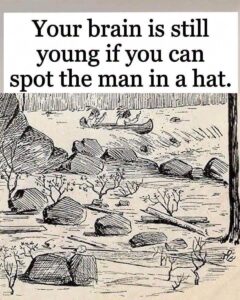
A peaceful shoreline hides a surprising secret in plain sight. At first glance, the illustration appears to show nothing more than a quiet stretch of water, scattered rocks, fallen trees, and two people traveling in a canoe. However, somewhere within this beautiful landscape, a hidden portrait of a man wearing a hat is waiting to be discovered.
Can you find his face without looking at a hint?
This vintage-style picture puzzle challenges you to look beyond the obvious and notice details that might otherwise go unnoticed. What appears to be an ordinary collection of natural shapes may actually form the outline of a human face. Take your time, examine the entire image, and see whether you can uncover the secret.
A Peaceful Landscape With a Hidden Surprise
The illustration creates a calm outdoor scene that encourages viewers to focus on its natural beauty. The water stretches quietly along the shoreline, while rocks, trees, and fallen branches create interesting patterns throughout the picture. Two travelers in a canoe add a sense of adventure to the otherwise peaceful setting.
Yet the landscape contains something unexpected.
A man’s face, complete with a hat, is cleverly integrated into the surrounding scenery. Rather than appearing as a separate portrait, his facial features blend into the shapes and shadows of the natural environment.
This makes the puzzle particularly challenging. Your eyes may initially recognize the trees, rocks, and water as separate objects, preventing you from noticing how their outlines work together to create another image.
Can You Spot the Hidden Man?
Before reading further, take a moment to examine the picture carefully.
Start by looking at the overall composition rather than concentrating exclusively on the canoe and its passengers. Move your attention across the shoreline, the larger rocks, and the outlines created by the trees and fallen logs.
Try to identify shapes that could represent the man’s forehead, eyes, nose, and chin. The hat may provide an important clue because its outline can help you recognize the direction in which the face is positioned.
If you still cannot see it, try these simple techniques:
- Step back from the picture. Looking at the image from a little farther away can make the larger shapes easier to recognize.
- Squint slightly. Reducing the amount of detail you see may help reveal the overall outline of the portrait.
- Look at the negative space. Examine the spaces between the rocks, branches, and trees rather than focusing only on the objects themselves.
- Change your perspective. If permitted, rotate the image slightly or tilt your head to see whether the shapes become easier to interpret.
- Take a short break. Looking away for a moment and returning with fresh eyes may help you notice something you previously missed.
Don’t give up too quickly. Sometimes, the hidden face becomes obvious only after you stop searching for a traditionally drawn portrait and begin viewing the landscape as a collection of connected shapes.
Why Is It So Difficult to Find the Face?
The secret behind this puzzle lies in the way the human brain processes visual information.
When we look at a landscape, our brains naturally organize the scene into familiar objects. Trees look like trees, rocks look like rocks, and a canoe looks like a canoe. We rarely stop to consider whether the boundaries between these objects might also form something else.
This is where a phenomenon called pareidolia comes into play.
Pareidolia is the tendency to perceive familiar patterns, especially faces, in ambiguous visual information. It explains why people sometimes see faces in clouds, recognize animals in rock formations, or notice facial expressions in everyday objects.
Our brains are particularly good at recognizing faces because facial information is important in everyday social interaction. Even a few suggestive lines or shadows may be enough to make us perceive eyes, a nose, and a mouth.
In hidden-picture puzzles, artists can use this tendency to create images that appear ordinary at first but reveal a second interpretation when examined carefully.
The Trick Is to See the Whole Picture
One of the most interesting aspects of this challenge is that the hidden face does not necessarily need clearly drawn facial features. Instead, the portrait emerges from the arrangement of existing elements in the landscape.
A dark shadow might resemble an eye. A curved branch could suggest the shape of a nose. The outline of a rock may form part of a cheek or chin, while a tree or another natural feature may help define the hat.
When these elements are viewed together, the brain may suddenly recognize a complete face.
This moment of discovery is what makes optical illusions and hidden-image puzzles so enjoyable. The picture itself has not changed; your interpretation of it has.
It is also worth remembering that these challenges are not reliable tests of intelligence, eyesight, or age. Some people notice the hidden portrait immediately, while others need more time or a different visual perspective. Both experiences are completely normal.
Ready for the Answer?
If you are still struggling, return to the illustration and focus on the larger shapes around the shoreline. Pay particular attention to the rocks, trees, and fallen logs, looking for a combined outline that resembles a man wearing a hat.
The hidden portrait is formed by the natural features of the landscape rather than being presented as a separate, clearly drawn figure. The key is to recognize how the shadows and outlines work together.
Because the exact position of the facial features depends on the illustration itself, avoid assuming that every rock or branch represents a specific part of the face. Instead, look for the overall silhouette and see whether the individual details begin to make sense once you recognize the portrait.
Did You Find the Hidden Man?
Whether you spotted the face immediately or needed a few hints, this puzzle demonstrates how easily our perception can change when we look at familiar things from a different perspective.
A simple shoreline can become a hidden portrait, and ordinary rocks and trees can suddenly appear to form something remarkable.
Share the challenge with friends and family to see who discovers the face first. Give everyone a little time to examine the picture before revealing the secret.