For six years, I put forty dollars from every Friday paycheck into savings. I never missed a week, even when money was tight or something unexpected came up. I skipped new clothes, passed on dinners at restaurants, and learned to ignore the little things I wanted because I had a bigger plan.
My name is Karen, and I had been married to my husband, Rick, for thirty years.
Our kitchen had seen better days. The stove worked only when it felt like cooperating, and the cabinet doors hung crookedly on their hinges. One drawer refused to close, and the countertop had a crack that seemed to grow longer every year. Every time I cooked dinner, I imagined how wonderful it would feel to have a clean, comfortable kitchen again.
So I saved.
Week after week, I slipped forty dollars into a savings account. I watched the balance grow slowly, from hundreds to thousands, until the total finally reached $11,012. It had taken six years of discipline, and I was proud of every dollar.
I had already started collecting pictures of kitchens I liked. Nothing extravagant, just sturdy cabinets, a dependable stove, and enough room to prepare meals without fighting broken drawers and cluttered countertops.
I imagined inviting our son, Tyler, and his wife over for Sunday dinner. I pictured baking pies without worrying whether the oven would suddenly stop heating. Most of all, I imagined finally fixing something that had bothered me for years.
Then, one Tuesday afternoon, everything changed.
I pulled into our driveway after running errands and immediately noticed a small fishing boat parked beside the garage. It was shiny, with a new motor and a trailer that looked as though it had barely touched the road.
For a moment, I thought someone had made a delivery to the wrong house.
Then Rick stepped outside, grinning like a boy who had just received the best birthday present of his life.
“Pretty nice, isn’t it?” he asked.
I stared at him.
“Whose boat is that?”
He rubbed the back of his neck, still smiling.
“Ours. Well, mine, mostly. I’ve been wanting one for years.”
I looked at the boat, then at him.
“How much did it cost?”
Rick’s smile faded slightly.
“About eleven thousand.”
The world seemed to go quiet around me.
I already knew the answer, but I asked anyway.
“Rick, where did you get that money?”
He looked toward the garage instead of meeting my eyes.
“From the savings account.”
I felt something inside me drop.
“You used our kitchen money?”
He sighed as though I were making an unreasonable fuss over something small.
“Karen, the kitchen still works fine. The stove heats up, doesn’t it? The cabinets are a little old, but they’re not falling off the walls. I’ve worked hard for thirty years. I thought I deserved something for myself.”
I stood there, unable to speak for several seconds.
I knew Rick had worked hard. He had spent three decades as an electrical lineman, often working in bad weather, climbing poles, and responding to emergencies while other people stayed warm at home. I had never dismissed his sacrifices. I was proud of him.
But I had worked hard, too.
Those forty-dollar deposits had come from my paycheck. I had saved that money with a purpose, and Rick had taken it without asking me.
The worst part wasn’t the boat.
It was the decision he had made on behalf of both of us without considering whether I agreed.
I wanted to shout. I wanted to tell him exactly how selfish he had been. Instead, I looked at the boat one more time and walked into the house.
Rick probably thought the argument was over.
He had no idea what I was planning.
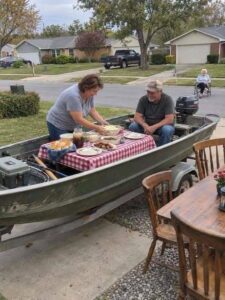
That evening, I opened the hall closet and took out my mother’s old red-and-white tablecloth. She had given it to me years before she died, and I used it for special family dinners. Carefully, I folded it over my arm and gathered two plates, silverware, a small candle, and the dinner I had prepared.
Then I carried everything outside.
Rick was in the garage, admiring his new purchase.
“What are you doing?” he called when he saw me approaching the boat.
“Serving dinner,” I replied.
I climbed aboard, spread the tablecloth across a flat surface, and arranged the plates. The boat was just large enough for two people to sit comfortably if we didn’t mind keeping our elbows close.
I lit the candle, set out the food, and called Rick over.
He stared at me as if I had lost my mind.
“You’re not seriously planning to eat out here.”
“Why not?” I asked. “We have a boat. We might as well use it.”
He muttered something under his breath but eventually joined me.
We ate our dinner in awkward silence. Every time I looked around, I noticed how ridiculous the arrangement was. Our kitchen was only a few steps away, but I had chosen to eat in a boat because our kitchen had become a symbol of a decision I hadn’t been allowed to make.
When we finished, I cleared the plates and went inside.
The next evening, I did it again.
I carried the tablecloth outside, arranged our dinner, and lit the candle. Rick looked irritated, but I didn’t argue with him. I simply served the food.
On the third night, he asked whether I intended to keep doing this.
“As long as we have this boat,” I replied.
“Karen, this is ridiculous.”
“Perhaps,” I said calmly. “But it’s where our money went.”
He had no answer to that.
By the fourth evening, our neighbor, Mrs. Collins, noticed me carrying plates through the driveway. She stopped by the fence and watched with open curiosity.
“Are you having a picnic?” she asked.
“Something like that,” I replied.
She glanced at Rick sitting stiffly in the boat, then back at me. I didn’t explain the entire story, but I could tell she understood that something unusual was happening.
By the sixth night, the boat dinners had become a neighborhood mystery.
Some people thought we were joking. Others assumed we had decided to try something new. I heard a few quiet laughs from the sidewalk, but I didn’t care. I wasn’t doing it to entertain anyone.
I was trying to make a point without turning our marriage into a shouting match.
Rick, however, was becoming increasingly uncomfortable.
He complained about the weather, the mosquitoes, and the awkward seating. He suggested eating inside several times, but I always gave him the same answer.
“The kitchen still works fine, doesn’t it?”
Each time I repeated his words, he grew quieter.
On the seventh night, our son Tyler arrived with his wife, Megan. They had planned to visit for coffee and were surprised to find their father sitting in the fishing boat while I served dinner beneath the evening sky.
Tyler stopped halfway up the driveway.
“Dad, what on earth are you doing?”
Rick rubbed his forehead.
“Ask your mother.”
I invited them to sit with us, but Megan gently declined, looking as though she was trying not to laugh. Tyler pulled me aside near the garage.
“Mom, what’s going on?”
I explained that I had spent six years saving money for a new stove and cabinets, only to discover that Rick had spent it on the boat without consulting me.
Tyler’s expression changed immediately.
“Dad did what?”
I held up a hand.
“I don’t need you to fight with him. I need him to understand that this wasn’t just money sitting in an account. It was a plan we should have made together.”
Tyler nodded slowly.
That evening, he spoke privately with his father. I couldn’t hear every word, but I saw Rick’s shoulders slump as their conversation continued.
For the first time, I suspected that my husband was beginning to understand that the problem wasn’t whether he deserved a fishing boat.
It was whether he believed I deserved a say in our future.
The eighth dinner was the quietest of all.
Rick barely touched his food. He stared at the tablecloth, at the candle, and at the sides of the boat that had seemed so exciting only a week earlier.
Finally, he asked me a question.
“Did you really save that money for six years?”
I looked at him.
“Every Friday.”
“And you never used any of it?”
“Not for myself. Not once.”
He looked down at his hands.
I told him about the kitchen pictures I had collected and the stove I had hoped to replace before it broke completely. I explained that I had imagined having our family over for meals in a room we could both be proud of.
“I wasn’t saving for luxury, Rick,” I said. “I was saving for our home. For something we both use every day.”
He remained silent.
Then he asked, almost in a whisper, “Why didn’t you yell at me?”
I considered the question.
“Because yelling wouldn’t give me back those six years. And because I wanted you to see what you had done, not just hear how angry I was.”
He didn’t respond, but that night he carried the dishes inside without being asked.
On the ninth evening, I prepared dinner as usual. I spread my mother’s tablecloth over the boat’s surface and placed two plates beside the candle.
Rick came outside before I called him.
He stood beside the boat for a long moment, then looked at me.
“Karen, can we talk?”
I set down the serving spoon.
He took a deep breath.
“I was wrong. I kept telling myself I had earned the boat because I’d worked so hard. But you worked hard, too. You saved that money for something important, and I acted like my wants mattered more than yours.”
His eyes moved toward the house.
“I should have talked to you. I should never have spent our savings without your agreement.”
For the first time in nine days, I saw no defensiveness in his face. Only regret.
He told me he had already contacted the seller to ask about returning the boat. The seller had agreed to discuss a resale, though Rick couldn’t promise that we would recover every dollar.
“I want to make this right,” he said. “Even if we lose some money, I’ll work to replace what I took. And we’ll decide together what happens next.”
I felt the anger I had carried for days begin to loosen, though it didn’t disappear completely.
“I don’t need you to give up everything you want,” I told him. “I need you to remember that we’re partners. We don’t make major decisions by ourselves and expect the other person to accept them afterward.”
Rick nodded.
Then he climbed into the boat, sat across from me, and reached for my hand.
We ate dinner together beneath the soft evening light. The candle flickered in the breeze, and the familiar red-and-white tablecloth lay between us.
The boat was still there. The kitchen was still worn. Our savings had not magically returned.
But something had changed.
Over the following weeks, Rick followed through on his promise. He worked with the seller to arrange a resale and began putting money aside to help rebuild our kitchen fund. We discussed our budget, our priorities, and the things each of us hoped to do in the years ahead.
The process wasn’t perfect, and rebuilding trust took longer than nine dinners. But Rick stopped treating our shared savings as though he could spend them whenever he wanted. I began speaking more openly about my own needs instead of assuming they could wait forever.
Eventually, we replaced the stove and repaired the cabinets. It wasn’t the grand renovation I had imagined six years earlier, but when the work was finished, I invited Tyler and Megan over for dinner.
We ate around our kitchen table, laughing and sharing stories as the new stove warmed the room.
Rick reached across the table and squeezed my hand.
“I should have listened to you sooner,” he said.
I smiled.
“Yes,” I replied. “You should have.”
Sometimes, people imagine that the only way to stand up for themselves is to shout, threaten, or walk away. But I learned that a quiet action can sometimes reveal what an argument cannot.
Those nine dinners were never really about a fishing boat. They were about respect, shared responsibility, and the painful realization that a marriage cannot thrive when one person’s dreams are treated as more important than the other’s.
Rick had spent thirty years working hard to provide for his family. I had spent six years saving to improve our home. Neither effort made one of us more deserving of a voice.
A partnership means making room for both people’s hopes.
And sometimes, the most important lesson in a marriage begins with a simple question: If we are building a life together, why are we making decisions alone?