At sixty-one, I boarded the plane carrying excitement and grief in equal measure. I was traveling to meet my first granddaughter, Rose, but I couldn’t stop thinking about my late husband, Steven, and how desperately I wished he were making the journey beside me.
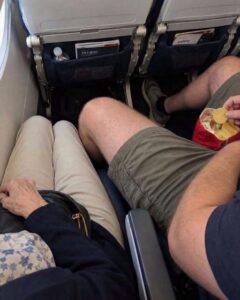
Shortly after taking my window seat, the man beside me introduced himself as Josh. Almost immediately, his knee pressed against mine, his elbow claimed the armrest, and his body began spilling into my limited space.
At first, I politely asked Josh to move over. He laughed, blamed his height, and barely adjusted himself before pushing into my space again. For nearly four hours, I remained squeezed against the window, uncomfortable but unwilling to create an argument.
I had spent most of my life avoiding confrontation, so when a flight attendant asked whether everything was okay, I automatically smiled and said yes.
Then Josh suddenly got up to use the restroom, and I realized this might be my only opportunity.
I took a deep breath and looked at the empty seat beside me. My heart was beating faster than it should have been over something so seemingly insignificant. Yet I knew the problem wasn’t simply the discomfort. It was the feeling that my presence, my comfort, and my right to occupy my own seat meant less than a stranger’s convenience.
For years, I had allowed people to make decisions for me because I wanted to keep the peace. After Steven died, that habit became even stronger. I didn’t want arguments, uncomfortable conversations, or situations that reminded me how lonely life could feel without someone beside me.
But as I looked out at the clouds, I remembered something Steven used to tell me.
“Being kind doesn’t mean you have to make yourself smaller for everybody else.”
I had smiled when he first said those words, believing he was talking about something entirely different. Now, thousands of feet above the ground, I finally understood what he meant.
When Josh returned, I decided I would speak up.
He dropped into his seat, stretched his legs, and immediately let his knee drift against mine again.
“Excuse me, Josh,” I said, keeping my voice calm. “I’ve asked you several times to give me some space. I’d appreciate it if you kept your legs on your side of the seat.”
He looked at me as though I had interrupted something important.
“Relax,” he replied. “It’s a plane. Everyone’s uncomfortable.”
“I understand that,” I answered. “But we’re both entitled to the space assigned to us.”
He rolled his eyes and turned toward the aisle.
For a moment, I thought he might finally leave me alone. Instead, he muttered something about people being too sensitive and resumed spreading his legs into my space.
My face grew warm. The old instinct to retreat returned, urging me to turn toward the window and endure the remaining flight in silence.
Then I thought about Rose.
I had never met her, yet I already wanted her to grow up believing that her voice mattered. I wanted her to know she could be considerate without accepting disrespect, and that she could stand up for herself without becoming cruel.
How could I hope to teach her those things if I couldn’t practice them myself?
I pressed the call button above my seat.
When the flight attendant arrived, I explained the situation clearly. I told her that I had repeatedly asked Josh to respect my personal space, but he continued pressing into my seat. I wasn’t asking for special treatment. I simply wanted to sit comfortably in the seat I had paid for.
The attendant listened without interrupting.
“Thank you for letting me know,” she said. “I’ll speak with him.”
Josh’s expression changed immediately.
“This is ridiculous,” he protested. “She’s making a big deal out of nothing.”
The flight attendant remained professional. She explained that passengers were expected to respect one another’s seating space and instructed him to keep his legs within his own area.
For the first time in hours, I felt my shoulders relax.
Josh grumbled, but he moved his legs. The pressure against my knee disappeared, and I could finally sit naturally without pressing myself against the window.
It was such a small change, yet I felt as though I had reclaimed something much larger than a few inches of space.
I had reclaimed my voice.
The flight attendant checked on me a little later. This time, when she asked whether everything was okay, I didn’t automatically smile and say yes.
“Yes,” I told her honestly. “Thank you for helping.”
She smiled back and continued down the aisle.
I spent the rest of the flight watching the clouds drift beneath us. For the first time that day, my thoughts returned to Steven without the usual heaviness.
I imagined him sitting beside me, giving me that familiar look he used whenever I apologized for asking for something perfectly reasonable.
“You did well,” I could almost hear him say.
By the time the plane began its descent, I felt lighter. The journey had started with grief, frustration, and a familiar fear of confrontation. Somehow, it had become an unexpected lesson in courage.
When I finally stepped into the arrivals hall, I spotted my daughter, Emily, holding a tiny pink blanket. Her face lit up when she saw me.
“Mom!”
She hurried forward and hugged me tightly.
Then she carefully placed a small bundle in my arms.
There was Rose, my beautiful granddaughter, sleeping peacefully beneath the blanket. Her tiny fingers curled around mine, and I felt tears gathering in my eyes.
“She’s perfect,” I whispered.
Emily laughed softly. “We’ve been waiting for you all morning.”
I kissed Rose’s forehead and promised her silently that I would always do my best to show her what love looked like. Not just the gentle, comforting kind, but the kind that includes self-respect, honesty, and the courage to speak when something isn’t right.
Later that evening, after holding Rose for hours, I told Emily about the flight.
She listened, then squeezed my hand.
“I’m proud of you, Mom,” she said. “I know how difficult that must have been.”
Her words touched me more deeply than she could have imagined.
For so long, I had believed that being a good person meant avoiding conflict at all costs. I thought politeness required silence, even when someone treated me unfairly.
That day taught me otherwise.
Kindness does not require surrendering your comfort. Patience does not mean accepting repeated disrespect. And speaking up calmly is not the same as starting a fight.
Josh may have forgotten the encounter before the plane even landed. Perhaps he never understood why his behavior mattered. I couldn’t control what he thought, and I didn’t need his agreement to know that my request had been reasonable.
What mattered was what I learned about myself.
I could be sixty-one, grieving the love of my life, and still discover new strength within myself. I could feel nervous and speak anyway. I could be gentle without being silent.
As I watched Rose sleeping in her mother’s arms that evening, I made myself one final promise.
I would never teach her that keeping everyone else comfortable was more important than respecting herself.
Because sometimes, the most important journey isn’t the one that takes you across the country.
Sometimes, it’s the journey from believing your voice doesn’t matter to finally finding the courage to use it.