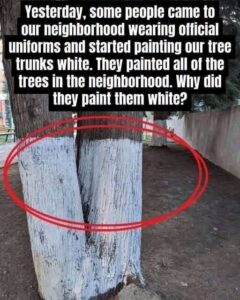
The first time you notice it, the sight can be surprising. Rows of trees stand with their lower trunks painted bright white, creating a pattern that looks almost unnatural. Many people assume the paint is decorative, used to mark property lines, or simply added to make the trees look neat.
In reality, the white coating often serves a practical purpose: protecting vulnerable tree trunks from damage caused by sudden temperature changes, particularly during winter.
Although trees appear strong and resilient, their bark can suffer serious damage when exposed to alternating periods of sunlight, warmth, and freezing temperatures. A simple white coating can help reduce this risk by reflecting sunlight and limiting extreme temperature fluctuations.
But winter protection is only one reason trees may have white trunks. Understanding the science behind the practice reveals why it is used in orchards, gardens, and other landscapes.
1. White Paint Helps Prevent Winter Sunscald
One of the main reasons fruit trees and other vulnerable trees are painted white is to reduce the risk of sunscald.
During winter, sunlight can warm the south- or southwest-facing side of a tree trunk, even when the surrounding air remains very cold. The bark absorbs solar energy, causing its temperature to rise. If temperatures fall rapidly after sunset, the warmed tissues cool again.
Repeated temperature changes can stress the bark and the living tissues beneath it. In susceptible trees, this can contribute to cracks, damaged bark, and areas of dead tissue.
Young trees are particularly vulnerable because they often have thinner bark that provides less insulation than the bark of mature trees.
White coatings help by reflecting a portion of the incoming sunlight. Because the trunk absorbs less solar energy, its temperature may fluctuate less dramatically.
This is the key scientific principle behind the practice: white surfaces generally reflect more visible sunlight than dark surfaces, helping reduce solar heating.
However, white paint does not make trees immune to winter injury. Its effectiveness depends on the tree species, local climate, application method, and other environmental conditions.
2. Why Fruit Trees Often Have White Trunks
If you have ever visited an orchard, you may have noticed apple, pear, peach, or other fruit trees with white coatings around their lower trunks.
Orchard owners sometimes use this technique to protect young trees, especially those with relatively thin bark.
Newly planted trees may be particularly susceptible to temperature fluctuations while they establish themselves. Their trunks can also be exposed to strong winter sunlight when surrounding vegetation provides little shade.
By reflecting sunlight, a suitable white trunk coating can help reduce the likelihood of sunscald.
The practice is especially relevant in climates where bright winter days are followed by freezing nights. Under these conditions, the difference between daytime and nighttime temperatures can create stress for vulnerable bark.
Not every orchard uses white coatings, and not every tree needs them. Growers consider local weather, tree age, species, and other protective measures when deciding whether to apply a treatment.
3. Does White Paint Protect Trees From Insects?
Another reason people associate white-painted trunks with tree protection is pest management.
In some locations, white coatings are used as part of broader agricultural or horticultural practices. However, ordinary white paint should not be assumed to repel every insect or prevent infestations.
Certain specialized trunk treatments may contain ingredients intended for a specific pest or disease, but their effects depend on the formulation and how they are applied.
White trunk coatings can also make some insects easier to notice against the contrasting surface. This may help with visual inspection, but visibility alone does not prevent pests from attacking a tree.
If a tree has signs of infestation, such as holes in the bark, sawdust-like material, unusual discoloration, or dying branches, identifying the underlying cause is more useful than applying ordinary paint.
Use only products specifically labeled for the intended horticultural purpose, and follow the manufacturer’s instructions.
4. Why Some Trees Are Painted White in Parks and Along Roads
White-painted trunks are not limited to fruit orchards. You may also see them in public gardens, rural landscapes, parks, or along roads.
In some places, the coating is used to reduce sunscald on vulnerable trees. In others, it may be part of a local landscaping tradition or a practical way to make trunks more visible.
White trunks can stand out against dark soil, grass, and vegetation, potentially making trees easier to see in certain settings. However, this does not mean every white-painted tree has been treated for winter protection.
Practices vary by region, and the reason for a particular coating may not be obvious from appearance alone.
Sometimes, the material is not ordinary paint at all. It may be a horticultural whitewash or another purpose-made product designed for application to tree trunks.
The distinction matters because products intended for buildings and household surfaces are not automatically appropriate for living trees.
5. Can Painting a Tree Actually Harm It?
Yes, using an unsuitable product or applying it incorrectly can potentially damage a tree.
Tree bark is not simply a decorative outer layer. It helps protect the living tissues beneath it from physical injury, environmental stress, and certain biological threats.
Household paints, especially products containing unsuitable solvents or other additives, may interfere with the bark’s normal condition. Thick or inappropriate coatings can also create problems depending on the formulation and circumstances.
For this reason, homeowners should avoid assuming that any white paint will work.
If trunk protection is needed, consult local gardening guidance or an arborist about an appropriate product. In some situations, a breathable, water-based white coating specifically recommended for tree trunks may be suitable.
Some growers also use purpose-made trunk guards or protective wraps. These must be selected and installed carefully because poorly fitted materials can trap moisture, harbor pests, or injure the trunk as it grows.
Never coat the entire tree indiscriminately. Treatments should be appropriate to the species, the intended purpose, and the manufacturer’s instructions.
6. What Is the Difference Between White Paint and Whitewash?
The terms are sometimes used interchangeably, but they do not always refer to the same material.
Whitewash traditionally refers to a light-colored coating made using materials such as lime and water. Modern horticultural products may use different formulations designed for particular applications.
Ordinary household paint, on the other hand, is developed primarily for surfaces such as wood, plaster, or masonry. Its ingredients and properties may differ considerably from those of a product intended for living trees.
Although a white appearance may be similar, the materials are not necessarily interchangeable.
If you are considering treating a tree in your yard, choose a product based on reliable horticultural advice rather than color alone.
7. Should You Paint the Trees in Your Garden?
Not necessarily.
Many established trees with thicker bark do not require white trunk coatings under ordinary conditions. Painting every tree may provide little benefit if sunscald is not a significant local problem.
Young trees with thin bark, newly planted fruit trees, and trees exposed to strong winter sunlight may be better candidates for protection.
Before taking action, consider the tree species, its age, the local climate, and whether it has previously suffered sunscald. A local extension service, experienced orchard grower, or qualified arborist can help determine whether treatment is appropriate.
Other preventive measures may include choosing suitable planting locations, maintaining healthy growing conditions, and using appropriate trunk guards where recommended.
The objective should always be to protect the tree without introducing unnecessary risks.
Final Thoughts
White-painted tree trunks may look unusual, but the practice often has a practical explanation. By reflecting sunlight, suitable white coatings can help reduce temperature fluctuations that contribute to winter sunscald in vulnerable trees.
The method is particularly relevant to certain young fruit trees and other trees with thin bark, although its usefulness varies with climate and species.
White coatings are not a universal solution for insects, disease, or every form of tree damage. The material used and the reason for applying it matter just as much as the color.
The next time you see a row of white-painted trees, remember that the coating may be doing more than changing their appearance. It may be helping protect delicate living tissues from the effects of winter sunlight and sudden temperature changes.
Sometimes, a simple horticultural practice has a surprisingly scientific explanation.