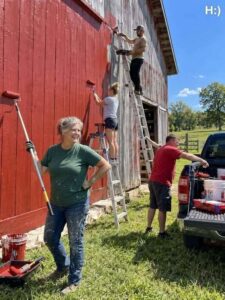
Carol Jensen was fifty-eight years old when she returned to her family farm after eleven exhausting days in the hospital beside her husband, Arlo. His stroke had changed their lives overnight, leaving him struggling to speak and unable to use his right hand properly. Carol had spent every waking moment worrying about his recovery, praying that the man she had loved for more than thirty years would regain his strength. She expected the familiar red barn to welcome her home. Instead, she found it painted completely gray.
The barn had stood on their property since 1925. Its weathered red boards, white-trimmed windows, and enormous wooden doors were more than parts of an old building. They represented generations of hard work, family celebrations, and memories that could never be replaced. Carol remembered watching Arlo repair its roof, helping his father stack hay inside, and listening to their children play beneath its rafters during summer afternoons.
Now, every inch of that familiar red had disappeared.
Carol walked slowly around the building, unable to believe what she was seeing. Then she noticed that the crooked initials Arlo’s father had painted above the haymow door in 1958 were hidden beneath the gray paint. Her eyes filled with tears. Those initials had survived decades of storms, harsh winters, and repairs. They were a small but precious reminder of the people who had built their family home.
The following morning, Carol discovered that her son, Brad, had arranged the painting while she was at the hospital. Brad worked as a real estate agent and believed the farm would sell more easily if the buildings looked modern.
“Gray is what buyers want now,” he explained over the telephone. “The property will look cleaner, Mom. You should be thanking me.”
Carol gripped the phone tightly.
“You painted your grandfather’s barn without asking me,” she replied.
Brad sighed impatiently. “Dad can’t manage the farm anymore. You need to start thinking practically. You can’t keep everything the way it was forever.”
His words hurt more than she wanted to admit. She understood that Arlo’s stroke had forced them to reconsider their future. Medical expenses were growing, the farm required constant maintenance, and neither of them knew when Arlo would be able to work again. But she had not agreed to sell their home, and she certainly had not given Brad permission to erase its history.
That afternoon, Carol sat beside Arlo’s hospital bed and told him what had happened.
His face tightened with frustration. He tried to speak, but the words came slowly. Finally, he managed to whisper, “Our barn.”
Carol took his left hand and squeezed it gently.
“I know,” she said. “I’ll fix it.”
Arlo looked at her with uncertainty. He was still weak, and the thought of another battle seemed exhausting. Carol, however, had made up her mind.
The next morning, she drove to a local paint supplier. The employee behind the counter looked surprised when she explained what she needed.
“Forty gallons of barn-red paint,” Carol said.
“Forty gallons?” he repeated. “Are you painting an entire farm?”
“Just one barn,” she answered. “And I’m bringing back its original color.”
She spent nearly all her savings on the paint, brushes, rollers, and supplies. Before leaving, she asked the supplier to recommend a durable exterior coating suitable for old wooden boards. She wanted the barn to withstand years of weather without losing the color that had defined it for a century.
When she returned home, Carol changed into old work clothes and began preparing the building. She scraped loose paint, cleaned the boards, and carefully examined the areas where the gray coating covered the original wood. Some sections required more preparation than others, and she quickly realized that the job would take far longer than a weekend.
Her neighbors watched with concern.
“Carol, you shouldn’t be doing all that alone,” one of them told her.
She smiled tiredly. “Then perhaps you can help me with the ladder.”
By the end of the week, two neighbors had joined her. One brought tools, another supplied lunch, and a retired carpenter offered advice on protecting the barn’s older boards. Word spread through the small community, and people who had known Arlo for decades began stopping by to see the restoration.
Some remembered the barn being built. Others recalled dances held in its hayloft, harvest celebrations, and the years when Arlo’s father kept horses inside. Every story reminded Carol that the building belonged to something larger than her immediate family.
Brad returned several days later and found his mother standing on a ladder, painting the upper boards red.
“What are you doing?” he demanded.
Carol continued brushing paint across the wood.
“Restoring the barn.”
“You spent forty gallons of paint on something that might be sold!”
She climbed down carefully and faced him.
“You decided what this property was worth without asking the people who live here. You saw an investment. I saw our family.”
Brad shook his head, insisting that he had only wanted to help. Carol listened without interrupting. She knew he was worried about his father’s health and the family’s finances. Perhaps he believed making decisions quickly was the same as protecting them.
But good intentions did not give him the right to make those decisions alone.
“I’m not saying we will never sell the farm,” she told him. “I’m saying that decision belongs to your father and me. Until we make it, this barn deserves the respect it has earned.”
For the first time, Brad seemed to understand how deeply he had hurt her.
Over the next two weeks, the barn slowly returned to its familiar color. Carol worked whenever the weather allowed, resting when her back ached and visiting Arlo whenever she could. Her neighbors continued helping, turning a lonely task into a community effort.
When Arlo finally returned home, he was still recovering. His speech remained difficult, and his right hand needed extensive rehabilitation. But when Carol helped him into the yard, he stopped his wheelchair beside the barn and stared at the restored red boards.
Tears gathered in his eyes.
Carol knelt beside him and showed him the haymow door. The initials were still faint beneath the newer layers of paint, but she had carefully uncovered and preserved them.
Arlo reached toward the wood with his left hand and touched the old letters.
“Thank you,” he whispered.
Carol rested her head against his shoulder.
The barn was not simply red again. It was a reminder that some things deserved patience, care, and a voice in their own future.
Brad eventually apologized. He admitted that he had been frightened by his father’s illness and had tried to control the situation because he did not know how else to help. Carol accepted his apology, although she made it clear that future decisions about the farm would be made together.
The family still faced difficult questions about Arlo’s recovery and the cost of maintaining their property. Restoring the barn had not solved every problem. But it had reminded them that fear should never be allowed to erase the things that mattered most.
For Carol, those forty gallons of paint became a symbol of love, determination, and the courage to stand up for her family’s history.
And every time she looked at the old red barn, she remembered that preserving a legacy sometimes begins with one simple decision: refusing to let someone else decide what your memories are worth.