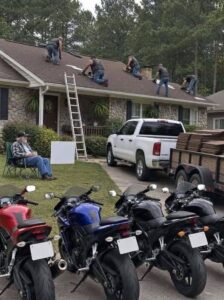
My eighty-six-year-old father had always been the kind of man who kept his promises. He paid his bills on time, helped his neighbors whenever they needed him, and never asked anyone for more than he was willing to give in return. So when he hired a roofing contractor to repair his aging farmhouse, he believed he was making a sensible decision.
Six weeks later, he was standing in his front yard, staring at an unfinished roof and wondering how everything had gone so wrong.
He had already paid the contractor $17,400. The materials were scattered across the property, several sections of the roof were exposed, and the weather forecast promised another week of rain. Every time the wind picked up, my father worried about water entering the attic and damaging the home he had lived in for nearly fifty years.
The contractor stopped answering his calls.
At first, my father tried to remain patient. He told himself that construction delays happened and that the crew might be working on another urgent project. He left polite messages and waited for someone to call him back.
Nobody did.
After the fourth week, his patience turned into embarrassment. He had spent a lifetime being careful with money, and now he felt foolish for trusting someone who had promised to protect his home.
By the sixth week, he had stopped telling his neighbors what was happening. He was afraid they would think he had been careless.
That was when my friend Bertram visited him.
Bertram had known my father for years. He was a broad-shouldered man with a gray beard, a quiet voice, and a habit of listening before offering advice. He also belonged to a local motorcycle club whose members were often misunderstood by people who judged them by their leather jackets and loud engines.
When Bertram learned how much money my father had paid and how long the roof had remained unfinished, he grew concerned.
“Have you spoken to the contractor directly?” he asked.
“Every day,” my father replied. “He doesn’t answer anymore.”
“Do you have a written agreement?”
My father nodded and brought out the paperwork. Bertram read through it carefully, examining the payment receipts, the original estimate, and the promised completion date.
“This isn’t right,” he said quietly.
My father lowered his eyes.
“I don’t want trouble. I just want my house finished before winter.”
Bertram understood. My father wasn’t looking for revenge. He wanted the contractor to honor the agreement and repair the damage caused by the delays.
After leaving the house, Bertram began making calls. He contacted people who knew the contractor and eventually confirmed an address where the man lived.
He didn’t announce a plan to hurt anyone. Instead, he spoke with members of his motorcycle club and explained the situation.
By Tuesday evening, thirty motorcycles had gathered outside the contractor’s home.
The sight was impossible to ignore.
Engines rumbled along the street before falling silent one by one. Riders parked neatly along the curb, removed their helmets, and waited. Some leaned against their motorcycles. Others stood with their hands folded in front of them.
There were no weapons, no shouting, and no threats.
Still, thirty bikers outside a person’s home was enough to make anyone wonder what was happening.
A neighbor peered through a curtain. Someone across the street began recording on a phone. Within minutes, rumors started spreading that the contractor was about to be attacked.
But Bertram had a different intention.
He walked up the front path, knocked on the door, and waited.
After a few moments, the contractor opened it. He appeared confused when he saw Bertram, then glanced past him at the rows of motorcycles.
“Can I help you?” the contractor asked nervously.
Bertram kept his voice calm.
“My name is Bertram. I’m here because an eighty-six-year-old widower paid you $17,400 to repair his roof. Six weeks have passed, and the job remains unfinished. He’s called you repeatedly, and you haven’t responded.”
The contractor’s expression changed.
Bertram continued.
“Those men outside aren’t here to hurt you. They’re here because somebody needs to take responsibility. We want to know what you’re going to do to make this right.”
For several seconds, the contractor said nothing.
He looked at the motorcycles again, then back at Bertram. Perhaps he had expected anger or threats. Instead, he was facing a simple question he could no longer avoid.
Finally, he stepped away from the doorway and reached for his phone.
He called his roofing crew.
Bertram stayed where he was while the contractor explained that they needed to return to the farmhouse first thing in the morning. The contractor then agreed to meet my father personally and discuss the unfinished work.
Before leaving, Bertram made one thing clear.
“We expect you to honor your agreement. That’s all. If you don’t, he can pursue the matter through the proper legal channels.”
The following morning, my father heard the sound of trucks arriving outside his house.
He looked through the window and saw the roofing crew unloading ladders, tools, and fresh materials. A few minutes later, the contractor approached the front door.
My father opened it cautiously.
The contractor looked tired and uncomfortable. He apologized for ignoring the calls and admitted that his business had fallen behind schedule after several jobs went wrong. He had taken on too much work, spent money before completing the projects, and then avoided the people who were waiting for him.
It wasn’t an excuse, he acknowledged. It was simply the truth.
He offered to finish the roof immediately and arrange an inspection when the work was complete. He also agreed to repair any damage caused by leaving the house exposed.
My father listened carefully.
“All I wanted was for you to speak to me,” he finally said. “If you had told me there was a problem, we could have discussed it. But you left me worrying that my home would be ruined.”
The contractor lowered his head.
“I’m sorry,” he replied.
The crew worked through the next several days. They replaced damaged sections, secured the roofing materials, and checked the areas where rain might have entered. My father watched from the porch, asking questions and making sure the promised work was completed.
This time, the contractor answered.
When the final inspection was finished, the roof was secure, and my father finally felt that he could sleep without worrying about the next storm.
A week later, I visited him and found Bertram sitting at the kitchen table, drinking coffee while my father told him about the completed repairs.
I asked Bertram whether he had expected the visit to the contractor’s home to work.
“Not exactly,” he admitted. “But I knew your father deserved to be heard. Sometimes people ignore one person because they think that person has nobody standing beside him.”
My father smiled.
“I never wanted thirty motorcycles outside anybody’s house,” he said. “I just wanted somebody to answer the telephone.”
We all laughed, but his words stayed with me.
The story eventually spread around town. Some people exaggerated what had happened, claiming the bikers had threatened the contractor or forced him to his knees. None of that was true. There had been no violence, no broken arms, and no destruction.
There had been thirty men who showed up, stood quietly, and refused to let an elderly neighbor’s problem be ignored.
My father never forgot that evening. Neither did the contractor, who later told Bertram that seeing thirty motorcycles outside his home had forced him to confront a problem he had spent weeks avoiding.
The experience also taught our family an important lesson about standing up for people who are vulnerable. My father had spent his life helping others, yet when he needed help himself, he felt ashamed to ask for it.
Bertram reminded him that accepting support was not a weakness.
Sometimes, justice begins with a phone call. Sometimes, it requires a written complaint, a lawyer, or a visit to the appropriate authorities. And sometimes, it begins when a group of people shows up simply to make sure someone is no longer ignored.
My father still lives in his farmhouse. His roof has held through several storms, and he no longer worries every time the forecast predicts rain.
As for Bertram and the thirty bikers, they never asked for payment or praise. They went home together that Tuesday evening, leaving behind no damage and no threats.
They had accomplished what they came to do: remind one contractor that a promise still matters, and remind one elderly man that he did not have to face his problems alone.